
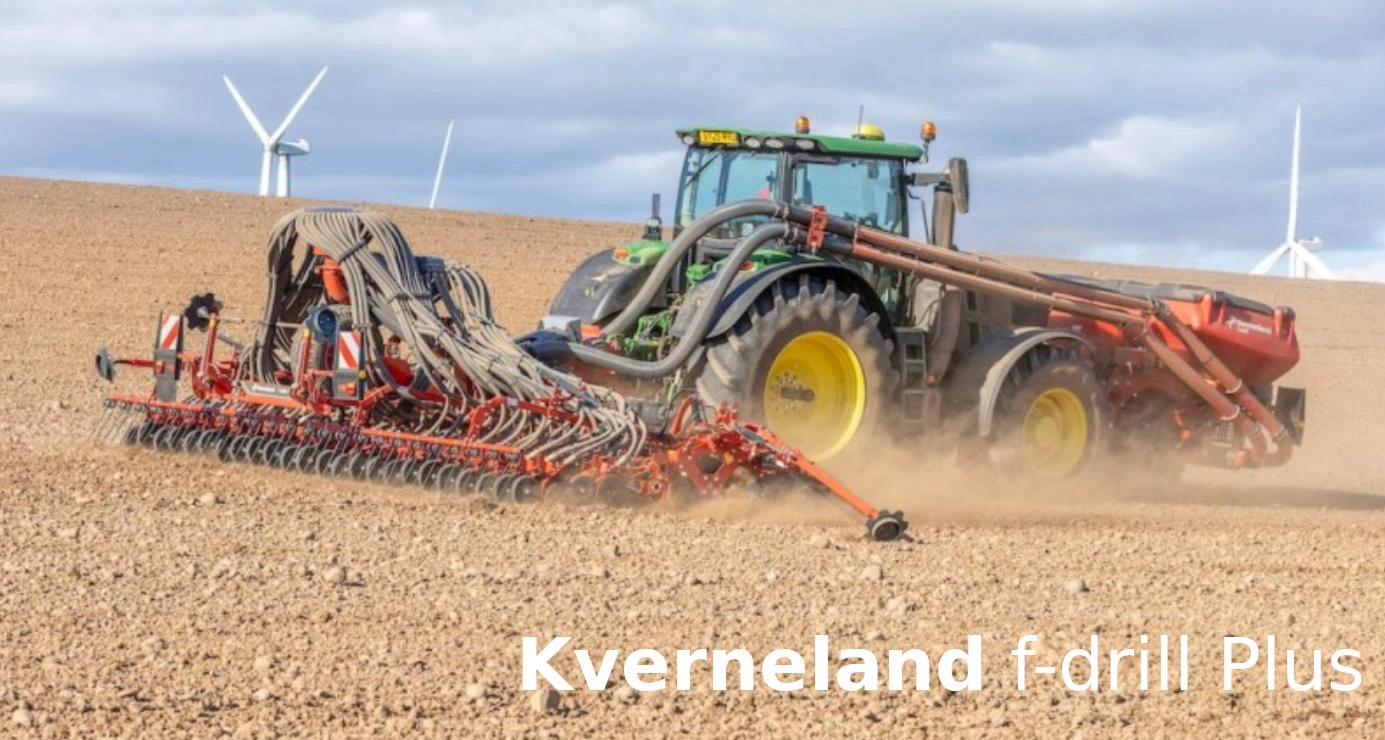
Review of the New 6-Metre Kverneland f-drill Combi Drill: A Wider Format for Simultaneous Seeding and Fertiliser Placement
Kverneland is expanding the concept of combined seeding in the 6-metre format. The new f-drill Plus configuration with the folding f-drill CB F coulter bar makes it possible to work not only with seed, but also with two different materials in a single pass: seed and fertiliser, two crops, or a main crop and a cover crop mixture. For farms aiming to increase the productivity of the sowing campaign without compromising placement accuracy, this is an important development in the class of mounted pneumatic combi drills.
In practice, Kverneland is not offering a single “drill” in the traditional sense, but a modular seeding system. It consists of the f-drill Maxi Plus front hopper, the folding f-drill CB F coulter bar and the Rotago F power harrow. This approach helps distribute weight between the front and rear linkage of the tractor, improves visibility, reduces excessive load on the rear axle and combines seedbed preparation, material application and seed placement in one system.
What Is New in the 6-Metre Version
The key update is the introduction of a wide 6-metre configuration for dual-product application. Previously, the f-drill Plus concept with two material flows was available in a narrower format, while the new version brings this logic to a larger working width. For large farms and contractors, this means higher daily output, fewer passes across the field and better use of short agronomic working windows.
In the 6-metre version, the folding coulter bar is built around two 3-metre sections. Depending on the row spacing, it can operate with 48 coulters at 12.5 cm, 40 coulters at 15 cm or 24 coulters at 25 cm. On the 6-metre model, Kverneland specifically offers the 15 cm row-spacing option, which may be useful for crops and systems where a compromise is needed between row density, residue flow and inter-row space.
The Plus version uses CX-II double-entry coulters. Their main feature is the ability to deliver two materials into the seeding zone through a dual-entry design. This may be seed and starter fertiliser, two different crops, or seed and an additional material. From an agronomic perspective, this layout is especially relevant for farms working with cover crops, green manure mixtures, oilseed rape combined with legume components, or systems where phosphorus fertiliser needs to be placed more accurately near the seed row during early crop development.
f-drill Maxi Plus Front Hopper: Two Materials in One Pass
For the 6-metre combi drill, the key partner is the f-drill Maxi Plus front hopper with a capacity of up to 2,200 litres. In the Plus version, the hopper is divided in a 60:40 ratio and equipped with two electrically driven ELDOS metering units. This architecture allows two different materials to be applied simultaneously: for example, cereal seed and mineral fertiliser, two types of seed, or a main crop and a cover crop mixture.
It is important that Kverneland places the hopper at the front of the tractor not only to increase capacity. The front-mounted layout also addresses the balance of the entire combination. In wide seeding systems, a heavy rear-mounted combination can negatively affect stability, steering and axle load distribution. Moving part of the weight to the front makes the system better balanced, especially when the rear linkage carries a power harrow, coulter bar and consolidation elements.
The electric ELDOS metering system deserves separate attention. It allows the operator to adjust the seed rate from the cab, work through ISOBUS-compatible control and respond more precisely to changing field conditions. In modern seeding equipment, this is not just a convenience but an element of technological discipline: fewer manual operations, fewer calibration errors and better rate control on variable fields.
Technical Overview of the 6-Metre Configuration
| Parameter | Value |
|---|---|
| Working width | 6.0 m |
| System type | Mounted pneumatic combi seeding system |
| Main modules | f-drill Maxi Plus, f-drill CB F, Rotago F |
| Hopper | Front-mounted, up to 2,200 l |
| Hopper split in Plus version | 60:40 |
| Metering | Two electrically driven ELDOS metering units |
| Coulters | CX-II or CX-II double-entry, depending on specification |
| Number of coulters on 6 m version | 48 / 40 / 24 depending on row spacing |
| Row spacing | 12.5 / 15 / 25 cm |
| Coulter pressure | 5–50 kg |
| CX-II steel disc diameter | 325 mm |
| Disc angle | 5.4° |
| Maximum seeding depth for CX-II | Up to 6 cm |
| Control | ISOBUS, e-com, compatibility with Kverneland Tellus terminals |
| Combination | Designed to work with the Rotago F power harrow |
CX-II Coulter: Focus on Placement Accuracy
The CX-II coulter is one of the key elements of this system. Its design combines a 325 mm steel disc with a flexible plastic disc. Thanks to this layout, Kverneland eliminates the need for separate scrapers, reducing the number of potential wearing parts. The shallow disc angle of 5.4° helps reduce draft requirement and supports consistent seeding depth.
When working in conditions with plant residues, coulter spacing and residue flow are also important. Kverneland specifies 445 mm of clearance within the coulter group, which helps soil and residues move more effectively through the working zone. Coulter pressure can be adjusted within a 5–50 kg range, allowing the machine to be adapted to both lighter and firmer soils.
The CX-II double-entry version adds another technological option: separate delivery of a second material. In practice, this allows fertiliser not simply to be broadcast, but to be linked more closely to the seed row. For starter nutrition, this has clear agronomic value, especially on cold soils or in situations where early root development determines the later uniformity of the crop.
Rotago F Power Harrow: Seedbed Preparation in One Pass
In the wide f-drill combination, the system logically works together with the Rotago F power harrow. This allows active seedbed preparation and seeding to be combined in one pass. For the farm, this means time savings, fewer field passes and lower soil compaction, especially during periods when sowing must be completed quickly.
The folding Rotago F is available in working widths up to 6 metres and is designed for operation with powerful tractors. In combination with the f-drill, it acts as the active soil-working module, while the coulter bar is responsible for precise material placement. This division of functions makes the system flexible: depending on conditions, the operator can adjust the harrow settings, working depth, seedbed intensity and seeding parameters.
ISOBUS, Cab Control and Operator Convenience
Kverneland focuses not only on the mechanical side of the machine, but also on control. The system operates via ISOBUS, while the e-com software allows the front hopper, coulter bar and power harrow to be integrated into a single controlled combination. For the operator, this means fewer separate control units, faster adjustment and better process monitoring from the cab.
The f-drill line also includes updates such as a hopper weighing system, a redesigned sieve system for easier cleaning, a camera for monitoring the front hopper and Kverneland Sync digital connectivity. In real field operation, these solutions are no less important than working width. A wide drill must work not only quickly, but also predictably: the operator needs to see the material level, control the rate, clean the hopper quickly and reduce the risk of errors when switching between crops.
Practical Value for Farms
The 6-metre Kverneland f-drill Plus is most relevant for farms where the sowing campaign is limited by short weather windows and where the technology involves active seedbed preparation before drilling. This may include cereals, oilseed rape, cover crops, mixed crops or systems with simultaneous starter fertiliser application.
The main advantage of the system is not only its 6-metre working width. Its real value lies in combining several operations: soil preparation, seeding, second-material application, rate control and seed placement. Where some of these operations previously required separate passes, the combined system can reduce time, fuel consumption and machine wear. At the scale of a large farm, this has a direct effect on the cost of seeding.
At the same time, the 6-metre combination requires a suitable tractor, well-organised seed and fertiliser logistics, and a skilled operator. It is not a universal solution for every field, but a high-capacity tool for farms that can fully use its potential. This is especially true for technologies where material placement accuracy, stable seeding depth and the ability to work within narrow timeframes are critical.
Spare Parts for Kverneland Drills on the Bas-Agro Website
For farms already using Kverneland drills or other equipment from this manufacturer, timely access to spare parts remains an important issue. On the website of Bas-Agro LLC, spare parts for Kverneland drills can be purchased in a dedicated catalogue section: spare parts compatible with Kverneland.
The catalogue includes both original spare parts and alternatives manufactured by Bas-Agro LLC. This is useful for agricultural enterprises that need to quickly restore the performance of their seeding equipment, select compatible parts or order the production of a component based on a sample or drawing. For drills working under peak seasonal loads, the availability of high-quality spare parts is often just as important as the technical characteristics of the machine itself.
The new 6-metre Kverneland f-drill Plus configuration shows how combi drills are moving towards greater productivity and functional flexibility. Its strengths include the wide folding coulter bar, dual-product application capability, front hopper with two ELDOS metering units, CX-II double-entry coulters and integration with the Rotago F power harrow.
This solution does more than increase working width. It changes the logic of seeding: one pass can combine seedbed preparation, drilling and second-material application. For large farms and contractors, such a system can become a way to increase output without simplifying agronomy. For the Ukrainian market, where sowing schedules often depend on unstable weather, combined systems of this type are likely to gain increasing practical importance.
Add a comment
Comments
There are no comments yet. Be the first to comment.
You must be logged in to post a comment
Login