
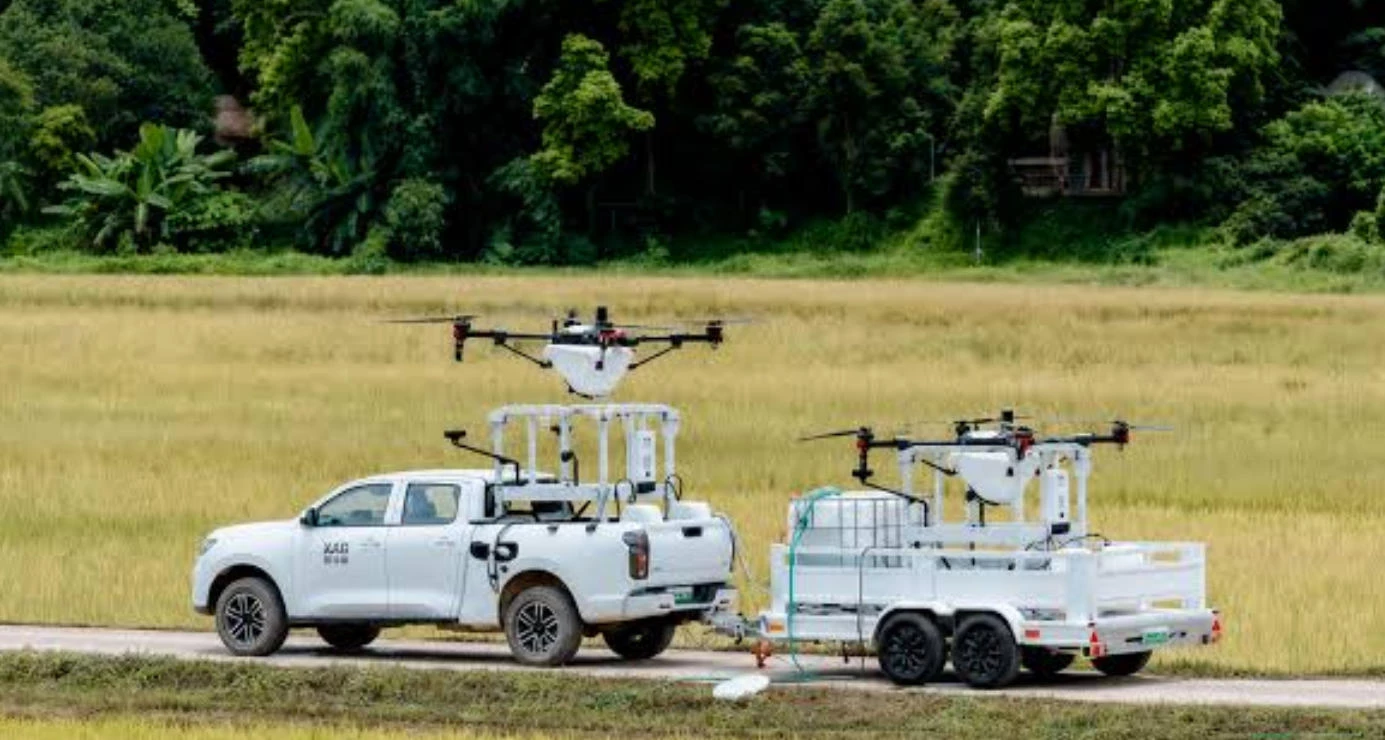
XAG Automates the Full Agricultural Drone Work Cycle: From Solution Mixing to Charging and Cleaning
Chinese company XAG has introduced the new X Series of agricultural robots designed to provide comprehensive automation of crop protection operations. The main distinction of the new platform is that the manufacturer has automated not only flight and spray application, but also most ground-based procedures that previously required constant operator involvement.
The X Series includes the XAG X100 and XAG X150 agricultural drones, the automated XA1 field station, and the LM1 solution mixing and refilling system. Integrated into a single digital ecosystem, these components can plan routes, survey fields, prepare spray solutions, refill the drone, charge its batteries, and clean tanks and pipelines after the operation is completed.
In practical terms, XAG is attempting to transform the agricultural drone from a standalone flying machine into an autonomous production system capable of performing repetitive operations for extended periods with minimal human intervention.
Why Automated Flight Alone Was Not Enough
Modern agricultural drones can already follow routes autonomously, maintain altitude above crops, regulate spray flow, and return to the launch point. However, automating the flight itself solves only one part of the technological process.
After every flight, the operator usually still has to:
- check the remaining spray solution;
- prepare a new chemical mixture;
- refill the tank;
- replace or recharge the batteries;
- rinse the tank, pumps, atomisers, and pipelines;
- relaunch the aircraft.
These ground-based procedures create downtime between flights, increase labour requirements, and raise the risk of workers coming into contact with concentrated crop protection products.
XAG describes the previous development stage of agricultural drones as a “human–machine” model, in which the aircraft flies autonomously but still depends on a ground crew. The X Series is intended to move the system to the next stage, where the entire cycle is automated, from task creation to post-flight servicing.
Three Main Components of the X Series System
A complete X Series complex consists of three interconnected elements.
The first is the X100 or X150 agricultural drone, which performs mapping, autonomous flight, and spraying. The second is the XA1 field station, which provides precise landing positioning, charging, and automatic connection to the refilling system. The third is the LM1 mixing and refilling unit, which prepares the spray solution according to a specified recipe and delivers it to the drone’s tank.
The operator creates or selects an application task in the software. The system can then calculate a route based on a digital field map, determine the required amount of spray solution and energy, complete the spraying operation, return the drone to the station, recharge it, and refill it for the next flight.
XAG X100 and X150: Two Drones for Farms of Different Scales
The X Series officially includes two agricultural drone models.
The XAG X100 is equipped with a 50-litre tank, one battery, and 63-inch propellers. The manufacturer positions it as a more compact option for smaller fields, orchards, and farms with moderate workloads.
The larger XAG X150 features an 85-litre tank, two batteries, and 66-inch propellers. It is intended for more intensive use and larger operating areas. The X100 is paired with a 10 kW version of the XA1 station, while the X150 uses the more powerful 18 kW version.
At the same time, the manufacturer has not yet published a complete open specification table containing maximum take-off weight, rated payload, maximum flight speed, or calculated field productivity for each model. These figures should therefore not be replaced with specifications from earlier XAG P Series drones. Despite similar tank capacities, the X Series is based on a different engineering platform.
XAG X Series Agricultural Drone Specifications
| Specification | XAG X100 | XAG X150 |
|---|---|---|
| Intended use | Spraying, mapping, and autonomous operation as part of the X Series system | Spraying, mapping, and autonomous operation as part of the X Series system |
| Spray tank capacity | 50 L | 85 L |
| Number of batteries | 1 | 2 |
| Propeller size | 63 inches | 66 inches |
| Maximum combined spray system flow rate | Up to 42 L/min | Up to 42 L/min |
| Maximum flow rate per pump | 21 L/min | 21 L/min |
| Droplet size range | 50–500 μm | 50–500 μm |
| Effective working width | 5–10 m | 5–10 m |
| Optional fine atomisation kit | Minimum droplet size down to 10 μm | Minimum droplet size down to 10 μm |
| Flight control system | SuperX 5 Apex | SuperX 5 Apex |
| Environmental perception system | Multidimensional radar and vision system | Multidimensional radar and vision system |
| Obstacle detection range | 1–100 m | 1–100 m |
| All-round visual monitoring | Two cameras, 360° coverage | Two cameras, 360° coverage |
| Enclosure protection rating | IPX6K | IPX6K |
| Recommended field station | XA1, 10 kW | XA1, 18 kW |
| Station power supply | Single-phase or three-phase | Three-phase |
| Automatic charging | Yes | Yes |
| Automatic refilling | Yes | Yes |
| Automatic cleaning | Yes | Yes |
| Mapping support | Yes | Yes |
| Maximum area per mapping task | Up to 300 ha* | Up to 300 ha* |
| Support for simultaneous multi-drone management | Yes | Yes |
| Maximum flight speed | Not specified by the manufacturer | Not specified by the manufacturer |
| Maximum take-off weight | Not specified by the manufacturer | Not specified by the manufacturer |
| Claimed field productivity | Not specified by the manufacturer | Not specified by the manufacturer |
*The officially stated 4,500 Chinese mu is equivalent to approximately 300 hectares.
The spray-system and sensor specifications published by the manufacturer refer to the X Series platform as a whole. XAG does not clearly state whether every parameter is identical for both drone configurations.
Automatic Spray Solution Preparation
The LM1 system is available with two mixing tank capacities: 120 or 190 litres. The unit supports connection to several containers holding concentrated products and uses weighing sensors to control dosing.
After the operator enters the recipe, the LM1 automatically measures the required amount of each component, adds water, mixes the solution, and transfers it to the agricultural drone. The maximum refilling rate is 60 L/min. In theory, the X100’s 50-litre tank can therefore be filled in less than one minute, while the X150’s 85-litre tank can be filled in approximately one and a half minutes, excluding positioning and system switching time.
Automatic dosing is important not only for speed. It can reduce the risk of mixing errors and limit direct worker contact with concentrated chemical products.
However, the use of an automated mixing unit does not remove the need to verify product compatibility, mixing order, water quality, and the label requirements of the specific crop protection product.
Autonomous Return, Landing, and Connection
Fully automated operation requires more than simply guiding the drone back to an approximate landing point. The machine must accurately align its charging and liquid-transfer connections with the station.
The XA1 uses a mobile dual-antenna RTK station and a local close-range positioning system. After landing, guide elements adjust the aircraft’s position so that it can automatically connect to the charging and refilling interfaces.
The connection uses a flexible floating design. This configuration is intended to compensate for minor landing inaccuracies and reduce impact loads on the connectors. Such features are especially important in agricultural conditions, where the station may operate on uneven ground and be exposed to wind, dust, precipitation, and vibration.
Charging in 2.5–3.5 Minutes
The X Series uses the B18630 battery with a rapid-charging system. According to XAG’s laboratory data, the 18 kW XA1 station can charge the battery set from 30% to 80% in approximately 2.5 minutes. Charging from 15% to 90% takes around 3.5 minutes.
For this reason, claims of a “full charge in 3.5 minutes” require clarification. XAG’s official test procedure refers not to charging from 0% to 100%, but from 15% to 90%.
The stated battery service life is up to 4,000 cycles. The batteries do not need to be removed regularly from the aircraft. The drone is charged directly after automatically parking on the station. The battery management system monitors cell condition, while active air cooling is intended to remove heat during intensive charging cycles.
XAG offers two XA1 versions. The 10 kW station can operate from either single-phase or three-phase power and is used with the X100. The 18 kW version requires three-phase power and is designed for the X150.
Spray Output of Up to 42 L/min
The X Series spray system uses two centrifugal atomisers and two pumps. Each pump has a maximum flow rate of 21 L/min, giving a combined flow rate of up to 42 L/min.
Droplet size can be adjusted within a range of 50–500 μm. Depending on operating conditions, the stated effective working width is between 5 and 10 metres. An optional fine atomisation kit is also available for specialised applications and can produce droplets as small as 10 μm.
However, the smallest droplets are not always agronomically preferable. They are more susceptible to wind drift and evaporation. The actual operating mode must be selected according to the product, crop, temperature, humidity, wind speed, and required coverage density.
New Obstacle Detection System
The X100 and X150 are equipped with the SuperX 5 Apex controller. According to XAG, its computing performance is twice that of the previous platform. The controller integrates RTK navigation, flight control, and data processing from radars, cameras, and communication channels.
The multidimensional perception module operates within a range of 1–100 metres. It includes a 4D millimetre-wave radar, an additional vertical radar, and two cameras that provide all-round coverage.
The manufacturer states that the system can identify overhead power lines with an accuracy of more than 90%. This is a significant capability for an agricultural drone because thin wires remain among the most difficult obstacles for both radar and computer-vision systems to detect.
However, an accuracy figure above 90% does not mean that every wire will be detected under all conditions. Performance depends on conductor thickness and material, installation angle, lighting, precipitation, and sensor condition. Even an autonomous system still requires prior mapping of hazardous objects and compliance with established safety zones.
Mapping and Multi-Field Operation
Before spraying, the X Series can perform autonomous mapping. The drone photographs the area, after which the system creates an orthophoto map or spatial model used to identify field boundaries and obstacles.
The stated maximum area for a single mapping task is 4,500 Chinese mu, or approximately 300 hectares. According to the manufacturer, mapping productivity has doubled due to a new wide-angle camera system.
The XAG Agriculture application allows up to ten fields to be combined into one task. Routes and application parameters can be configured separately for each field. The system also supports simultaneous control of several agricultural drones, allowing work to be carried out in parallel across large areas.
Automatic Cleaning After Operation
After the task is completed, the system initiates a washing cycle for the tank, mixing vessel, pumps, and pipelines. Water circulates through the liquid circuit to remove chemical residues, while the rinsing liquid is collected through a separate channel.
Automatic cleaning should reduce the risk of atomiser blockages, component corrosion, and cross-contamination between incompatible products. However, the wastewater must not be discharged directly into the field. XAG itself states that it should be collected and disposed of in accordance with local requirements governing pesticide residues.
Can the System Operate Entirely Without People?
Technically, the X Series substantially reduces the need for an operator to remain constantly beside the drone. However, the phrase “fully automated cycle” should not be interpreted as the complete absence of human supervision.
A specialist must still:
- create the agronomic task;
- select the product and application rate;
- verify weather conditions;
- monitor flight restrictions;
- inspect the technical condition of the equipment;
- replenish water and concentrated products;
- collect and dispose of rinsing liquid;
- respond to alarms and emergency notifications.
The X Series therefore automates primarily the physical execution of repetitive operations. Agronomic responsibility, safety supervision, and technical oversight remain with the operator.
Potential Significance for Agriculture
The most promising application environment for such a system may be large farms with stable field boundaries, intensive crop protection programmes, and access to a reliable power supply. The benefits may be particularly noticeable in orchards, vegetable production, seed crops, and other crops requiring repeated treatments throughout the season.
A network of several XA1 stations could theoretically create automated service points across different parts of a farm. The drone could move between them, replenish its spray solution, and recharge without returning to a single central base.
At the same time, economic efficiency will depend on more than the purchase price of the drone itself. Farms must also consider station installation, power supply, digital mapping, liquid-circuit maintenance, water and chemical logistics, and national regulations governing aerial application of crop protection products.
The XAG X Series illustrates a shift in the overall logic of agricultural drone development. While previous generations were primarily autonomous aerial platforms, the new series is being developed as a unified robotic system with its own field infrastructure.
The integration of the X100 and X150 drones, the XA1 station, and the LM1 mixing system allows mapping, route planning, flight, spraying, solution preparation, refilling, charging, and cleaning to be automated.
Eliminating manual procedures between flights may ultimately prove more important than further increases in tank capacity or drone speed. XAG is moving away from selling a standalone machine and towards creating a complete automated production line for field operations.
However, the system can only be fully assessed after extended use under real farm conditions. The main outstanding questions concern the reliability of automatic connections, resistance of equipment to agrochemicals, sensor performance in difficult weather, availability of service support, and the cost of operation per hectare.
Add a comment
Comments
There are no comments yet. Be the first to comment.
You must be logged in to post a comment
Login