
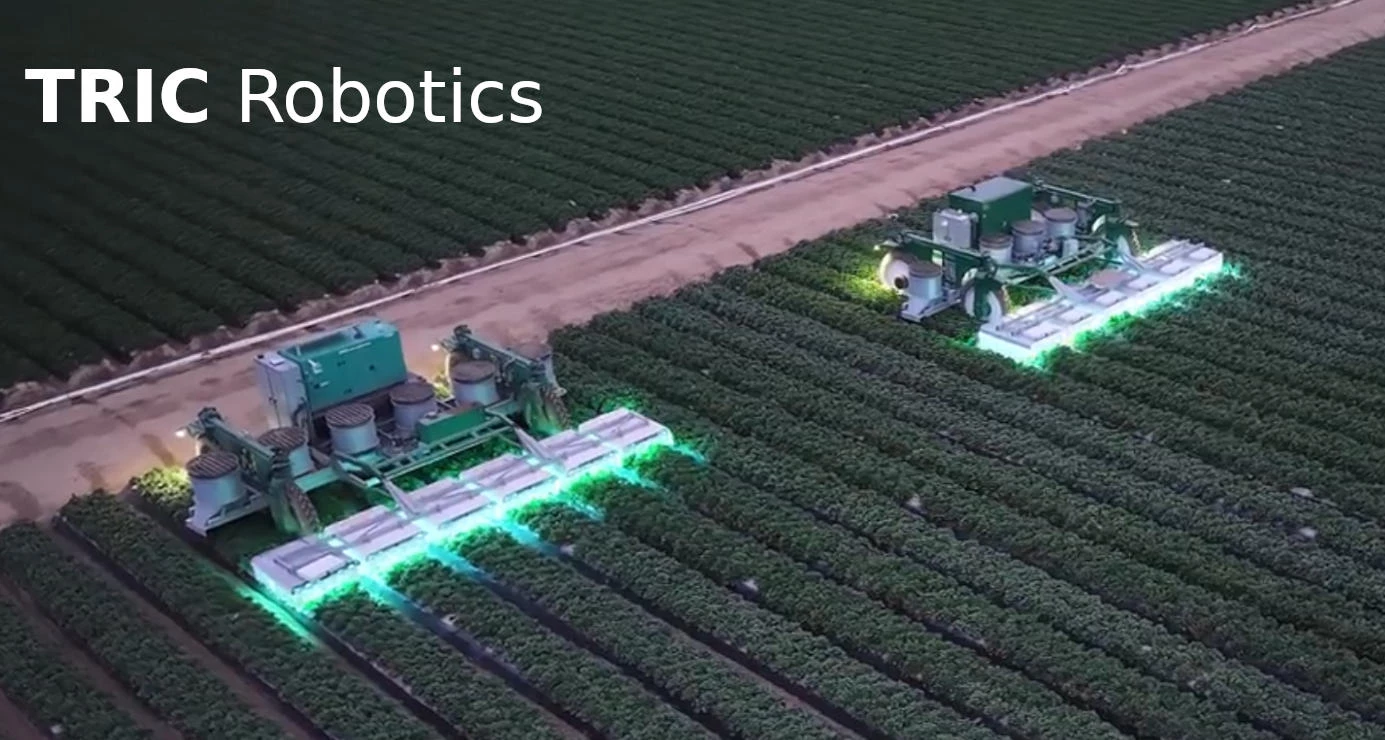
TRIC Robotics: Autonomous UV Robots Protect Strawberries from Diseases and Pests
The American company TRIC Robotics is taking ultraviolet crop protection from laboratory research to commercial-scale farming. Its autonomous machines operate at night in California strawberry fields, treating plants with UV-C light while also mechanically removing insects with a vacuum system.
In June 2026, the company reported that two robots operating in a commercial field near Santa Maria could treat up to 60 acres, or approximately 24 hectares, overnight. According to TRIC Robotics, the combined UV-C and Bug Vac system reduced Lygus bug populations by 35%, spotted wing drosophila by 58%, spider mites by 33%, and powdery mildew pressure by 30%. These figures should be regarded as company-reported results from commercial operations rather than universal performance rates applicable to every farm.
A Combined Crop Protection System
Describing the TRIC Robotics machine simply as an “ultraviolet pest-control robot” would be an oversimplification. The platform combines several different control mechanisms.
UV-C treatment primarily targets fungal pathogens and vulnerable life stages of certain arthropods. The Bug Vac system physically removes mobile insects from plants. An autonomous carrier enables treatments to be repeated regularly, while cameras and navigation sensors help the machine move between strawberry beds.
This distinction is important. Ultraviolet radiation does not affect adult insects, larvae, eggs, fungal spores, and beneficial organisms in the same way. Consequently, the reported reductions in Lygus bugs and spotted wing drosophila cannot automatically be attributed to UV-C alone. The vacuum module may play a significant role in controlling these pests.
How Night-Time UV-C Treatment Works
UV-C is the short-wave portion of the ultraviolet spectrum. Natural UV-C radiation from the Sun barely reaches the Earth’s surface because it is absorbed by the atmosphere. Artificially generated UV-C can damage the DNA of fungi, bacteria, mites, and other organisms, interfering with their ability to reproduce.
However, effectiveness depends on more than the radiation dose. Many microorganisms possess a photoreactivation mechanism that allows them to repair UV-damaged DNA when exposed to visible light and UV-A. If treatment is carried out at night and followed by a period of darkness, this repair process becomes considerably less effective. The pathogen can therefore be suppressed with a lower UV-C dose, reducing the risk of damage to the crop.
Research conducted by the United States Department of Agriculture’s Agricultural Research Service has shown that a properly selected night-time treatment can suppress pathogens responsible for strawberry powdery mildew, gray mold, and anthracnose. The USDA has also confirmed that its scientists collaborated with TRIC Robotics during the development and field testing of the robotic system.
At the same time, UV-C should not be considered completely harmless. Excessive exposure can damage leaves, flowers, and fruit, while direct exposure is hazardous to human skin and eyes. Precise control of travel speed, distance from the crop, lamp output, and delivered dose is therefore essential. Operating at night also reduces the likelihood that workers will be close to active UV-C equipment.
Luna: TRIC Robotics’ Main Multi-Row Platform
The development of TRIC Robotics began in 2019 with an experimental machine built from aluminium construction scaffolding. The first prototype treated a single row and had a service range of approximately one acre. In 2021, the company introduced the five-row Eden5 platform with a stated treatment range of up to 15 acres. It was followed by Eden7, which covered seven rows and up to 30 acres.
In 2023, the company presented Luna, a considerably larger multifunctional machine designed for open-field strawberry production. Its standard configuration covers six rows, although the manufacturer’s development history also lists versions covering six to eight rows. The stated treatment range is 50–100 acres, or approximately 20–40 hectares, depending on field configuration, treatment frequency, and the operations being performed.
Luna can carry:
- a boom fitted with UV-C light sources;
- vacuum modules for insect removal;
- cameras for crop monitoring;
- equipment for collecting field data.
Large wheels allow the platform to travel above the plants and negotiate deep field ruts. Its dimensions resemble the multi-row tractor equipment already familiar to American berry growers, reducing the need to redesign the field around a small robotic platform.
The manufacturer also continues to use its Eden platform. This three-wheeled machine has a span of more than 40 feet, or over 12 metres. It features automatic boom-height and wing-position adjustment to help maintain the required dose across uneven strawberry beds.
Autonomous Navigation Using Maps, Cameras, and Sensors
The TRIC Robotics navigation system combines satellite positioning, cameras, wheel encoders, and sensors that monitor the position of steering and working mechanisms. A digital map is created for each farm, and the robot follows a predetermined route. Cameras are used to detect rows and obstacles, while encoders help monitor speed and actual machine movement.
The company describes its latest system as a platform focused on machine perception. Operators can start robots remotely and monitor their work. This does not mean, however, that the machine independently makes unrestricted agronomic decisions. Its route, operating area, treatment schedule, and working modes are defined in advance, while remote supervision remains part of the system.
Unlike the company’s early battery-powered prototypes, its current field platforms receive electricity from an onboard diesel generator. TRIC Robotics explains that many remote fields lack adequate charging infrastructure, while UV-C lamps and vacuum fans require substantial continuous power.
The technology can therefore reduce pesticide use, but it does not yet eliminate fossil fuel consumption. This represents a compromise between energy autonomy and the ability to treat large areas throughout the night.
Up to 30 Acres per Robot per Night
According to TRIC Robotics founder Adam Stager, one robot can treat approximately 30 acres, or around 12 hectares, per night. The recently announced figure of up to 60 acres therefore refers to two machines working together.
Treatment is generally carried out twice a week throughout the growing season. This is an important characteristic of UV-C crop protection: the treatment does not leave a long-lasting protective layer on the plant. Its effectiveness depends on regularly interrupting the development cycle of the pathogen or pest. Missed treatments caused by equipment failure, poor field accessibility, or incorrect dosing can reduce the performance of the entire programme.
By the summer of 2025, the company was operating nine machines and planned to expand its fleet to 40–50 units. By that time, its robots had already completed treatments across more than 1,000 acres near Santa Maria. A $5.5 million seed funding round supported the expansion.
Robots as a Service
TRIC Robotics is not primarily focused on selling expensive machines directly to farmers. Instead, it provides crop protection through a Robots-as-a-Service model: the machine remains the property of the provider, while the grower pays for seasonal treatment services.
TRIC specialists deliver and configure the equipment, map the field, supervise operations, and perform maintenance. According to the company, it aims to keep the service price comparable to the cost of conventional programmes targeting the same diseases and pests.
This approach removes the need for farms to purchase machinery, train specialised personnel, or manage software updates. However, it also makes the grower dependent on the availability of the service provider. TRIC Robotics currently operates mainly on California farms, so direct availability in Ukraine remains unlikely in the near future.
What Independent Research Says About Mite Control
A study by California Polytechnic State University, published in April 2026, helps define the technology’s actual capabilities more precisely. The trials used both Luna and Eden platforms, applying field-level UV-C doses of 600–1,800 J/m².
Researchers found that these doses substantially suppressed egg hatching in two-spotted spider mites and Lewis mites. Mobile larvae, and especially adult mites, were considerably more tolerant. The estimated lethal doses for adult mites exceeded 9,000 J/m², a level considered unsuitable for routine field treatment because of the risk of crop damage.
UV-C therefore acts primarily as an ovicidal tool. It prevents eggs from developing and slows population growth, but it should not be presented as a complete replacement for acaricides, predatory mites, or other components of integrated pest management.
Another challenge is delivering sufficient light into a dense canopy. Mite eggs are often located on the underside of leaves, where direct UV-C exposure is limited. TRIC platforms use reflective panels to redirect some of the light upwards, although shading cannot be eliminated completely.
The effects on beneficial predatory mites must also be considered. TRIC Robotics reported no reduction in beneficial mite populations during its field observations. However, laboratory studies have found that the eggs of some beneficial species can be highly sensitive to UV-C. Ultraviolet treatments and releases of predatory mites must therefore be coordinated as parts of a single crop protection programme.
Other Agricultural Robots Using Ultraviolet Light
TRIC Robotics is not the only company developing this type of equipment. Its closest commercial counterpart is Thorvald, produced by the Norwegian company Saga Robotics. These electric autonomous robots apply UV-C to greenhouse and polytunnel strawberries in the United Kingdom and are also used in US vineyards.
In 2025, more than 150 Thorvald robots travelled approximately 200,000 autonomous kilometres with a reported uptime of 97%. In the United Kingdom, they treated around 20% of the country’s tabletop strawberry area, while in California they covered almost 1,300 acres of vineyards.
Another example is Lumion from Octiva. This autonomous UV-C implement for protected cultivation can operate on either a rail-mounted or rail-free Xenion platform. It is offered for strawberries, cucumbers, and tomatoes, primarily to control powdery mildew. Unlike TRIC, Lumion is designed for controlled greenhouse environments, where level pathways and consistent crop geometry make accurate dosing easier.
A system combining the electric autonomous Burro platform with the UVEX UV-C unit is also being tested in Australia. The project is primarily aimed at protecting grapevines against powdery mildew. It demonstrates that robotic ultraviolet treatment may be relevant not only to berry farms but also to orchards and vineyards.
How TRIC Robotics Differs from Its Competitors
TRIC’s main distinction is its focus on large open-field strawberry farms. Thorvald has established a significant commercial presence in tabletop strawberry production and vineyards, while Lumion works mainly in greenhouses. With its size, clearance, and multi-row design, Luna more closely resembles an autonomous self-propelled sprayer.
The second difference is the combination of light-based and mechanical crop protection. UV-C targets fungal pathogens and mite eggs, while Bug Vac physically removes some mobile insects. A third potential development is the automated release of beneficial organisms. The company has already reported that it is working on a suitable module.
In the future, a robot that regularly travels through every row could become a universal platform for plant phenotyping, fruit counting, disease detection, and yield forecasting. Luna’s cameras are already used for collecting field information, although the manufacturer has not yet disclosed detailed specifications for its analytical system.
Prospects for the Technology in Ukraine
For Ukrainian farms, the most obvious applications for UV-C robots may include intensive field strawberry production, covered berry plantations, vineyards, and greenhouse complexes. On high-value crops, savings in fungicides and manual labour could potentially offset the high cost of robotic equipment more quickly.
However, transferring the California experience to Ukraine would require considerable adaptation. Important factors would include row spacing, terrain, canopy density, night length, humidity, cultivar sensitivity, service availability, and local safety requirements. Separate field trials would be required for each crop and pathogen because an incorrectly selected dose may be ineffective or phytotoxic.
TRIC Robotics demonstrates an important change in the underlying logic of crop protection. Instead of periodically applying a chemical substance, the field receives regular physical treatment performed by an autonomous machine. Scientific evidence nevertheless suggests that UV-C should not be regarded as a universal replacement for all pesticides. It is better understood as one component of integrated pest management, particularly effective against fungal pathogens and the eggs of certain mite species.
Bas-Agro Group LLC manufactures spare parts for agricultural machinery using a customer’s sample or technical drawing and also supplies components from stock. The parts catalogue and additional information are available at bas.ua.
Add a comment
Comments
There are no comments yet. Be the first to comment.
You must be logged in to post a comment
Login