
Tractor Wheels for Hydrogen Storage: German Engineers Are Looking for a Way to Turn the Hydrogen Tractor into a Real Working Machine
Hydrogen tractors have remained one of the most interesting topics in the debate about the future of agricultural machinery for several years. They promise fast refuelling, no local emissions during fuel-cell operation, and the possibility of using “green” hydrogen produced from renewable energy. However, this concept has one problem that cannot be solved by decarbonisation slogans alone: hydrogen must be stored somewhere, in sufficient quantity, without reducing the tractor’s functionality.
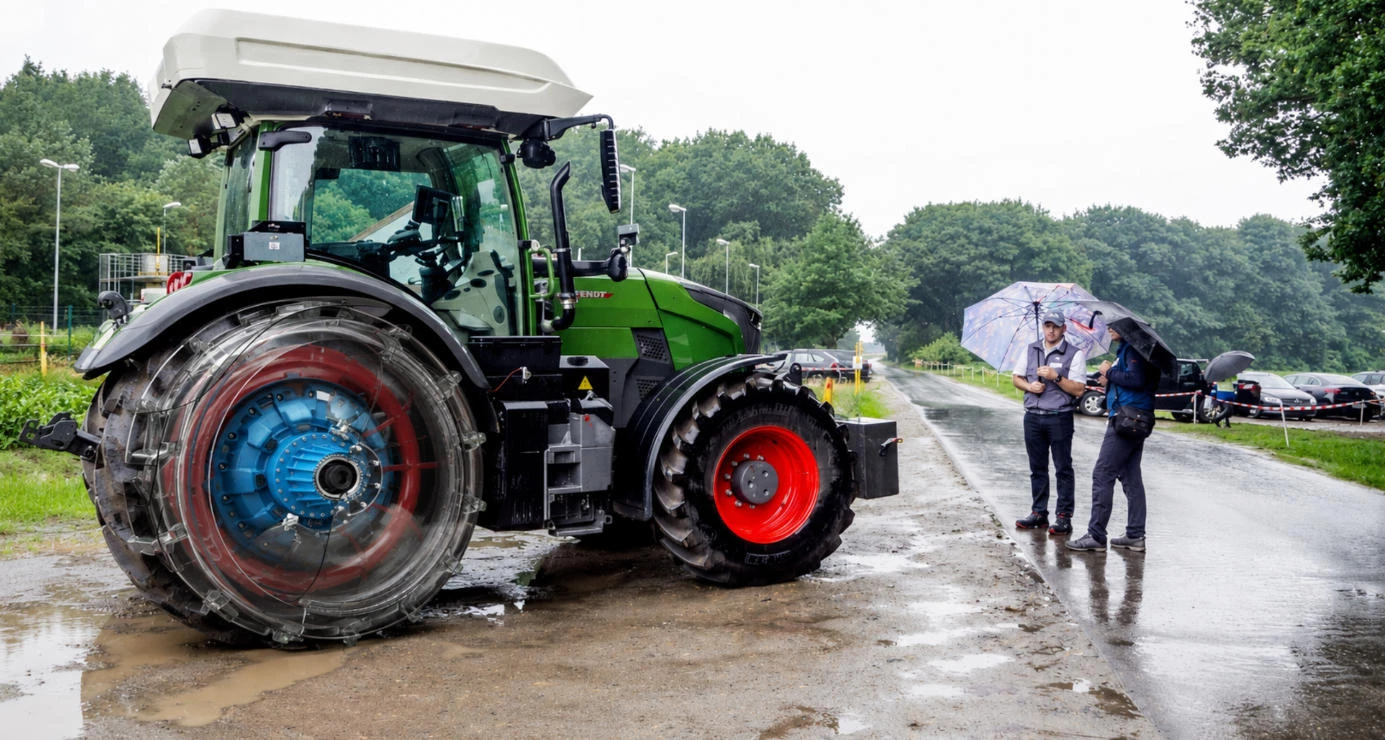
This is the question that the German company HÖRMANN Vehicle Engineering, based in Chemnitz, has attempted to answer. Its engineers have presented an H₂ solution concept for heavy off-road machinery in which hydrogen is stored not in conventional cylinders on the roof or frame, but within the volume of the rear wheel. At first glance, the idea sounds almost paradoxical: a tractor wheel as an energy reservoir. Yet from a technical point of view, this is not science fiction, but an attempt to use space that already exists inside a large wheel and is usually almost absent from the machine’s energy architecture.
Why the Wheel?
For a diesel tractor, energy storage does not look like a major engineering problem. Diesel fuel has high volumetric energy density, and the tank can be placed in a relatively compact space. With hydrogen, the situation is different. Even at high pressure, gaseous hydrogen requires considerable volume, which means designers must find room for large and robust tanks.
In an agricultural tractor, there is less free space than it may seem. The cab, mounted implements, visibility, centre of gravity, access to service areas, and safe operation with trailed and mounted equipment all restrict layout options. If hydrogen tanks are installed on the roof, as in some experimental machines, a real working prototype can be built, but the hydrogen reserve may still be insufficient for a full heavy working day.
HÖRMANN proposes a different approach: integrating a ring-shaped hydrogen tank into the rear wheel. An important technical detail is that, according to the manufacturer’s layout, the tank itself remains stationary while the wheel rim rotates. In other words, this is not a “cylinder spinning chaotically inside the tyre”, but a much more complex engineering system in which the reservoir, rim, tyre, and drive unit must operate as a coordinated module.
What Is Known About the Technical Parameters
According to HÖRMANN Vehicle Engineering, the system is designed for gaseous hydrogen storage at a pressure of 700 bar. The reservoir has a lightweight ring-shaped structure made of carbon-fibre-reinforced plastic, a composite material based on carbon fibre. The company’s white paper states that the tank is designed with reference to the requirements of ECE R134, the regulation covering the safety of hydrogen components in vehicles.
For tractors with an output of approximately 100-150 hp, the stated energy capacity is up to 21 kg of hydrogen per wheel. If two rear wheels are used, the total reserve can reach 42 kg of hydrogen. In HÖRMANN’s materials, this is compared to roughly 200 litres of diesel fuel in energy-equivalent terms. The manufacturer also gives another interesting benchmark: in a battery-electric configuration, an equivalent energy reserve would correspond to about 750 kWh, which could mean approximately 3.5 tonnes of battery mass.
| Parameter | HÖRMANN Vehicle Engineering data |
|---|---|
| Storage type | Gaseous hydrogen in the vehicle wheel |
| Location | Integration into the rear wheel |
| Tank design | Lightweight ring-shaped tank made of carbon-fibre-reinforced plastic |
| Operating pressure | 700 bar |
| Hydrogen reserve | Up to 21 kg per wheel |
| Potential reserve per tractor | Up to 42 kg in two wheels |
| Approximate equivalent | Around 200 litres of diesel |
| Target machine class | In particular, tractors of 100-150 hp |
| Protection | Shielding against dirt and stones |
These figures should be understood as parameters of a concept and a development direction, not as specifications of a production tractor that can already be ordered from a dealer. The RAHD project, within which this solution is being developed, is an active research project planned for the period from 2023 to 2026.
Not Just a Tank, but Part of a New Drive System
The distinctive feature of HÖRMANN’s approach is that the company sees the wheel not only as a place to store hydrogen. For fuel-cell electric machines, it proposes a combined system: an H₂ reservoir in the wheel plus an electric wheel drive. Such an architecture could potentially reduce the need for traditional transmission components and allow heavy machinery to be laid out in a new way.
The white paper states that the electric drive uses a reluctance motor. Its advantage is the absence of rare-earth materials in the design, a simpler structure, and potential suitability for harsh operating conditions. This is important for agricultural machinery: a tractor works in dust, vibration, shocks, uneven soil, and under long-lasting load. Therefore, any solution that looks convincing in the laboratory must still prove its durability in the field.
Why This Matters Specifically for Hydrogen Tractors
The closest practical example of hydrogen-powered agricultural machinery is the Fendt Helios, which AGCO/Fendt uses in the German H2Agrar demonstration project. This tractor has five hydrogen tanks of 4.2 kg each, meaning up to 21 kg of hydrogen in total. The tanks are mounted on the roof, and the hydrogen is stored at a pressure of up to 700 bar. A 100 kW fuel cell generates electricity, while a 25 kWh buffer battery helps power the traction electric motor and auxiliary electrified consumers.
According to Fendt’s initial estimates, the Helios can operate for approximately 5-8 hours on one refuelling, depending on the task. This is already a real result for an experimental machine. However, for a heavy field day, especially during peak seasonal periods, farmers often need greater autonomy. This is where the logic of “hydrogen in the wheel” appears: if the fuel reserve can be doubled without radically increasing tractor dimensions, the hydrogen machine comes closer to practical parity with a diesel tractor.
Infrastructure: The Main Condition Without Which the Wheel-Tank Will Not Work
Any hydrogen-powered machine depends not only on the vehicle itself, but also on the energy environment around it. The H2Agrar project in Lower Saxony is interesting precisely because it demonstrates the full chain: production of “green” hydrogen, storage, refuelling infrastructure, and tractor use on a real farm.
In this project, the electricity for hydrogen production comes from a local wind farm with 16 wind turbines. Two electrolysers with a capacity of 1 MW each can produce up to 900 kg of hydrogen per day. Energy storage infrastructure and a dedicated hydrogen refuelling station operate nearby. Without such infrastructure, a hydrogen tractor remains a technically interesting but practically limited solution.
For Ukraine, this aspect is especially important. Potentially, hydrogen may be of interest to large agricultural enterprises, bioenergy complexes, farms with their own generation capacity, or regional agro-industrial clusters. However, without local production, safe storage, and fast refuelling, it will not become a mass replacement for diesel.
Engineering Risks That Should Not Be Ignored
The concept of an H₂ tank in the wheel looks impressive, but its success depends on very complex technical issues. These include high pressure of 700 bar, operation in an area exposed to mechanical impacts, field vibration, temperature cycles, stones, mud, service maintenance, and safe refuelling. Even if the tank is stationary relative to the wheel unit, the very integration into the wheel creates a far more complex environment than conventional tank placement on the frame.
The design’s service life, the resistance of the composite tank to real field loads, safety in case of damage, system behaviour in accidents, repairability, and regulatory compliance all have to be proven. In agriculture, machinery often works far from a service centre, so any solution must be not only innovative, but also understandable and practical in operation.
Cost is a separate issue. High-pressure carbon-fibre tanks, hydrogen valves, safety sensors, fuel cells, and special infrastructure remain expensive components. Therefore, the first practical applications are likely to appear not on small farms, but where machinery utilisation is intensive and where there is an opportunity to build a dedicated energy ecosystem.
What This Means for Agricultural Machinery Engineering
HÖRMANN’s idea is interesting not only because of hydrogen itself. It demonstrates a new way of thinking about agricultural machinery design. Previously, the tractor wheel was viewed mainly as an element of soil contact, traction transfer, and ballast. Now it is being proposed as part of the machine’s energy system.
This may also influence other areas. In the future, wheel modules could combine drive, energy storage, braking, load sensors, and traction control systems. For heavy machinery, where every litre of layout space matters, such integration may become an important competitive advantage.
However, today it is more accurate to speak not about a “ready tractor of the future”, but about a serious engineering step toward practical hydrogen-powered agricultural machinery. HÖRMANN Vehicle Engineering has not simply proposed an attractive idea, but has formulated a technical architecture with specific parameters: 700 bar, a ring-shaped composite tank, up to 21 kg of hydrogen per wheel, protection against external damage, and the possibility of integration with an electric wheel drive.
Hydrogen in a tractor wheel is neither a curiosity nor a marketing metaphor. It is an attempt to solve one of the central problems of alternative energy in agricultural machinery: how to carry enough energy without compromising the practicality of the machine. If the RAHD concept passes testing and proves its safety, durability, and economic feasibility, it may become one of the possible routes toward heavy tractors with low emissions.
For the agricultural sector, the main conclusion is simple: the future of the tractor will be determined not only by the type of engine, but by the entire energy architecture of the machine. The diesel tank was a simple and familiar element. A hydrogen system requires new thinking - from fuel production to storage, from wheel layout to farm infrastructure. That is why the German idea of an H₂ tank in the wheel deserves attention not as a sensation, but as a sign of how deeply agricultural machinery engineering is changing.
Add a comment
Comments
There are no comments yet. Be the first to comment.
You must be logged in to post a comment
Login