
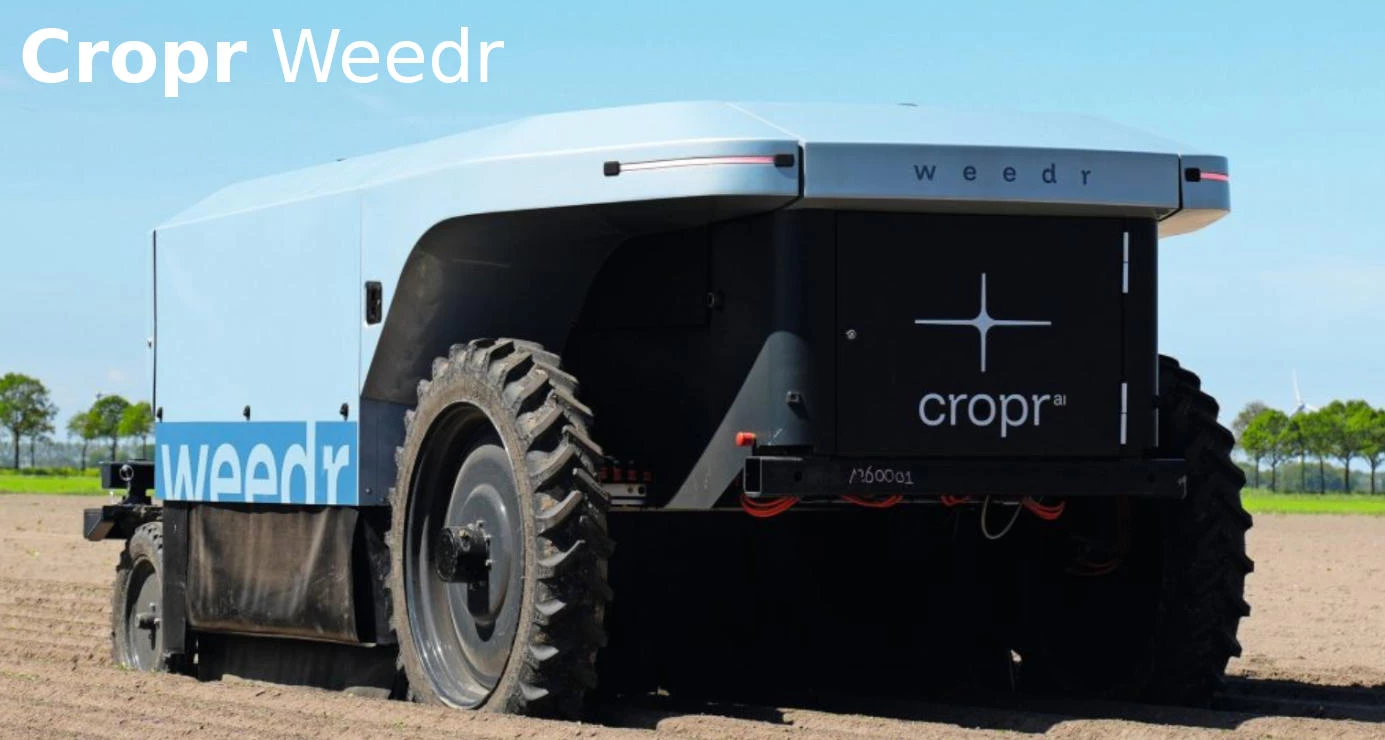
Cropr Weedr Review: A Laser Weeding Robot for Vegetable Farming
The Dutch company Cropr has introduced the autonomous Weedr weeding robot - a machine that combines computer vision, artificial intelligence, GPS RTK navigation, and laser treatment of weeds. For European vegetable farming, this is not simply another robot designed for exhibition demonstrations. Cropr Weedr is entering the market at a time when vegetable producers are facing several pressures at once: a shortage of labor, fewer available herbicide solutions, the high cost of manual weeding, and the need to work more precisely around crop plants.
According to the manufacturer’s concept, Weedr should become a more accessible route to chemical-free weed control in conventional vegetable farming, not only in organic production. This is what makes the new machine particularly interesting. Laser weeding has looked technologically attractive for years, but practical adoption has often been limited by productivity, the difficulty of recognizing plants under real field conditions, and the cost per hectare. Cropr is trying to address these issues through a narrow focus on high-value row crops, the experience of H2L Robotics, and the development of its own autonomous platform.
What Is Cropr Weedr?
Cropr Weedr is an autonomous machine for laser weed destruction. It does not apply herbicides, it does not work the soil with hoes or blades, and it does not mechanically pull plants out. Its operating principle is different: cameras scan the soil surface, artificial intelligence algorithms distinguish between crop plants and weeds, and then the laser module directs energy to the required point. According to Cropr, the laser destroys the chlorophyll in the weed, after which the plant dies.
This is an important difference from a conventional inter-row cultivator. A mechanical implement can work effectively between rows, but it requires caution near the crop row, especially at early growth stages. A laser-based solution can theoretically work closer to the crop plant, because the working element does not touch either the soil or the root system. Cropr describes this advantage as millimeter-level precision and maximum protection for both the crop and the soil.
The first target applications for Weedr are chicory, onions, carrots, and lilies. Initial field operation begins specifically in chicory in the Dutch province of Flevoland. This choice is logical: chicory is a high-value crop, it is sensitive to weed competition, and it is also a crop where manual labor or repeated machine passes can quickly become expensive.
Technical Specifications of Cropr Weedr
Cropr’s official specification gives a fairly clear idea of the machine’s class. Weedr is not a lightweight laboratory robot, but it is also not a heavy self-propelled platform weighing several tonnes. It is a compact autonomous machine for bed and row crops, designed for long operating periods in the field.
| Parameter | Cropr Weedr Data |
|---|---|
| Machine type | Autonomous laser weeding robot |
| Main purpose | Chemical-free weed destruction in row crops |
| Supported crops at launch | Onions, carrots, chicory, lilies; further expansion is stated by the manufacturer |
| Recognition system | Cameras and AI-based plant analysis |
| Navigation | Autonomous movement based on GPS RTK |
| Working modules | 10 blue diode lasers |
| Laser operating intensity | 28 shots per second |
| Drive | Electric motors on the rear wheels |
| Energy source | Diesel generator |
| Fuel autonomy | Up to 25 hours on one tank |
| Travel speed | Variable, up to 2 km/h |
| Adjustable track width | 150-225 cm |
| Dimensions | Length 4.3 m, width 2.33-2.55 m, height 1.84 m |
| Weight | Less than 2000 kg |
| Control | User online platform |
One detail concerning width deserves separate clarification. In several industry publications, the 1.50-2.25 m figure is presented as adjustable working width. In Cropr’s official specification, however, this figure is listed as “spoorbreedte”, meaning track width. For practical use, this is not a minor distinction: track width determines compatibility with beds, row spacing, and the farm’s tramlines. Therefore, when assessing the machine for a specific growing system, it is important to consider not only the general statement about working width, but also the actual sowing pattern, bed width, and row arrangement.
How Laser Weeding Works
Traditional weed control is based on three main approaches: chemical, mechanical, and manual. Chemical control delivers high productivity, but it depends on product availability, regulations, weather conditions, and weed resistance. Mechanical control reduces chemical load, but it has limitations near the row, can disturb and dry the upper soil layer, and requires precise navigation. Manual weeding remains accurate, but it is expensive and increasingly difficult because of the shortage of seasonal labor.
The laser approach attempts to take the accuracy of manual work, automate it, and avoid physical contact with the soil. In Cropr Weedr, the first stage is visual scanning. Cameras collect images of the area ahead of the working modules. The second stage is classification: the AI model determines where the crop plant is and where unwanted vegetation is located. The third stage is laser action. The system directs the beam to a specific point on the weed, damaging vital plant tissue.
In theory, this concept is especially interesting for crops in which unwanted plants compete with the main crop during early growth stages, and where any displacement of a mechanical tool can damage seedlings. If the algorithm correctly distinguishes between crop and weed, the laser can operate close to the row where a conventional cultivator is forced to leave a safety zone.
However, recognition is the critical point of the entire system. In a controlled presentation, the camera sees an ideal plant on a clean background. In the field, the situation is more complex: uneven emergence, soil clods, crop residues, shadows, moisture, different weed growth stages, overlapping leaves, and traces from previous machine passes. That is why Cropr is starting with specific crops while simultaneously training its AI model for broader application. This is not a weakness, but the normal logic of agricultural robot adoption: first precise operation in a well-described scenario, then expansion of the crop library and field-condition database.
Why H2L Robotics Experience Matters for Weedr
Cropr is a new brand in robotic weeding, but behind it is a team connected with H2L Robotics. This is important because H2L already has practical experience in developing autonomous agricultural machines for the Dutch market, including robots for tulip selection and disease detection. According to H2L, its robots use GPS RTK, cameras, and AI-based image analysis to detect disease symptoms in tulips and potatoes.
For Weedr, this background is fundamental. Laser weeding is not only about the laser. In reality, the laser is the final element in a longer chain, while most of the value is created before the shot: stable autonomous driving, correct positioning, high-quality imaging, fast recognition, precise calculation of target coordinates, and safe execution. If even one link in this chain works unreliably, the advantage of the laser disappears.
This is why Cropr emphasizes that Weedr uses H2L’s autonomous technology and AI infrastructure, but that a new platform has been developed for laser weeding. This means the machine is not simply a converted selection robot. It is designed for a different type of work: not to find a diseased plant and perform a spot treatment in tulips, but to repeatedly, quickly, and accurately destroy small weeds in row crops.
Productivity and Economics: Why 100 Euros per Hectare Matters
One of Cropr’s most interesting claims is the ability to work for less than 100 euros per covered hectare, depending on weed pressure and usage mode. For laser weeding, this is a key figure, because expensive technologies often remain limited to demonstrations or organic production, where the economics can justify a high operating cost.
If Cropr can genuinely bring the cost of laser weeding closer to a level acceptable for conventional vegetable growers, Weedr may change the logic of robot adoption itself. The machine stops being only an environmental symbol and becomes a tool of production economics. For a farm, the key question is not how futuristic the robot looks, but whether it can pass through the field in the required time window, avoid crop damage, reduce dependence on manual labor, and deliver a predictable operating cost.
The claimed autonomy of up to 25 hours on one tank also supports this economic model. During the weed control season, the decisive factor is not only speed in kilometers per hour, but the number of hours during which the machine is actually performing useful work. A 24/7 autonomous operating model can compensate for the relatively low travel speed of up to 2 km/h by extending working time. This is especially important for crops where the effective weed-control window is short and a delay of several days can significantly reduce the result.
At the same time, the speed of up to 2 km/h shows that Weedr should not be viewed as a direct equivalent of a wide-boom sprayer or a high-speed cultivator. This is a precision machine. Its efficiency will depend on weed pressure, weed size, bed width, the number of crop rows in the treatment zone, and field logistics. Where a cheap full-field pass over a large area is required, conventional equipment will continue to have an advantage for a long time. Where the main problem is precision close to the crop, labor shortages, and chemical restrictions, the laser robot has a much stronger position.
A Diesel Generator in a Chemical-Free Machine: Compromise or Necessity?
At first glance, it may seem paradoxical that a robot for chemical-free weeding uses a diesel generator. From an engineering standpoint, however, this is an understandable solution. Lasers, computer vision, computing modules, navigation, and electric drive systems require stable power supply. A fully battery-electric architecture could reduce local emissions, but it could also limit working duration or increase the machine’s weight and cost.
Cropr has chosen a hybrid logic: electric motors on the rear wheels and a diesel generator as the power source. This provides up to 25 hours of autonomy on one tank and allows the machine to operate almost continuously. For a production farm, this stability is often more important than the ideological purity of the design. This is especially true during the first stage of adoption, when the main objective is to prove that laser weeding can be not an exotic technology, but a practical field operation.
In the future, electric or partially electrified versions of such machines cannot be ruled out. But for the current market, Cropr Weedr focuses on practicality: long working time, field autonomy, predictable energy supply, and less dependence on charging infrastructure.
First Crops: Chicory, Onions, Carrots, and Lilies
Starting with chicory in Flevoland looks cautious and correct. For a robotic system, it is important to collect real field data not in abstract “vegetable farming”, but in a specific crop, a specific region, and a specific growing system. This is where the recognition algorithm can gradually be adapted to different growth stages, weed pressure levels, lighting conditions, soil conditions, and typical false detections.
The parallel training of the AI model for carrots, onions, and lilies shows that Cropr sees Weedr not as a narrow machine for one crop, but as a platform. However, expansion will not happen automatically. Each new crop requires field images, training datasets, accuracy testing, and adaptation of operating scenarios. Carrots, onions, and lilies have different morphology, different growing patterns, and different visual profiles during early stages. To a human, these are obvious plants; to an algorithm, they are sets of features that must be reliably distinguished from weeds in a changing environment.
The manufacturer’s stated broader availability of Weedr for field vegetable production from 2027 looks realistic only if the first seasons generate enough high-quality data. In this sense, every hectare covered by the first machines is not only a production operation, but also training material for the next version of the system.
Who Could Benefit from This Machine?
The first target audience for Cropr Weedr is vegetable growers who produce crops with high weed-control costs and face problems with labor availability or herbicide programs. These may be conventional farms seeking to reduce dependence on chemistry, as well as producers operating in segments with higher requirements for residue levels, environmental performance, or precision crop care.
Weedr looks especially promising for farms with repeatable field structures, clearly defined tramlines, and crops where row standardization is possible. Autonomous machines prefer order: stable field geometry, well-prepared soil, clear field boundaries, predictable headlands, and accurate RTK data. The better a farm is prepared for precision agriculture, the easier it is to integrate such equipment.
At the same time, Weedr is not a universal answer to all weed problems. If a field has uneven emergence, severe infestation with large weeds, a complex layout, or constant obstacles, productivity and accuracy may differ from demonstration conditions. Laser weeding works best as part of a system, not as a magical replacement for agronomy. Crop rotation, high-quality seedbed preparation, uniform sowing, control of the first weed flush, and correct timing remain critically important.
What Cropr Weedr Means for the Agricultural Robot Market
The emergence of Cropr Weedr clearly shows where agricultural robotics is moving. The first stage was the prototype phase: machines had to prove that they could drive autonomously across a field and recognize plants. The second stage is the phase of specialized platforms, where a robot must perform a specific operation with an economically understandable result. Weedr belongs to this second stage.
For a farmer, the key question is simple: can the robot replace or reduce one of the most painful cost items without reducing yield? If the answer is yes, the technology has a chance to move beyond demonstration fields. If not, it will remain interesting but niche.
Cropr is trying to offer the market a production-oriented argument: 24/7 autonomy, millimeter-level action near the crop, 10 laser modules, up to 25 hours of work on one tank, and a cost below 100 euros per covered hectare under certain conditions. This set of arguments speaks not only to engineers, but also to farm economists.
Cropr Weedr is one of the most interesting examples of how artificial intelligence is moving from “data analysis” to physical work in the field. The machine does not simply display a weed map and does not merely recommend a decision to an agronomist. It moves independently, sees plants, makes decisions based on an AI model, and performs targeted laser action.
Weedr’s strengths are chemical-free weeding, operation near the crop plant without mechanical soil contact, autonomous GPS RTK navigation, long working duration, and a focus on the economics of conventional vegetable farming. Its limitations are also clear: the technology requires high-quality recognition, well-organized fields, crop-specific training, and productivity verification under real conditions with different weed pressures.
This is why the first seasons in chicory will be critical for Cropr. If Weedr confirms its stated accuracy, stability, and acceptable operating cost, laser weeding may become not an exotic technology of the future, but a practical tool for vegetable growers looking for a precise, autonomous, and less herbicide-dependent crop-care system.
Add a comment
Comments
There are no comments yet. Be the first to comment.
You must be logged in to post a comment
Login