
A Tractor Running on Spirit: Not a Joke, but a New Direction in Agricultural Machinery
The world of agricultural machinery continues to evolve faster than even optimists could have imagined just a few years ago. If the main focus of innovation used to be higher power, lower diesel consumption, and the development of precision farming, manufacturers are now increasingly turning toward alternative fuels. One of the most intriguing recent topics is tractors capable of running on spirit-based fuel.
This does not mean spirit in the everyday sense, but industrial spirit fuels - primarily methanol and ethanol. These are increasingly being considered a real alternative to diesel for heavy machinery. The reason is simple: the agricultural sector is under growing pressure from environmental regulations, energy prices, and the need to reduce dependence on traditional petroleum products. Against this backdrop, news of a tractor running on spirit no longer sounds bizarre, but rather signals the beginning of a new stage in machinery development.
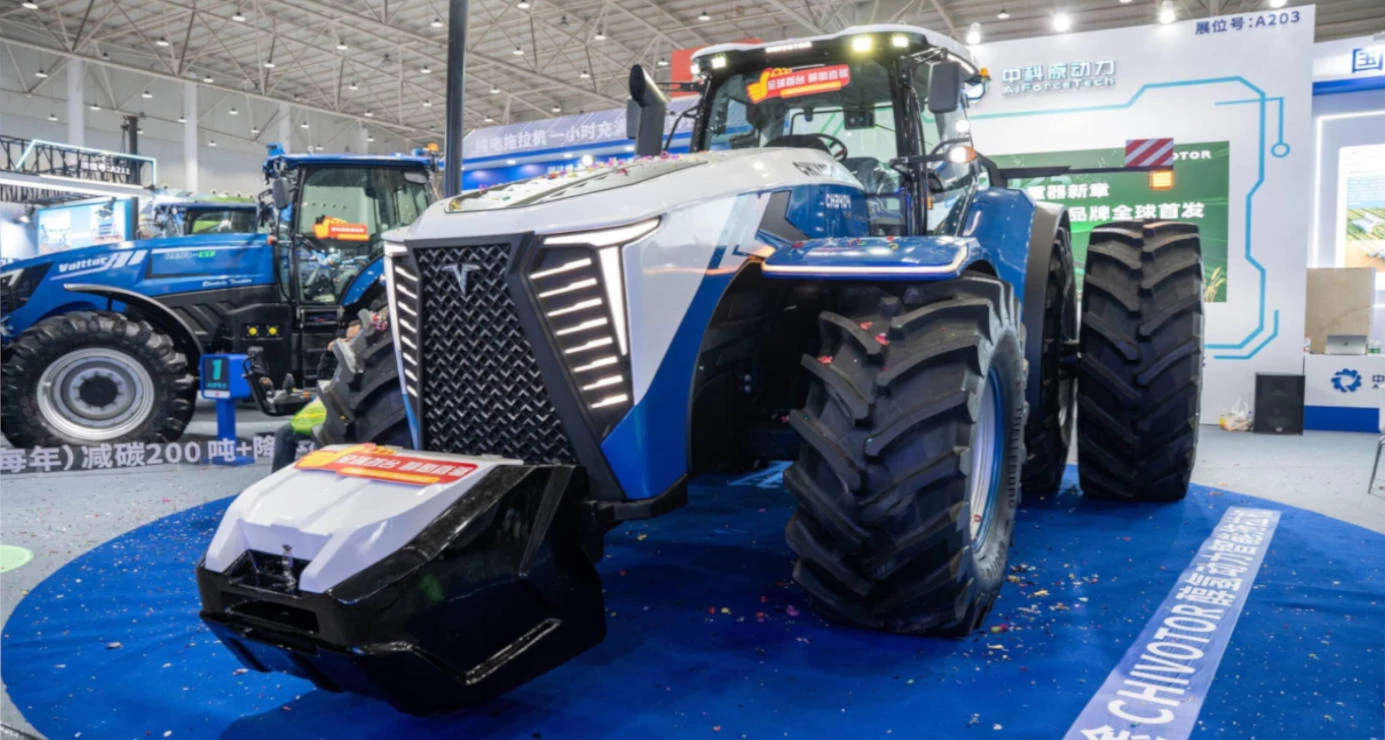
The trigger for this discussion was a Chinese tractor under the CHIVOTOR brand, presented by Beijing Zhongke Yuandongli. Industry publications and the company’s own materials indicate that in 2025 it launched the first spirit-hydrogen intelligent tractor platform, while the 340 hp machine is positioned as the first tractor of its kind in the world. According to industry sources, the new model features a CVT transmission, is designed for heavy-duty work, and can integrate autonomous functions. There are still not many detailed technical specifications available on the company’s open official pages, but the public launch of the brand and its statements about spirit-based fuel have been confirmed by several sources.
What matters most here is not the launch itself, but the logic behind the technology. In the case of methanol, manufacturers point to several advantages. First, this fuel can potentially be cheaper than traditional diesel. Second, with the right production chain, methanol can be made from a range of alternative sources, including biogas, syngas, or renewable energy-based pathways. Third, methanol-powered engines and energy systems are seen as a way to reduce nitrogen oxide and particulate emissions compared to conventional diesel solutions. This is exactly what the CHIVOTOR developers emphasize.
However, it would be a mistake to think that the Chinese project appeared in a vacuum. In reality, major global players have been looking at spirit-based fuels for quite some time. One of the clearest examples is Case IH in Brazil. In 2025, the brand officially announced that it sees ethanol as a fuel of the future for agricultural machinery. The first step was field testing of the two-row Austoft 9000 sugarcane harvester equipped with an ethanol engine developed by FPT Industrial. The company openly stated that it sees this technology expanding further - into tractors, combines, and sprayers. Moreover, Case IH emphasized that this is not a new subject for them: as early as 2012, the brand was testing adapted engines and hybrid diesel-ethanol solutions.
The Brazilian case currently looks like one of the most convincing practical examples. Why? Because ethanol in Brazil is not an exotic concept, but part of a real fuel economy. The country has a strong sugar-ethanol industry, established logistics, and an agribusiness sector that can itself produce this fuel. For farmers, this means not just a “green” technology for marketing purposes, but potentially a real tool for reducing carbon footprint and improving farm energy independence. It is no coincidence that Case IH is directly talking about the possibility of creating an entire fleet of ethanol-powered machinery.
Another important signal comes from John Deere. The company has officially confirmed that it is developing an ethanol engine concept for 8R series tractors. In its corporate materials, Deere stresses that renewable fuels - especially ethanol, biodiesel, and renewable diesel - are seen as a realistic decarbonization pathway for large machinery where full electrification is still not practical enough. In other words, this is no longer about abstract laboratory ideas, but about a strategic direction pursued by one of the world’s largest agricultural machinery manufacturers.
AGCO is not standing aside either. The company has officially stated that it is developing low-carbon power solutions, and its AGCO Power division in Finland has opened a clean energy laboratory to test hydrogen, methanol, battery-electric, and hybrid systems. AGCO also mentions methanol research as an energy source for range extenders and fuel cells in agricultural equipment. So even if a serial-production methanol tractor from AGCO has not yet become a mainstream product, the direction is already being developed at the engineering strategy level.
So, do such tractors have a real chance of success in practical use? The answer is yes - but not at the same pace everywhere. Spirit-based fuel has the best prospects where a strong raw-material and fuel base already exists. For ethanol, this means above all Brazil, partly the United States, and in some cases regions with major corn or sugar feedstock production. For methanol, the logic is somewhat different: it can be attractive where synthetic or “green” fuels are being promoted, as well as where future low-carbon energy systems are being integrated. That is why China currently looks like a natural platform for experiments of this kind.
Success, however, does not depend on the engine alone. For farmers, four practical criteria matter most: fuel price, refueling infrastructure, range, and the machine’s reliability under load. This is exactly where spirit-fueled tractors still face several challenges. Methanol is toxic and requires more careful handling in logistics and safety. Ethanol systems, although better understood in some countries, also require adapted powertrains and a stable fuel supply base. In addition, any new agricultural technology must pass a strict reality test: it must survive sowing season, transport work, cultivation, dust, mud, temperature swings, and lack of service time. That is why field trials, such as those carried out by Case IH, are much more convincing today than presentations alone.
There is another important nuance as well. Some manufacturers present spirit-based solutions not simply as engines running on new fuel, but as part of a broader system - together with autonomy, electronic control, CVT transmissions, digital services, and even robotic functions. In this sense, the Chinese CHIVOTOR is especially interesting as a hybrid of two trends: alternative fuel and automation. Meanwhile, Zhongke Yuandongli already has experience bringing intelligent electric tractors to market which, according to the company’s official claims, have been deployed on large farms and pastures and have demonstrated higher efficiency and lower energy costs compared to conventional machinery. This is not direct proof of the success of the methanol model itself, but it shows that the company is not just a random trade show startup.
Advantages of Spirit-Fueled Tractors
If we summarize, the key advantages of this direction are quite clear. First - reduced dependence on traditional diesel. Second - a potential reduction in harmful emissions and carbon footprint. Third - a chance for agriculture to close part of its energy cycle around its own raw materials, especially in regions where ethanol or biofuel production is well developed. Fourth - if the fuel economics work out properly, operating costs may also be reduced. These are the arguments used today by Chinese, Brazilian, and American developers alike.
What Slows Down Mass Adoption
There are also restraining factors. The first is the lack of widespread infrastructure outside specific countries. The second is market inertia, since diesel machinery has been proving its reliability for decades. The third is the need for specialized service, staff training, and adapted fuel logistics. The fourth is the issue of resale value for such machines on the secondary market. Farmers do not simply buy a tractor - they buy a tool that must work for many seasons, remain repairable, and fit smoothly into everyday farm operations. That is why a real breakthrough is most likely to happen first in segments where the economics are already clearly better today.
Where This Leaves Ukrainian Farmers
For Ukraine, the topic of spirit-fueled tractors currently looks more like a direction worth monitoring closely than a mass-market reality for tomorrow. Still, it should not be underestimated. First, the domestic agricultural sector is highly sensitive to the cost of field operations. Second, the issue of energy independence and flexible fuel supply is especially important for us. Third, in the long term, the farms that adapt faster to new environmental standards and energy-efficient solutions will be the ones that benefit most.
It is quite possible that such technologies will first appear not as mass tractors on every farm, but as specialized machines, demonstration projects, or local solutions for large agricultural holdings. Yet the very fact that such tractors have entered the global discussion already shows one thing clearly: the future of agricultural machinery will not be tied only to conventional diesel.
Agricultural Spare Parts - Available from Bas-Agro
Whatever the energy source of the future may be - diesel, ethanol, methanol, or electric drive - the basis of efficient farm work remains the same: machinery must stay operational, and spare parts must be available on time. That is why it is so important for farmers to have a reliable supplier of components and assemblies for agricultural equipment.
At Bas-Agro, farmers can buy spare parts for agricultural machinery from various brands and machine categories. The company works to ensure that agricultural businesses can quickly meet their repair, maintenance, and restoration needs without unnecessary downtime during the season. The agricultural spare parts catalog at bas.ua can be useful both for large farms and for individual farmers who value speed, compatibility, and a practical service approach.
A tractor running on spirit is no longer an informational curiosity, but a real technological direction that is gradually gaining momentum. China is presenting bold methanol and spirit-hydrogen solutions, Brazil is promoting ethanol as a practical agricultural resource, and global brands such as John Deere and AGCO are officially investing in the development of alternative fuels for heavy machinery. A mass transition will not happen overnight, but the trend has already taken shape.
For the agricultural market, this means one thing: in the coming years, we will see even more experiments, field trials, and new machine series where efficiency will be measured not only in horsepower, but also in the flexibility of the fuel model. And it is entirely possible that, very soon, a tractor running on spirit-based fuel will stop sounding surprising - just as autopilots, telematics, and electrified components in modern machinery no longer surprise anyone.
Add a comment
Comments
There are no comments yet. Be the first to comment.
You must be logged in to post a comment
Login