
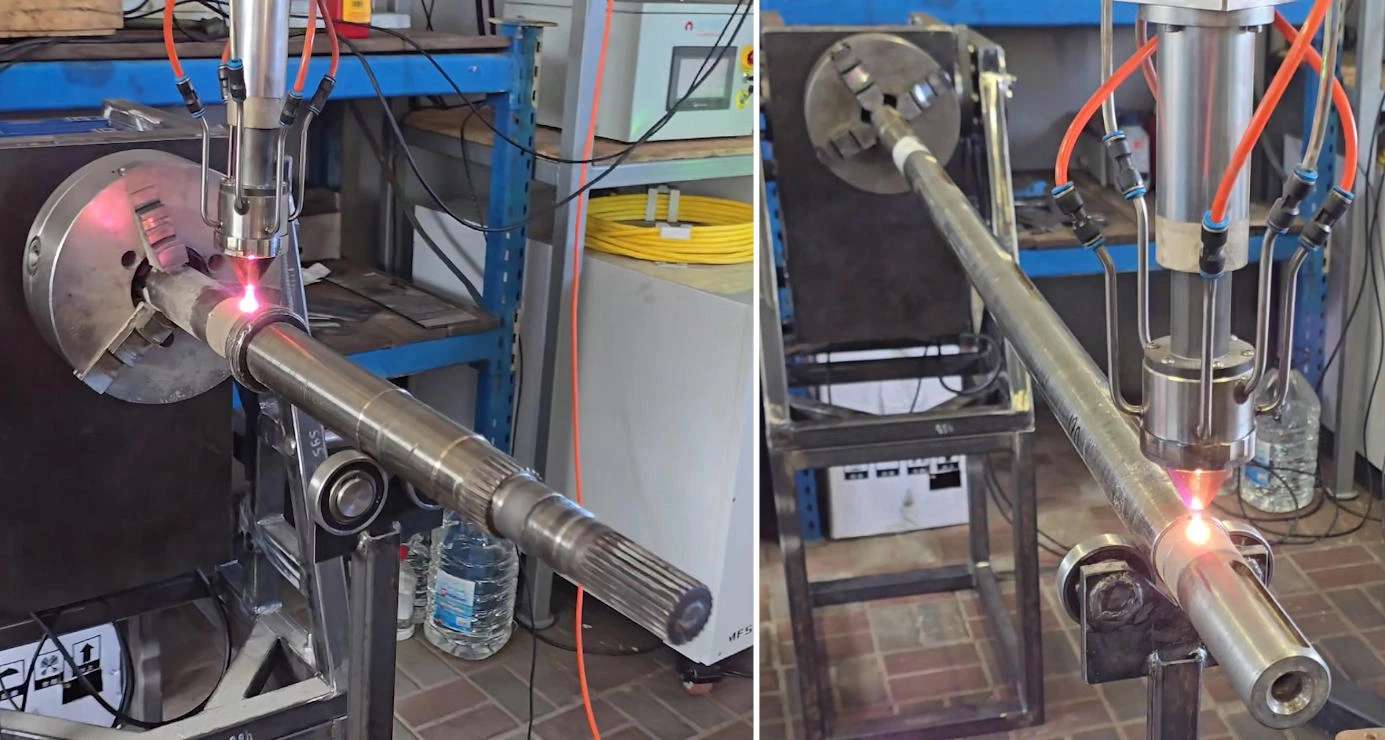
Restoring the Bearing Seat Diameter on a Shaft: Laser Cladding, Turning, and Grinding
In agricultural machinery, a shaft often operates under heavy loads, dust, vibration, misalignment, shock loads, and intensive seasonal use, when downtime is especially undesirable. The most vulnerable areas are the bearing seats and mounting surfaces for pulleys, sprockets, couplings, bushings, and other components. Over time, these areas wear out: the fit becomes loose, the bearing may start rotating on the shaft, play appears, runout increases, and the unit may begin to heat up or produce unusual noise during operation.
In many cases, such a shaft does not need to be replaced completely. If the main geometry of the part is preserved and there are no critical cracks or severe damage to the shaft body, the seat diameter can be restored. One practical method for this type of repair is laser cladding followed by machining to the final working size.
What restoring the seat diameter means
A seat on a shaft must have a precisely defined diameter. For example, when a bearing is installed on a shaft, the inner ring of the bearing must have the correct fit: it should not be too loose, but it also should not create excessive interference. When the surface is worn, the diameter becomes smaller, and the assembly no longer works as intended by the original design.
Restoring the seat diameter includes several key stages.
First, the part is inspected, and the nature of the wear is evaluated. It is important to understand how badly the surface is damaged, whether there is runout, whether the shaft is deformed, which dimensions must be restored, and what the final fit should be.
After that, the worn area is prepared for cladding. The surface is cleaned and, if necessary, pre-machined to remove irregularities, corrosion marks, or the old damaged layer. Proper preparation is very important because it affects the stability and quality of the new metal layer.
Next, laser cladding is performed. A layer of metal is applied to the worn seat area to compensate for the material loss and create machining allowance for the next stage. Laser cladding allows work to be done locally, exactly where restoration is needed, without overheating the entire part. This is especially important for shafts, where excessive thermal deformation is undesirable.
After cladding, the shaft is transferred to machining. First, turning is performed: excess material is removed, and the correct diameter and geometry of the seat are formed. Then, if the assembly requires higher precision, grinding is carried out to reach the final size. As a result, the seat receives the required diameter, a smooth surface, and becomes suitable for installing a bearing or another component.
Restoring long shafts up to 4 meters
One of the advantages of our production capabilities is the ability to work with long shafts up to 4 meters. This is important for agricultural machinery because combines, headers, conveyors, augers, drives, and various mechanisms often use long components. Replacing them is not always simple: a new shaft may be expensive, take a long time to manufacture, or require additional adjustment for a specific unit.
Bas-Agro Group LLC restores seat surfaces on such parts with further turning and finishing to the required size. When a shaft is long, it is important not only to apply new metal, but also to position the part correctly, control alignment, minimize runout, and ensure stable geometry after machining.
A video showing the restoration of a long shaft is available here: https://www.youtube.com/shorts/pC9qPiwsG7E
The result after restoring the long shaft is shown here: https://youtube.com/shorts/03R_ciq0bZw
Restoring a bearing seat
One of the most common repair cases is a worn bearing seat. If a bearing works on a damaged seat, it may rotate on the shaft, heat up, destroy the seating area even faster, and transfer vibration to adjacent assemblies. In agricultural machinery, this can lead to machine downtime at the worst possible moment — during sowing, harvesting, or other intensive seasonal operations.
Restoring the bearing seat diameter makes it possible to return the shaft to service without replacing the whole part. After laser cladding and machining, the seat again receives the correct diameter. At the same time, the goal is not simply to “add metal”, but to bring the surface to a specific technical size, taking into account the bearing type and the operating conditions of the assembly.
A video showing shaft repair and restoration of the bearing seat diameter is available here: https://youtube.com/shorts/KOp78zxC9vs
When shaft repair makes sense
Restoring a seat surface is reasonable when the shaft is generally suitable for further operation but has local wear in the working area. This may be a bearing seat, a pulley seat, a sprocket seat, a bushing seat, or another drive component mounting area.
This type of repair is especially relevant for expensive, non-standard, or long shafts that are difficult to replace quickly. In many cases, restoration helps reduce costs and return machinery to operation faster than waiting for a new part.
At the same time, every shaft must be evaluated individually. If there are cracks, severe bending, critical spline damage, or other serious defects, repair may not be the best option, and manufacturing a new part may be required. That is why diagnostics and understanding the actual condition of the shaft are important before starting the work.
Production capabilities of Bas-Agro Group LLC
Bas-Agro Group LLC restores and manufactures parts for agricultural machinery. We work with shafts, seat surfaces, pulleys, sprockets, bushings, and other components that require precise machining. Worn surfaces can be restored by laser cladding with subsequent turning and grinding to the final working size.
The company website also includes a catalog of spare parts for agricultural machinery: https://bas.ua/
If you have a worn shaft or another part that needs restoration, you can contact us for consultation. For a preliminary assessment, it is useful to provide photos of the part, key dimensions, information about the assembly where it operates, or a sample of the worn component.
For inquiries, please call: +38 (067) 470-35-44
Add a comment
Comments
There are no comments yet. Be the first to comment.
You must be logged in to post a comment
Login