
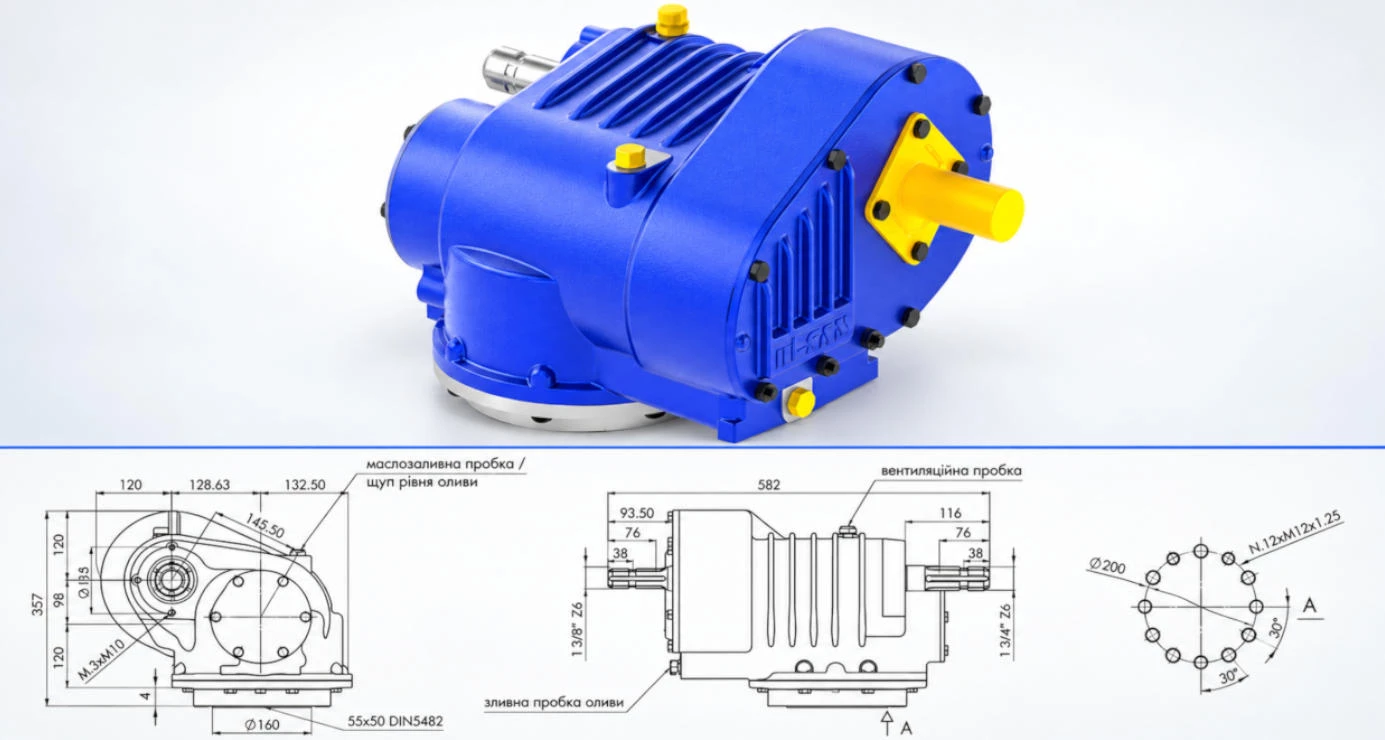
DI-SAN DS008 Power Harrow Gearbox: Specifications and Operating Modes
A power harrow operates under continuous resistance from the soil. Its tines loosen compacted layers, break down clods, mix crop residues and create a level seedbed. When the working tools encounter dense soil or stones, resistance increases sharply. The machine’s driveline must therefore withstand both continuous power transmission and short-term impact loads.
The DI-SAN DS008 is a two-speed reduction gearbox designed for power harrows. It receives power from the tractor’s power take-off, reduces rotational speed and simultaneously increases the torque required to drive the working components of the tillage machine.
What Machines Is the DI-SAN DS008 Designed For?
DI-SAN classifies the DS008 as a gearbox for soil-tillage machinery and specifies its application as a power harrow. This is an active tillage machine equipped with several rotors arranged on vertical axes.
Tines are attached to each rotor and move primarily in a horizontal plane. Adjacent rotors operate in a coordinated sequence, allowing the machine to cultivate the soil across its entire working width.
A power harrow should not be confused with a rotary tiller. On a rotary tiller, the blades are mounted on a common horizontal rotor and travel in a vertical circular path. A power harrow uses individual rotors turning around vertical axes. This difference in working-unit design results in different requirements for the gearbox, power-flow direction and driveline arrangement.
The DS008 serves as the central power-transmission unit of a power harrow. Rotation from the PTO shaft passes through the gearbox to the machine’s internal rotor-drive system.
Technical Specifications of the DI-SAN DS008
The gearbox has two operating modes with different gear ratios, output speeds and torque ratings.
| Specification | First mode | Second mode |
|---|---|---|
| Gear arrangement | 32–24 | 24–32 |
| Gear ratio | 2.76:1 | 1.55:1 |
| Input speed | 540 rpm | 540 rpm |
| Output speed | 196 rpm | 348 rpm |
| Input power | 95 hp / 71 kW | 95 hp / 71 kW |
| Output torque | 3,280 Nm | 1,847 Nm |
| Recommended oil | SAE 90 / SAE 140 | SAE 90 / SAE 140 |
| Oil capacity | 4 litres | 4 litres |
| Gearbox weight | 93.5 kg | 93.5 kg |
| Application | Power harrow | Power harrow |
With an input speed of 540 rpm, the DS008 always operates as a reduction gearbox. The first mode reduces output speed to 196 rpm, while the second mode provides 348 rpm.
How the Two-Speed DS008 System Works
The gearbox uses two gear arrangements: 32–24 and 24–32. Changing their arrangement provides two gear ratios without replacing the complete gearbox.
In the first mode, the gear ratio is 2.76:1. An input speed of 540 rpm is reduced to 196 rpm at the output, while torque reaches 3,280 Nm. This is the high-torque mode, combining comparatively low rotational speed with maximum output torque.
In the second mode, the gear ratio is 1.55:1. Output speed increases to 348 rpm, while torque decreases to 1,847 Nm. This mode provides a higher operating speed and more intensive action of the working tools on the soil.
The greater the speed reduction, the more torque the gearbox can transmit at the output for the same input power. The two operating modes therefore serve different purposes and should not be treated as interchangeable settings.
The gear arrangement is selected according to the power harrow’s design, the required cultivation intensity and operating conditions. The driveline must be completely stopped before changing the configuration, and the procedure must follow the instructions for the particular machine.
What Do 196 and 348 rpm Mean?
These values refer to the output shaft of the DS008 gearbox. They describe the operating speed transmitted from the gearbox to the subsequent driveline components.
A power harrow may have an additional distribution gear train connecting the central gearbox to the individual rotors. The gearbox output speed should therefore only be treated as the actual rotor speed when the machine’s driveline does not provide another speed-changing stage.
When selecting a replacement gearbox, the specifications of the original unit and the technical documentation for the power harrow must be checked. A matching input speed of 540 rpm alone is not sufficient to confirm compatibility.
Power and Torque
The stated input power of the DS008 is 95 hp, or 71 kW. This figure defines the gearbox’s rated input capacity; it is not a universal tractor-power recommendation.
The actual power requirement of a machine depends on its working width, number of rotors, cultivation depth, soil density and moisture, forward speed and rear-roller design. Tractor power must be selected according to the requirements of the complete power harrow rather than the gearbox rating alone.
The maximum output torque of the DS008 is 3,280 Nm at 196 rpm. When the gearbox is configured for 348 rpm, the output torque is 1,847 Nm. This relationship is a normal consequence of the transmission ratio: increasing output speed reduces the available torque.
Why the DS008 Cannot Be Selected by Power Rating Alone
Even if another gearbox is designed for a 540 rpm input and has a similar power rating, this does not confirm that it can replace the DS008. Correct selection requires verification of:
- The model and working width of the power harrow.
- The designation of the original gearbox.
- The required input and output speeds.
- The gear ratio in each operating mode.
- The permitted power and torque.
- The positions of the input and output shafts.
- The direction of shaft rotation.
- The spline types and dimensions.
- The gearbox housing dimensions.
- The mounting-hole arrangement.
- The design of the speed-changing system.
- The gearbox position on the machine frame.
Gearboxes intended for the same type of machine can have different housing geometry, output-shaft height, mounting arrangements and internal kinematics. A similar external appearance is not sufficient evidence of compatibility.
Loads on a Power Harrow Gearbox
During uniform soil cultivation, the DS008 transmits a continuous load to the rotor driveline. When a tine encounters a compacted layer, stone or other solid object, resistance rises abruptly. The resulting shock load passes through the distribution gear train to the central gearbox and PTO shaft.
- The principal causes of premature wear include:
- tines striking stones and other obstacles;
- blockage of one or more rotors;
- operation at excessive working depth;
- selecting a mode unsuitable for the actual load;
- abrupt PTO engagement at high engine speed;
- a defective PTO shaft safety clutch;
- insufficient oil level;
- oil leakage through damaged seals;
- a contaminated or defective breather;
- bearing wear and excessive shaft play;
- loose gearbox mounting connections;
- incorrect PTO driveline alignment;
- operation with bent or unevenly worn tines.
Continuous operation with excessive vibration accelerates wear of the bearings, shafts, seals and gears. The machine must be stopped and inspected if unusual noise, excessive play or abnormal heating appears.
Lubrication and Maintenance
The DS008 is designed to use SAE 90 or SAE 140 transmission oil. Its nominal oil capacity is 4 litres.
Before the operating season, the oil level and condition, housing integrity, seals, breather and mounting connections should be inspected. The PTO shaft and safety clutch require particular attention because they protect the driveline from dangerous impact loads.
Input- and output-shaft play must also be checked. Excessive play can indicate bearing wear and incorrect positioning of the gears. Continued operation in this condition causes improper tooth contact and accelerates transmission damage.
The PTO should be engaged at a low engine speed. After engagement, the driveline should be brought gradually to the specified operating speed of 540 rpm. Abrupt engagement creates additional dynamic loads on the PTO shaft, gears, gearbox shafts and bearings.
DI-SAN DS008 Gearbox from BAS-Agro
BAS-Agro supplies DI-SAN gearboxes for agricultural machinery and helps verify compatibility according to technical specifications and mounting dimensions.
The company’s online catalogue includes the DI-SAN DS008 gearbox for power harrows. Before ordering, customers should provide the machine model, the designation of the original gearbox and photographs of the shafts, mounting points and housing. If the original marking is no longer visible, the principal mounting dimensions will be required.
Accurate identification is especially important for the DS008 because the gearbox has two operating modes and must correspond not only to the machine’s power requirements but also to the complete driveline configuration.
The DI-SAN DS008 is a two-speed reduction gearbox for power harrows. With an input speed of 540 rpm, it provides two operating modes: 196 rpm with an output torque of 3,280 Nm and 348 rpm with an output torque of 1,847 Nm.
The first mode delivers maximum torque at a lower speed, while the second provides a higher operating speed. The mode is determined by using the 32–24 or 24–32 gear arrangement.
The reliability of the DS008 depends on correct selection, operation at the specified PTO speed, a functioning safety clutch, properly maintained working tools and regular oil-level inspections. Matching the model, gear ratios and mounting geometry is essential for safe installation on a power harrow.
Add a comment
Comments
There are no comments yet. Be the first to comment.
You must be logged in to post a comment
Login