
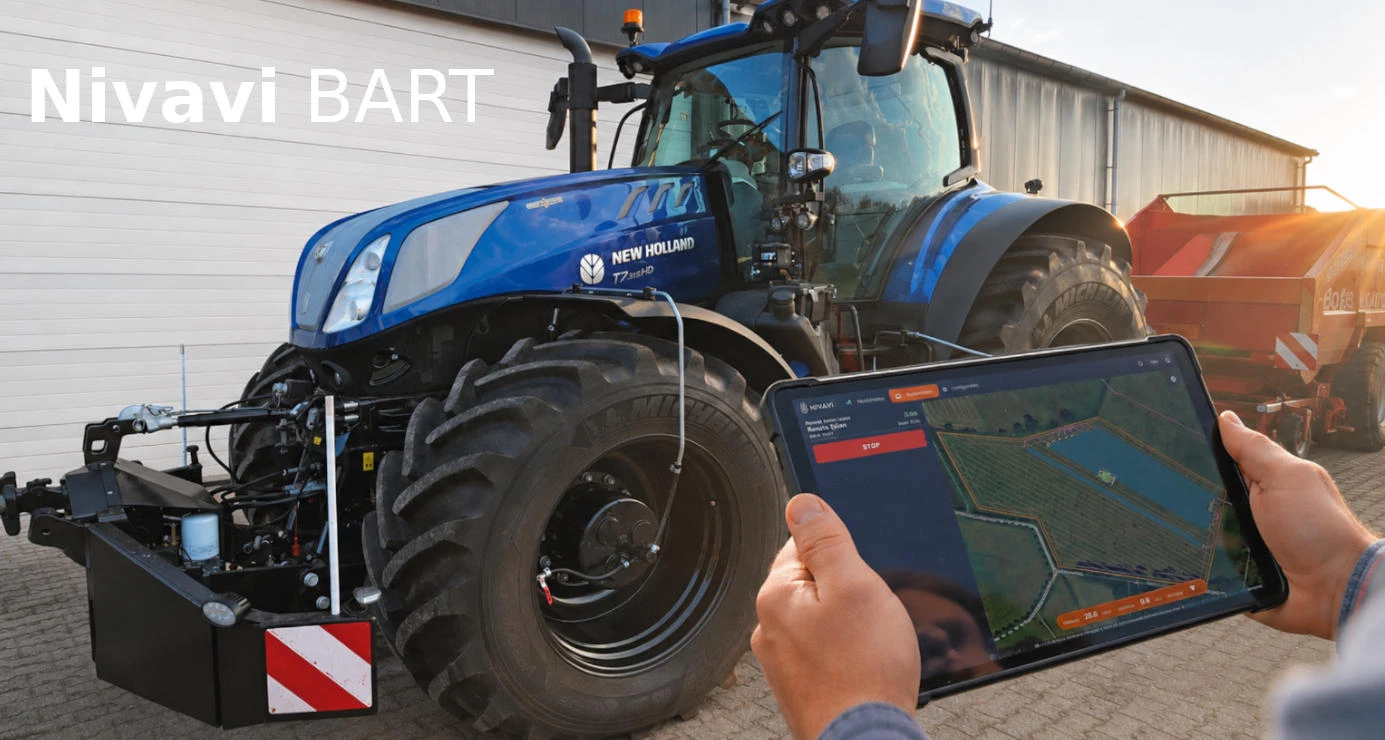
Nivavi BART: How an ordinary tractor can be turned into a robot with a retrofit kit
The autonomy of agricultural machinery is beginning to look less like science fiction about entirely new robotic platforms and more like practical engineering. One of the most interesting directions today is not replacing the entire tractor fleet with new robots, but adding a package of hardware, software and sensors to machines that farms already own. This is exactly the logic behind BART, an autonomous retrofit kit from the Dutch company Nivavi.
The idea is simple in principle, but complex in execution: an ordinary tractor remains an ordinary tractor that can still be driven manually, but after the retrofit kit is installed, it gains the ability to perform field operations autonomously. This approach is especially relevant for farmers who already have tractors, mounted or trailed implements, a service infrastructure and no immediate intention to invest in a separate robotic platform. Retrofit autonomy does not promise a “magic button”, but it does offer a realistic pathway: add navigation, machine control, safety systems, implement monitoring and a digital operator interface to an existing tractor.
What is BART by Nivavi?
BART is an autonomous retrofit system that Nivavi, based in Zwolle in the Netherlands, positions as a “tractor driver” integrated into the tractor. The system had previously been tested under the name RoboDrive, but is now being presented under the new name BART. Based on available information, it is not merely an autosteer system for straight-line guidance, but a more comprehensive solution designed to take over tractor control and monitor the implement working behind the machine.
The working scenario is straightforward: the operator brings the tractor to the field, assigns the task through the interface, and then BART carries out the operation autonomously. When the job is completed, the system notifies the user through the interface. Importantly, the retrofitted tractor does not lose its manual mode. It can still be used as a conventional tractor or as an autonomous machine, depending on the task, the field, regulatory restrictions and the farm’s readiness for autonomous operation.
For positioning, BART uses RTK-GPS. This is expected: for most field operations requiring a stable trajectory, standard satellite navigation is not accurate enough. RTK correction enables the machine to follow planned lines with high repeatability, which is critical for tillage, sowing, inter-row operations, crop protection applications and other tasks where an error of several tens of centimetres can already be agronomically unacceptable. Nivavi uses its own GPS antennas, which indicates an intention to control not only the software layer, but also the quality of the hardware navigation architecture.
The second key element is safety. The BART prototype is equipped with a LiDAR sensor that scans the surrounding environment and helps detect obstacles. For an autonomous tractor, this is not an optional feature, but a basic requirement. People, animals, other machines, field boundaries, poles, irrigation components or unexpected objects can all appear in the field. That is why modern autonomous systems increasingly combine RTK navigation with sensor-based perception: GPS answers the question “where am I?”, but does not always sufficiently answer the question “what is in front of me right now?”.
Why implement control matters more than it may seem
One of the strongest aspects of BART is the ability to monitor not only the tractor itself, but also the implement working behind it. This is a crucial point. Autonomous tractor movement alone does not yet mean autonomous agricultural work. A machine may drive accurately along the planned route, but if the implement becomes clogged, leaves its working mode, loses working depth, fails to engage or operates incorrectly, the final result will be unacceptable.
This is where the boundary lies between “autosteer” and real robotisation. In agriculture, the tractor is almost always a traction and power platform for a specific technological process. The farmer does not simply need driverless movement; he needs a high-quality operation: uniform cultivation, precise application, stable working depth, section control, reliable drive operation, and no skips or overlaps. That is why the ability to equip the implement with sensors to monitor its condition is fundamentally important.
BART is currently described as a prototype that Nivavi plans to bring to the market commercially in early 2027. In other words, this is not yet a system that can be described as widely available today. Public sources also do not yet provide detailed information about the kit’s price, the exact list of compatible tractors, transmission and hydraulic requirements, ISOBUS limitations, working speed or specific implement categories. For farmers, these are decisive questions and should be separated from the general presentation logic. The technology looks promising, but its practical value will depend on compatibility, service, price, certification and proven performance in real farms.
Retrofit autonomy: not only BART
BART is interesting not only as an individual product. It reflects a broader market trend: the autonomy of existing tractor fleets is becoming a separate category of agricultural technology. Alongside entirely new field robots, a class of solutions is emerging that does not replace the tractor, but adds an autonomous layer on top of it.
In the Netherlands, one of the closest examples is iQuus Autonomy by GPX Solutions. This system is developing at the intersection of GPS technologies, robotics, ISOBUS and implement control. GPX Solutions states that iQuus has been operating since 2017, and that the technology is already present not only in Western Europe, but also in North America and Australia. For BART, this is an important context: Nivavi is not entering an empty niche, but a market that already has competitors with field testing and implementation experience.
The American company Sabanto represents another example of the retrofit approach. Its Steward system is positioned as a kit that adds autonomous functionality to existing tractors without removing the option of manual control. Public descriptions mention a main control unit, CAN-bus monitoring, GPS navigation, cellular connectivity, antennas and a receiver. For the market, this is important because Sabanto effectively promotes the idea that the autonomous tractor may already be standing in the farmyard — it simply needs a digital and robotic layer added to it.
Bluewhite, for its part, focuses on permanent crops — orchards and vineyards. Its Pathfinder Kit is installed on existing tractors and enables autonomous operations such as spraying and material spreading. The system is combined with the Compass Fleet Management platform, meaning that it is not only about an individual tractor, but about centralised fleet control. It is also significant that Bluewhite has a strategic partnership with New Holland: New Holland dealers in the western United States have been given the opportunity to sell, install and service these aftermarket kits for existing tractors. This is already a sign of a transition from start-up technology to a dealer-based sales and service model.
France’s Agreenculture offers the AGC Autonomy Kit, an autonomy package ready for integration by agricultural machinery manufacturers. Its architecture includes a roof-mounted module with navigation and positioning hardware, cameras and LED status indicators. This example is notable because the company is more oriented toward OEM integration: not only farmers wishing to retrofit a tractor, but also machinery manufacturers aiming to create an autonomous machine faster on the basis of an existing platform.
The Polish company GOtrack, with its Auto DRIVE system, claims even broader compatibility: the kit is designed for installation on different tractor models and for autonomous driving during orchard and field operations. The company’s materials highlight the possibility of installation on tractors with power steering, as well as control not only of the tractor’s movement, but also of implements. This is an important argument for farms whose machinery fleets are not made up exclusively of the newest tractors with the most open electronic interfaces.
PTx Trimble OutRun deserves a separate mention. This is not a universal system “for every task”, but a more specialised autonomous retrofit kit. Its first application is autonomous tractor operation with a grain cart during harvest. The system is compatible with John Deere 8R tractors from 2014 onward equipped with IVT, while compatibility with Fendt 900 tractors is planned for a later stage. Such specialisation may even be a stronger commercial strategy than trying to automate everything at once: during harvest, the shortage of operators is especially acute, and grain cart operation is a repetitive task with a high economic cost of downtime.
There are also semi-autonomous or narrowly specialised systems that should not always be placed in the same category as fully autonomous kits. For example, Braun Maschinenbau, together with RowCropPilot/Robot Makers technology and Fendt, is working on automated tractor and implement guidance in vineyards. Such systems can take over precise steering within the row, but often still require operator involvement, for example at headland turns or during motion supervision. They are not a full equivalent of BART, but they show how autonomy first enters the most demanding, repetitive and precision-dependent operations.
Why this has become realistic now
Technically, turning a tractor into a robot is genuinely possible today. The required components already exist: RTK receivers, inertial modules, electronic control units, cameras, LiDAR, radar, mobile connectivity, tablet interfaces, cloud platforms, route-planning algorithms, remote monitoring systems and integration tools for CAN-bus or ISOBUS. But the difference between “it can be assembled” and “it can be safely sold to a farmer” is enormous.
Field autonomy is more complex than a laboratory prototype. A tractor works with heavy implements, in dust, moisture, vibration and uneven terrain, near people, animals, other machines and field boundaries. It must not only follow a GPS line, but also react to unexpected situations, stop correctly, notify the operator, maintain control over the implement, avoid crop damage and not create hazards.
That is why ready-made retrofit solutions are valuable not only because of their hardware. Their real value lies in system integration. Navigation, sensors, tractor control, implement monitoring, user interface, emergency stop, remote supervision and service support must work as a single product. For a farmer, what matters is not a demonstration at a show, but repeatable seasonal performance, support, software updates, manufacturer responsibility and clearly defined limitations.
What this means for Ukrainian agriculture
For Ukraine, autonomous retrofit kits are of practical interest. Many farms already have powerful tractor fleets, while the shortage of qualified machine operators is increasing. At the same time, there is growing demand for night work, precise execution of technological operations and reduced dependence on the human factor. Full replacement of machinery with autonomous robots will be too expensive for most farms, while the gradual retrofitting of some machines may prove a more realistic scenario.
The most promising first applications may be repetitive operations with a clearly defined trajectory: shallow tillage, rolling, inter-row passes, application work, operations in orchards and vineyards, as well as logistical tasks during harvest. Where the task is structured, the field is well prepared, routes are clear and risks are controllable, autonomy has the best chance of being adopted quickly.
However, for the Ukrainian market, the decisive factor will not be marketing promises, but specific technical answers. Which tractor models are supported? Is a CVT transmission required, or is electronic control enough? How does the system interact with hydraulics, PTO, the hitch, and ISOBUS implements? Is local service available? How does emergency stopping work? What are the requirements for the RTK signal? Who is responsible for an incident in the field? Does legislation allow work without an operator in the cab? Without these answers, an autonomous kit remains an interesting technology, but not yet a fully mature tool for mass use.
BART by Nivavi is an important development not because it alone “turns a tractor into a robot”, but because it confirms a shift in the logic of agricultural robotisation. The future of autonomous machinery may arrive not only through new cabless platforms, but also through the intelligent retrofitting of tractors that already exist. This is especially important for markets where machinery is expensive, fleets are diverse and farms want autonomy without completely replacing their main assets.
BART has the architecture typical of modern autonomous systems: RTK-GPS for precise positioning, proprietary antennas, LiDAR for environmental scanning, a tablet interface, autonomous task execution and implement monitoring. At the same time, it is still a product approaching market launch, not a mass-produced technology with fully disclosed specifications.
The main conclusion for farmers and engineers is this: tractor autonomy is no longer a question of whether it is technically possible. It is possible. The question has moved to another level: how safe it is, how compatible it is with a specific machine, whether it is economically justified, legally permitted and properly supported by service. These criteria will determine which retrofit kits become real tools on farms and which remain impressive demonstrations at exhibitions.
Add a comment
Comments
There are no comments yet. Be the first to comment.
You must be logged in to post a comment
Login