
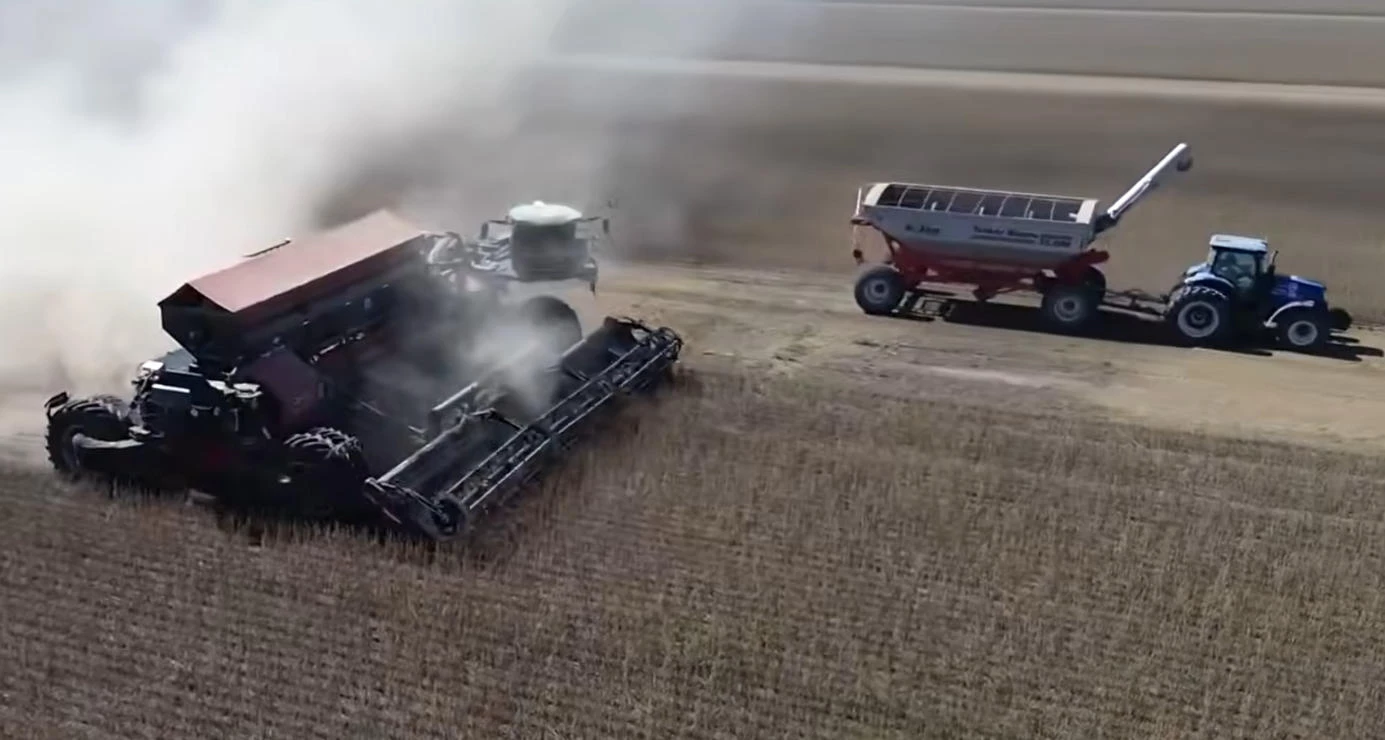
The NEXAT system tractor set a world record in soybean harvesting
In March 2026, the German company NEXAT made a strong statement in the Brazilian fields: its system vehicle with the NEXCO module officially set a new world record for soybean harvesting. At Fazenda Bananal, part of the Agro Basso Group in the state of Bahia, 637.76 tonnes of soybeans were harvested from 158.16 hectares in 8 hours under the official supervision of RankBrasil.
This result is impressive not only because of the total harvested volume. When converted into working indicators, the average productivity reached 79.72 t/h, while diesel consumption was only 7.5 l/ha. At the same time, according to NEXAT, losses were below 0.5%, and the moisture content of the harvested soybeans was 14%. For modern large-scale crop production, this is no longer just an eye-catching piece of news, but a serious signal that the concept of highly productive modular systems truly works in real field conditions.
It is especially notable that the new record exceeded the previous achievement by 32%. The previous record holder was also the Brazilian farmer Ricardo Basso, who had earlier harvested soybeans with a New Holland CR10.90 combine and reached 481.2 tonnes in 8 hours. Now the benchmark has risen by more than 150 tonnes over the same period of time.
Why NEXAT achieved such a result
The secret of this record lies not only in the power of the machine, but above all in the architecture of the system itself. NEXAT is developing the concept of a single base carrier that works with different interchangeable modules for seeding, application, tillage, and harvesting. The company directly positions NEXAT as a complete crop production system in which one machine replaces several traditional units of equipment at once.
The record-breaking harvest used the NEXAT carrier with the NEXCO harvesting module and a MacDon FD250 FlexDraper header. The key technical feature was the transversely mounted rotary threshing system. According to the company, this design makes it possible to feed crop material efficiently into two separation and cleaning systems, reducing the internal bottlenecks that often limit the productivity of conventional combines. The machine also has two straw choppers that distribute crop residue evenly across the full working width of 15.2 m.
In practice, NEXAT demonstrates a different logic of harvesting machinery development. In a conventional combine, engineers constantly have to balance header width, threshing capacity, cleaning performance, and material flow inside the machine. In the modular NEXAT system, these units are arranged differently. That is why the record should be seen not as a random success of a single run, but as proof that a new engineering concept can operate at a level unreachable for previous generations of machinery.
Brazil as a proving ground for next-generation machinery
It is no surprise that the record was set in Brazil. For NEXAT, this country is one of the key markets, and back in 2025 the company officially announced the start of commercial sales in Brazil after testing in local conditions that had continued since 2022. During the launch of its Brazilian operation, the company specifically emphasized the advantages of the system for large farms: lower costs, higher yields, improved soil structure, and reduced compaction.
For Brazilian farming businesses, with their vast acreage, intensive logistics, and strict demands on field operation speed, this approach looks especially logical. If machinery can do more than just show high theoretical potential at exhibitions and can instead set a world record on a real farm, that significantly strengthens confidence in the concept itself.
What this record means for the agricultural sector
The NEXAT world record is not simply news about yet another "biggest machine". In fact, it clearly illustrates the main trend in modern agricultural engineering: manufacturers are now competing not so much in horsepower as in total system efficiency. Today, it is not only tonnes per hour that matter, but also fuel consumption per hectare, loss levels, threshing quality, service speed, and stable performance over large areas. These are exactly the parameters that NEXAT placed at the center of its record attempt.
Another important point is that this record confirmed that the modular approach may be not an exotic idea, but a practical tool for large-scale agribusiness. The company emphasizes that NEXAT is the world’s first holistic crop production system in which all key field operations are performed by one carrier with interchangeable modules. If this philosophy truly takes hold in the market, we may see a major revision of the traditional machinery fleet in large farming operations in the future.
Why such news matters for Ukrainian farmers as well
For the Ukrainian market, the NEXAT record is interesting not only as a striking news story. It shows how quickly agricultural machinery is changing worldwide. Farms that are already closely following new machine formats, precision farming technologies, soil compaction reduction, and productivity growth will gain a real advantage tomorrow in production costs and field operation management.
But there is also another, more practical side to the issue. Even the most innovative machinery cannot operate without quality components, wear parts, and timely service. That is why it is important for Ukrainian farms to have a reliable partner where they can quickly find spare parts for agricultural machinery, consumables, and components for different types of equipment. You can explore the agricultural spare parts catalog at bas.ua.
The NEXAT record in Brazil is a very telling event for the entire agricultural machinery industry. 637.76 tonnes of soybeans in 8 hours, 158.16 hectares covered, an average productivity of nearly 80 t/h, and low fuel consumption all indicate that next-generation modular systems are already moving from the category of bold concepts into the category of real working solutions.
And although for most farms today the focus remains not on record-breaking machines, but on practical questions of reliability and equipment availability, such news clearly shows the direction in which the global agricultural sector is moving. That means it is worth following these developments very closely.
Add a comment
Comments
There are no comments yet. Be the first to comment.
You must be logged in to post a comment
Login