
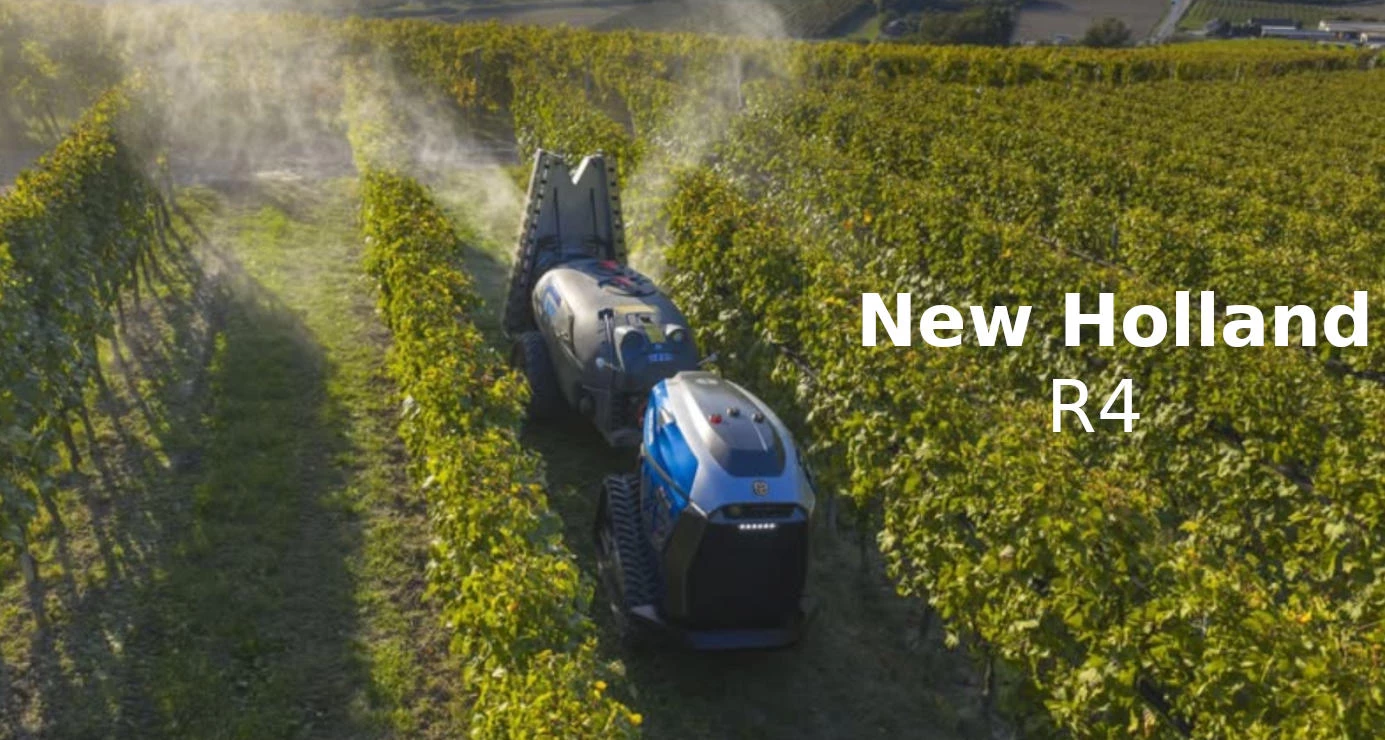
New Holland R4 Autonomous Robot for Orchards and Vineyards - What the Concept Brings to Specialty Crops
In orchards and vineyards, technology succeeds only when it solves real bottlenecks: labor shortages during peak season, the need for consistent timing, and the pressure to protect soil structure while still completing repeated passes on schedule. New Holland’s R4 autonomous robot concept fits directly into that reality - a compact tracked platform designed specifically for inter-row operations in high-value specialty crops.
According to New Holland’s communications, the R4 is built as a robot from the ground up, not as a tractor conversion. That matters because it enables a low profile, optimized weight distribution, and a layout focused on autonomy and safety without an onboard operator.
Why R4 Matters for Specialty Crops
The core challenge in vineyards and orchards is the volume of repetitive, time-critical work: inter-row mowing, light cultivation, and spraying tasks that must be performed precisely and often under narrow weather windows. R4 targets exactly those operations, aiming to shift human effort away from routine driving and toward higher-value work such as quality control, agronomy decisions, logistics, and supervision.
Two R4 Versions - Vineyard vs Orchard Use Cases
New Holland describes the R4 family as two distinct configurations tailored to row spacing, payload needs, and typical farm workflows. Both rely on rubber tracks to improve traction and reduce soil compaction, and both emphasize electric drive concepts intended to simplify the architecture and reduce maintenance complexity.
R4 Electric Power - For Narrow Vineyards
This version is presented as the ultra-compact solution for tight vineyard row spacing. New Holland highlights:
A 40 kWh battery
Very compact dimensions (about 0.7 m wide and up to 1.38 m tall)
Operation in narrow rows roughly in the 1.0 - 1.5 m range
Around 1 ton operating weight
A compact hitch with up to 500 kg lift capacity
The strategic idea here is a low-emission, low-impact platform that can work where standard tractors are either too large or too heavy.
R4 Hybrid Power - For Orchards and Wider Rows
For orchards and wider inter-row spacing, New Holland presents a hybrid approach:
Designed for row spacing from about 1.5 m and above
Roughly 1.2 m wide and about 1400 kg
A 59 hp (44 kW) diesel engine, compatible with HVO, used to power a generator
A fully electric operating option in sensitive areas, supported by two 4 kWh batteries
PTO capability including a mechanical 540 rpm PTO and an electric PTO interface (48V, up to 12 kW)
New Holland also emphasizes workflow logic like “double-pass” coverage, meaning the route planning concept is engineered to avoid missed strips in larger orchard blocks.
How R4 Navigates and Operates Safely
R4 is positioned as an app-managed autonomous machine using a multi-sensor autonomy stack - GPS combined with LiDAR and computer vision cameras. This combination is typical for specialty-crop environments where GNSS alone can struggle due to canopy shading, trellis structures, variable lighting, and irregular terrain. The intent is stable row-following, repeatable coverage, and robust obstacle awareness.
Target Operations - Inter-Row Work and Spraying
New Holland frames R4 as a platform for high-frequency orchard and vineyard tasks:
- Inter-row mowing
- Light tillage or cultivation
- Spraying as one of the most labor-intensive and timing-sensitive operations
For spraying, New Holland points to “smart” electrically controlled functions such as automated management on headlands, switching based on canopy gaps, adjustments based on canopy height, and development direction toward spot spraying driven by disease detection. If these capabilities mature into field-ready solutions, the practical payoff is straightforward - reduced chemical waste and fewer human errors when speed and timing matter most.
Why This Direction Is Relevant for Ukraine
For Ukrainian orchard and vineyard businesses, the same constraints apply: seasonal labor pressure, narrow windows to execute operations, and high cost of mistakes that affect fruit quality or increase disease risk. A compact autonomous platform could theoretically:
- Maintain consistent routine passes according to schedule
- Reduce compaction compared to heavier conventional machines
- Enable quieter or fully electric operation in specific zones and time windows
At the same time, R4 should be viewed as a concept that signals direction. The long-term value is not only the machine itself, but also the autonomy stack, app-based control, and a platform approach that aims to work with standard implements and workflows.
Spare Parts and Reliability - The Non-Negotiable Practical Layer
Whether a machine is driven by an operator or by algorithms, real-world farming still depends on reliability and the ability to recover quickly during the season. That makes spare parts, consumables, hitch components, running gear elements, and implement-related wear parts just as critical as the autonomy features.
Spare parts for agricultural machinery of various brands, as well as components for working units and assemblies, can be selected and ordered at BAS-Agro: https://bas.ua
Add a comment
Comments
There are no comments yet. Be the first to comment.
You must be logged in to post a comment
Login