
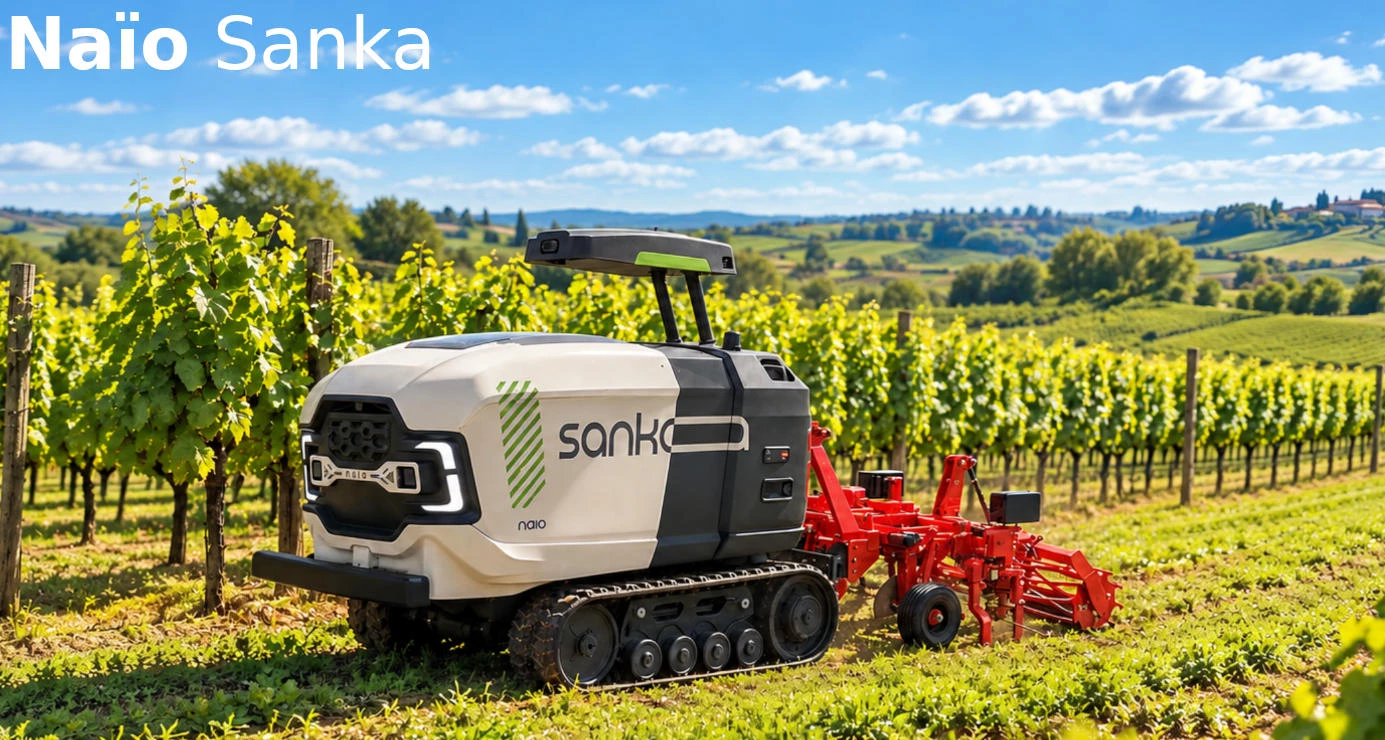
Naïo Develops Sanka Electric Field Robot for Use with Standard Farm Implements
French company Naïo Technologies unveiled its autonomous tracked robot, Sanka, at EIMA 2026 in Bologna. The 2.2-tonne machine features an electric drivetrain, a rear three-point hitch, a power take-off and hydraulic connections. This configuration allows it to use agricultural implements already available on the farm. The manufacturer plans the first deliveries for the second half of 2027.
Sanka is primarily intended for perennial crops. Naïo’s official website lists operations for which implements have already been tested: shredding pruning residues, terminating cover crops, maintaining inter-rows, cultivating soil beneath vines and hilling soil around them. The company offers two versions for these tasks: Compact, measuring 1.3 m wide, and Large, measuring 1.8 m wide.
Hitch, PTO and Hydraulics: How Implements Connect
Sanka is designed as an autonomous carrier for interchangeable implements. Its standard Category II three-point hitch has a lifting capacity of 1,000 kg. The independent power take-off operates at 540 rpm and can transmit up to 23 kW. Equipment connections include two hydraulic spool valves with four quick couplers, along with two Harting electrical connectors.
These different connections broaden the choice of implements. Some rely on the machine’s pulling force, while others require power for rotating mechanisms, hydraulic control or an electrical supply. Each requirement must be assessed separately when matching an implement to the robot. For example, traction power does not determine the power available at the PTO.
Using familiar equipment also preserves established agronomic settings. Working depth, working element positions and shredding settings are still selected according to the crop and field conditions. Autonomous travel frees the operator from steering the machine on every pass, while the farm determines how the operation should be carried out.
Naïo Sanka: Main Specifications
| Parameter | Manufacturer’s specification |
|---|---|
| Machine type | Autonomous tracked implement carrier |
| Drivetrain | Fully electric |
| Weight | 2,200 kg |
| Traction power | 64 kW, approximately 87 hp |
| Operating speed | 0.5–6 km/h |
| Width / track gauge, Compact | 1,300 / 1,000 mm |
| Width / track gauge, Large | 1,800 / 1,500 mm |
| Hitch lifting capacity | 1,000 kg |
| Hitch system | Three-point, Category II |
| Independent PTO | 540 rpm, up to 23 kW |
| Guidance | GNSS RTK |
The specifications are taken from Naïo’s official technical brochure. The width and track gauge figures refer to the machine’s two announced versions.
Balancing the Weight of Rear-Mounted Implements
One of Sanka’s distinctive features is its patented dynamic mass-balancing system. According to Naïo, it adjusts the centre of gravity in real time to account for the rear-mounted implement and its weight. The manufacturer links this design to improved traction, guidance accuracy and load distribution on the ground.
Weight distribution has practical consequences for a compact machine carrying a heavy rear-mounted implement. Raising the implement redistributes the load between the front and rear sections of the ground contact area. Assessing the stability of this combination therefore requires more than the robot’s own weight: the implement’s rearward reach and centre of gravity also matter.
Sanka’s track system was developed with Michelin through a research partnership launched in 2024. Its design draws on the company’s experience with agricultural track systems and lightweight snowmobile tracks. Naïo states that the robot can operate on slopes of up to 30%. This figure describes the gradient as a percentage, rather than an angle of 30 degrees.
Autonomous Travel and Work Area Monitoring
Sanka uses GNSS RTK satellite guidance to navigate the plot. Its safety system includes remote monitoring cameras, human detection cameras, obstacle detection sensors and a virtual work area boundary, or geofence. Operations can be managed through the Naïo App.
These components serve different purposes. Guidance keeps the machine on its planned route, the geofence limits its operating area, and the detection systems monitor the surroundings close to the machine. Preparing the plot and configuring the task correctly become part of organising robotic field operations.
From Field Trials to Deliveries
According to Naïo, Sanka has undergone testing over four agricultural seasons and is entering pre-series production. The project received government funding through France’s France 2030 investment plan. At EIMA 2026, the development received the Technical Evolution award.
For orchard and vineyard businesses, the combination of autonomous travel with a standard hitch and implement power connections is particularly relevant. It allows individual repetitive operations to be considered for automation while retaining suitable existing equipment. The machine should be selected around a specific implement and site, taking into account inter-row width, required PTO power, implement weight and the seasonal workload.
Add a comment
Comments
There are no comments yet. Be the first to comment.
You must be logged in to post a comment
Login