
Cutting Dies and Punches: Precision Machining of Hardened Steel up to 270 mm Thick
The production of dies, punches, industrial knives, and other tooling components requires a high level of precision. These parts often have complex geometries, operate under substantial loads, and are manufactured from tool steels that undergo heat treatment. After hardening, the material acquires the required hardness and wear resistance, but subsequent milling, drilling, or mechanical cutting becomes considerably more difficult.
Bas-Agro LLC provides wire EDM cutting services for dies, punches, and other critical components made from hardened steel. The technical capabilities of our equipment allow us to process workpieces up to 270 mm thick, producing complex profiles without significant mechanical force being applied to the part.
Why hardened steel is difficult to machine using conventional methods
High steel hardness is an advantage during the operation of tooling, but it creates significant challenges during manufacturing. Conventional cutting tools wear quickly, while mechanical machining requires rigid equipment, correctly selected cutting parameters, and specialised tooling.
The task becomes particularly difficult when it is necessary to produce:
- narrow slots;
- sharp internal corners;
- curved working profiles;
- long contours in thick workpieces;
- accurately matched die and punch surfaces;
- non-standard components for stamping or bending tooling.
During conventional machining, substantial mechanical forces act on the workpiece. These forces may cause vibration, local overheating, deformation of thin sections, or deviations from the specified contour. When machining already hardened parts, these risks are combined with accelerated wear of milling cutters, turning tools, and other cutting instruments.
Wire EDM cutting helps overcome many of these limitations.
How wire EDM cutting works
Electrical discharge machining removes material without mechanically cutting the metal. Instead, the material is locally eroded by a series of controlled electrical discharges between the wire electrode and the workpiece.
Because there is no direct forceful contact between the tool and the part, the hardness of the steel does not impose the same restrictions as conventional milling. This makes the technology suitable for cutting hardened, tool, and high-alloy steels, as well as other electrically conductive materials that are difficult to machine mechanically.
The wire moves along a programmed path and gradually forms the required contour. This makes it possible to reproduce complex geometries in accordance with a technical drawing, digital model, or customer specification.
Electrical conductivity is an essential requirement for EDM machining. For this reason, the technology is mainly used for steels, cast irons, cemented carbides, non-ferrous metals, and other conductive materials.
Cutting parts up to 270 mm thick
One of the key technological capabilities of Bas-Agro LLC is the wire EDM cutting of workpieces up to 270 mm thick. This allows us to process not only small plates or thin components, but also large industrial parts.
Machining workpieces of considerable thickness is particularly relevant for the production of:
- dies and punches for press equipment;
- tooling for press brakes and bending machines;
- blanking and forming dies;
- industrial knives;
- gauges and templates;
- profiled plates;
- repair and production tooling components;
- non-standard parts for machines and production lines.
Cutting thick workpieces requires correct machining parameters, stable wire guidance, and precise programming of the cutting path. Geometry control throughout the entire height of the part is especially important, because the profile must remain within the specified dimensions on both the upper and lower surfaces of the workpiece.
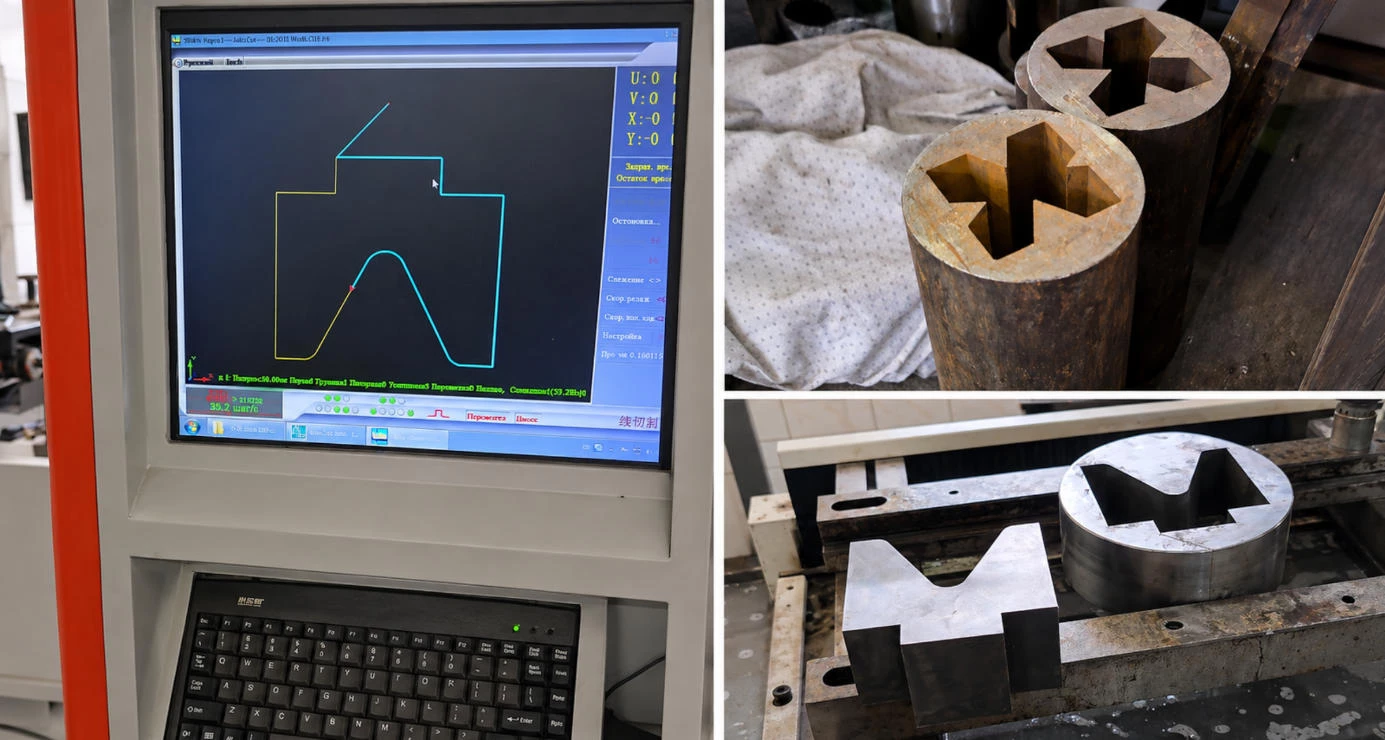
Manufacturing a die for a press brake
A representative example of wire EDM application is the production of a die for a press brake. In this case, the workpiece was 72 mm thick, while the working contour had a complex profile geometry.
The die is one of the key elements of bending tooling. Together with the punch, it directly forms the profile of the metal workpiece. The accuracy of its working surfaces therefore affects:
- the accuracy of the resulting bend angle;
- repeatability in serial production;
- uniform deformation of the metal;
- the absence of unwanted marks and surface damage;
- the service life of the tooling;
- the operational stability of the press brake.
During wire EDM cutting, the die profile is formed along a programmed path. The technology makes it possible to machine already hardened steel without creating substantial mechanical loads on the workpiece.
An example of this type of metalworking and the completed die can be viewed in the video: https://youtube.com/shorts/abkf5o6vKL4
Advantages of wire EDM for die and punch manufacturing
Wire EDM is particularly effective when high material hardness must be combined with complex part geometry.
Accurate profile formation
The movement of the wire is controlled by a CNC program, allowing the contour to be reproduced according to specified coordinates. This is especially important for matched components, including die-and-punch sets, where deviation in one element affects the performance of the entire tooling system.
Machining after hardening
A part can first undergo heat treatment and then have its working profile formed or corrected. This sequence makes it possible to account for potential dimensional changes that may occur during hardening.
No significant mechanical load
The wire does not cut the metal mechanically, so substantial cutting forces are not transmitted to the part. This reduces the risk of workpiece deformation and makes it possible to machine complex sections, thin bridges, and profiled elements.
Clean and accurate cut surface
Correctly selected machining parameters make it possible to achieve an even surface with controlled quality. Depending on the requirements for the part, a main cutting pass and additional finishing passes may be used.
In many cases, wire EDM significantly reduces the amount of subsequent grinding, milling, or manual finishing required.
Production of one-off and non-standard parts
The technology is suitable not only for serial production. Wire EDM is also a practical solution for producing a single punch, a replacement die, a custom industrial knife, or a part that is no longer supplied by the original equipment manufacturer.
Not only new tooling, but also industrial part repair
Wire EDM can be used both for manufacturing new dies and punches and as part of repair operations. For example, the technology can be used to correct a profile, produce a new slot, remove a worn section, or manufacture a replacement based on a damaged sample.
This is especially important for companies operating imported equipment, older machinery, or production lines for which original spare parts and tooling are difficult to obtain.
Manufacturing a part from a drawing or sample often allows equipment operation to be restored without a long wait for factory-made tooling.
What parts can be ordered
Bas-Agro LLC provides wire EDM cutting for:
- dies;
- punches;
- industrial knives;
- blanking and forming die components;
- profiled plates;
- gauges;
- templates;
- parts with internal and external contours;
- custom repair tooling;
- other components made from hardened steel and electrically conductive materials.
We work from technical drawings, specifications, and customer-provided samples. Before production begins, we assess the material, workpiece thickness, contour geometry, required accuracy, and surface quality requirements.
Order wire EDM cutting services in Cherkasy
Bas-Agro LLC accepts orders for cutting dies, punches, knives, and other industrial parts. The service is suitable for machine-building companies, repair departments, metal structure manufacturers, agricultural enterprises, and companies operating press, stamping, or bending equipment.
The maximum wire EDM cutting thickness is up to 270 mm.
For a preliminary assessment, customers are advised to provide a technical drawing, 3D model, sketch, or photographs of the part together with its main dimensions and material specification.
Enquiries and orders: +38 (067) 470-35-44
Website: https://bas.ua/
#WireEDMCutting
#DiesAndPunches
#MetalworkingCherkasy
#BasAgro
Add a comment
Comments
There are no comments yet. Be the first to comment.
You must be logged in to post a comment
Login