
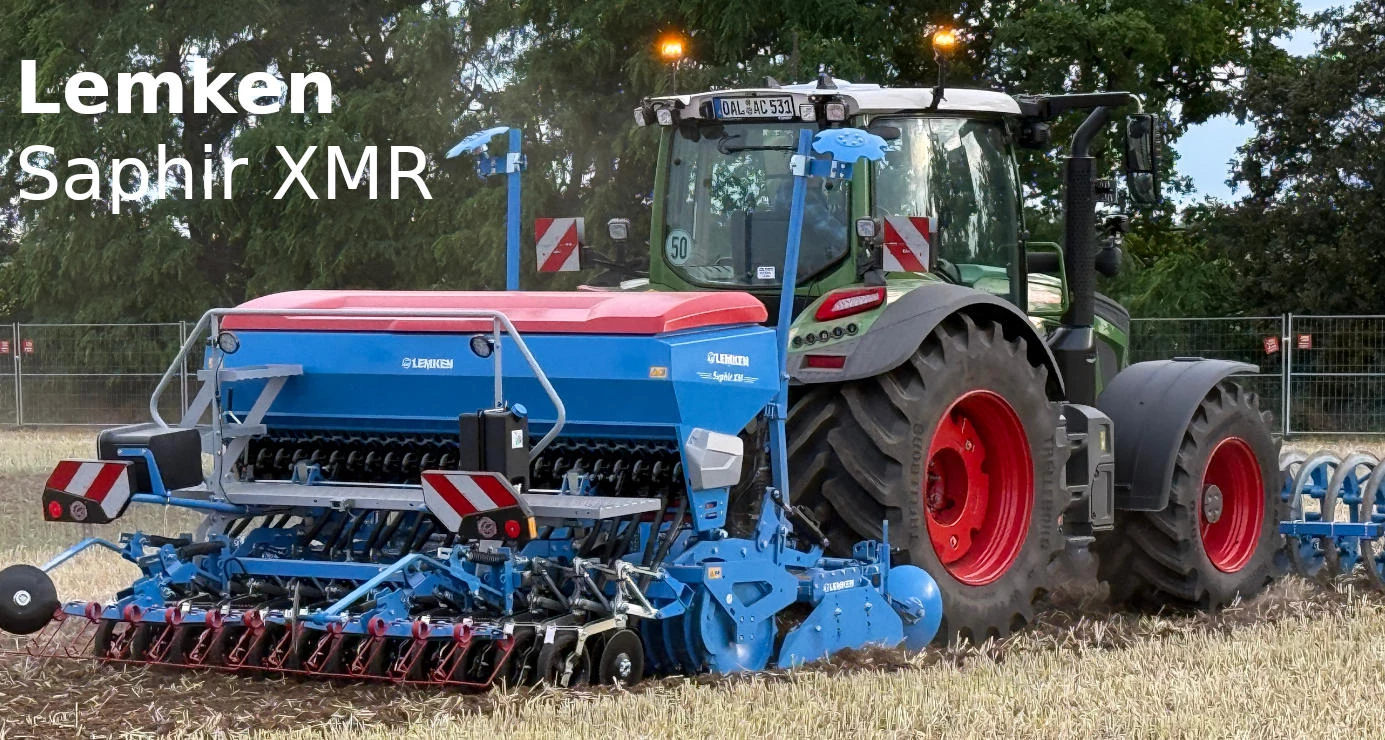
Lemken Saphir XMR Seed Drill Review: New Metering System and Hopper Capacity up to 1,500 Litres
Lemken has introduced the Saphir XMR mechanical grain seed drill as the successor to the Saphir 10. The new machine retains the compact three-metre design of the previous series but features a completely redesigned metering system, a wider choice of hoppers, electric half-width control and deeper integration with the iQblue digital platform.
The Saphir XMR is designed for farms that require a versatile seed drill combination capable of working with different crops within limited agronomic time windows. Its working width is 3 m, while two row-spacing configurations are available: 12.5 or 15 cm. Depending on the selected version, the machine is equipped with either 24 or 20 double-disc coulters.
A Mechanical Seed Drill with Electric Drive
The term “mechanical seed drill” may appear contradictory because the machine uses an electric drive. However, the designation refers to the seed-transport principle: after metering, the seed moves through the seed tubes to the coulters under gravity, without a pneumatic delivery system or fan.
The electric motors in the Saphir XMR drive the metering shafts and regulate the application rate. This design combines the relative simplicity of a mechanical seed drill with the capabilities of electronic control. The standard specification includes a dual-sided electric drive with a half-width shut-off function. On headlands and irregularly shaped field sections, this helps reduce overlaps and unnecessary seed consumption.
The electric drive also provides the technical basis for variable-rate seeding. With the appropriate equipment, the application rate can be changed while driving according to an application map, soil characteristics or the planned crop density in individual areas of the field.
Completely Redesigned Metering System
One of the main structural changes in the Saphir XMR is its new metering equipment. Each metering wheel can be removed individually without tools. This reduces the time required to switch between crops and simplifies cleaning after the work has been completed.
The machine uses two-component metering wheels adapted to different seed sizes. The main section of the wheel is intended for the consistent delivery of larger seeds, while the side cam section meters small-seeded crops such as oilseed rape. Individual wheel sections can be activated or deactivated according to the properties of the seed material.
The metering housings are made from wear-resistant polymer and are mounted directly on the hopper. Slides and bottom flaps can be adjusted without tools, while the accessible design of the components is intended to simplify the removal of dust, small seeds and seed-treatment residues.
According to the technical documentation, the application-rate range extends from 1.5 kg/ha at a forward speed of 3 km/h to 240 kg/ha at 10 km/h. These limits should be considered together with the specified speeds because the actual metering capacity depends on forward speed, seed properties and the installed metering wheels.
Double-Disc Coulters with Independent Adjustment
Uniform emergence depends not only on the metering system but also on the coulter’s ability to maintain the specified working depth. The Saphir XMR uses a proven design consisting of a parallelogram suspension, a double-disc coulter and a press wheel.
The parallelogram allows the coulter to move vertically as it follows the field surface, while the press wheel controls depth and consolidates the soil around the seed row. This configuration is particularly important on fields with uneven seedbed density, where a rigidly mounted coulter could penetrate too deeply or rise towards the surface.
Pressure on each coulter can be adjusted up to 45 kg. Seeding depth and coulter pressure are set independently: depth is adjusted centrally using a crank and threaded spindle, while downforce is controlled by a separate mechanism. This allows the machine to be adapted to light sandy, medium and denser soils without unintentionally changing both settings at the same time.
Maintenance-free bearings are installed inside the coulter assembly. Polymer scrapers clean the inner surfaces of the discs, while scrapers with carbide working elements are available for more demanding conditions. The latter option may be appropriate when operating in wet soils or conditions where soil adhesion is a problem.
Row Spacing of 12.5 or 15 cm
Lemken offers the Saphir XMR with two row-spacing configurations:
12.5 cm with 24 coulters;
15 cm with 20 coulters.
Narrower row spacing provides a more even distribution of plants across the field area, but it also increases the number of coulter units and requires greater attention to the passage of crop residues. The 15 cm configuration leaves more clearance between coulters and may be more suitable in difficult conditions or where substantial quantities of residue remain on the soil surface.
The choice of configuration will depend not only on the crop but also on the soil-preparation method, the design of the seed drill combination and the tramline system used on the farm.
Three Hopper-Capacity Options
The Saphir XMR is available with main hoppers offering capacities of 900, 1,200 and 1,500 litres. The large filling opening measures 715 × 2,675 mm, allowing the use of big bags or a front loader. The hopper is closed by a rigid, waterproof polymer cover, while an upper screen prevents foreign objects from reaching the metering units.
Increasing hopper capacity to 1,500 litres is particularly useful when sowing cereals at high weight-based application rates. Fewer filling stops reduce non-productive time, although the larger quantity of seed also increases the total weight of the machine. The tractor’s lifting capacity, permitted axle loads and the weight of the soil-working section should therefore be considered when selecting the specification.
As an option, Lemken offers a 200-litre MultiHub additional hopper. It is intended for microgranules and the seeds of cover or catch crops. The material can be delivered towards the coulter using a Double-Shot system or distributed across the surface through deflector plates.
Operation as Part of a Seed Drill Combination
The Saphir XMR can be combined with Lemken Zirkon EMR and Zirkon XMR rotary harrows. In this configuration, active seedbed preparation, soil reconsolidation and sowing are completed in a single pass.
For the new seed drill, Lemken is offering the 600-series roller with a diameter of 600 mm for the first time. The larger diameter is intended to reduce rolling resistance and improve reconsolidation, particularly on lighter soils. A larger roller is also less likely to push soil ahead of itself than a unit with a smaller diameter.
Hydraulic cylinders lift the seed drill and simultaneously pivot it forwards. Moving the centre of gravity closer to the tractor reduces the load on the rear axle and improves weight distribution during transport. This kinematic arrangement is particularly important when the combination includes a large hopper and a heavy rotary harrow.
iQblue Drill and ISOBUS Control
The Saphir XMR can operate with ISOBUS-compatible terminals, including Lemken CCI terminals. The iQblue drill interface combines application-rate settings, section control, tramline creation, calibration and monitoring of the machine’s main functions.
Depending on the equipment level, the operator can carry out the calibration test in three ways: through the terminal in the tractor cab, using an external control unit on the seed drill or via the iQblue Go application. The application also supports the emptying of residual seed.
Available software functions include automatic section control, variable-rate seeding, automatic tramline creation, calibration memory and guidance-line planning. Some of these capabilities belong to higher equipment levels, so the actual functionality of a specific machine should be confirmed when ordering.
Lemken Saphir XMR Technical Specifications
The parameters below are based on the official model information and the technical section of the current Saphir XMR brochure.
| Parameter | Lemken Saphir XMR/300 |
|---|---|
| Machine type | Mechanical grain seed drill with electric metering drive |
| Working width | 3,000 mm |
| Transport width | 3,000 mm |
| Length | 2,120–3,250 mm, depending on roller |
| Empty machine weight | 1,000–1,350 kg, depending on equipment |
| Main hopper capacity | 900 / 1,200 / 1,500 l |
| Filling-opening dimensions | 715 × 2,675 mm |
| Filling height | 670–907 mm |
| Application-rate range | From 1.5 kg/ha at 3 km/h to 240 kg/ha at 10 km/h |
| Row spacing | 12.5 or 15 cm |
| Number of coulters | 24 or 20 |
| Coulter type | Parallelogram-mounted double-disc coulter with press wheel |
| Maximum coulter pressure | 45 kg |
| Metering drive | Dual-sided electric drive |
| Section shut-off | Electronic shut-off of half the working width |
| Additional MultiHub hopper | 200 l, optional |
| Compatible rotary harrows | Lemken Zirkon EMR and Zirkon XMR |
| Available roller | 600 series, 600 mm diameter |
| Control system | ISOBUS, iQblue drill |
| Calibration | Terminal, external control unit or application, depending on equipment |
Weight, length, filling height and the range of digital functions vary depending on the roller and selected equipment.
Optional Equipment
The Saphir XMR equipment list includes the Seed Harrow S, a single-row harrow, tramline markers and a second seed-level sensor.
The Seed Harrow S levels the surface and closes the seed furrows. Its height and pressure can be adjusted without tools, while hydraulic lifting can be used during transport or when operating on selected field sections.
The additional level sensor monitors the seed supply from the opposite side of the hopper. Its installation height can be adjusted according to the crop and the bulk density of the material. Pre-emergence tramline markers are synchronised with the control system and leave a visible track for subsequent passes by a sprayer or fertiliser spreader.
Practical Assessment of the Design
The Lemken Saphir XMR is not simply an enlarged version of the Saphir 10. The manufacturer has redesigned the components that directly affect preparation time, metering accuracy and the machine’s ability to adapt to different crops.
For farms, the most important changes may include the individual tool-free removal of metering wheels, electric half-width shut-off, hopper options of up to 1,500 litres and independent adjustment of seeding depth and coulter pressure. At the same time, the 3 m working width means that the model is primarily intended for compact combined implements rather than maximum field capacity through a wider working width.
The design may be particularly suitable for farms that sow several crops during the season, frequently change seed material or operate on irregularly shaped fields. Under such conditions, rapid metering-system adjustment and half-width shut-off may be just as important as the nominal working width.
Spare Parts for Seed Drills
Even a precise seed drill requires regular inspection of its coulters, discs, bearings, scrapers, bushings, sprockets, drive components and other parts that either operate in contact with the soil or transmit mechanical loads.
Spare parts for seed drills manufactured by Lemken and other agricultural machinery brands can be purchased from the Bas-Agro LLC website. The catalogue includes components for the repair and seasonal maintenance of sowing equipment. The required part can be selected by catalogue number, dimensions, drawing or physical sample.
The Lemken Saphir XMR develops the concept of a compact mechanical seed drill by adding electronic metering, section control and digital management tools. The machine has a working width of 3 m, up to 24 coulters, coulter pressure of up to 45 kg and a hopper capacity of up to 1,500 litres.
The main feature of the new generation is not a single record-setting specification but a comprehensive reduction in non-productive time through rapid metering-wheel replacement, convenient calibration, fewer seed-filling stops and easier switching between crops. For farms operating within tight sowing windows and requiring a flexible three-metre seed drill combination, the Saphir XMR may represent a practical development of the previous Saphir 10.
Add a comment
Comments
There are no comments yet. Be the first to comment.
You must be logged in to post a comment
Login