
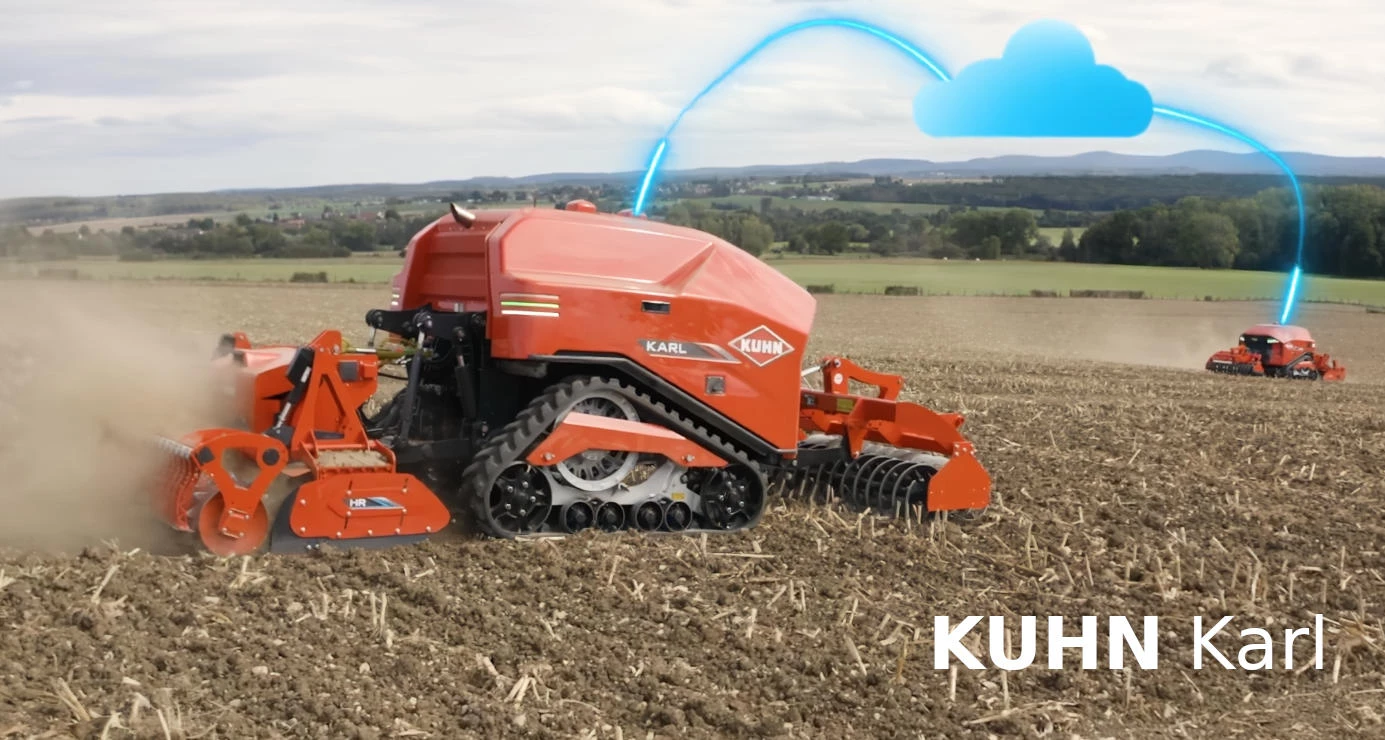
KUHN KARL Autonomous Tractor: When a “Smart Implement” Effectively Controls the Power Unit
Against the backdrop of a growing shortage of skilled machine operators and rising requirements for field-operation precision, manufacturers are increasingly moving from the idea of an “autonomous tractor” toward a broader concept: an “autonomous farming system.” This is exactly how KARL is presented—KUHN’s autonomous solution in which the core value lies not only in the power unit itself, but also in a mounted or trailed implement equipped with its own sensors and decision logic that adapts work to real field conditions. Industry publications have highlighted KARL as an autonomy concept for medium and large farms, with a particular focus on its “smart implement.”
What KARL Is: Not Just a “Robot Tractor,” but an Autonomous Field Tandem
Based on public descriptions, KARL is designed as a self-propelled tracked power module that executes a “mission” (an operation) in the field according to a defined scenario and interacts with the implement as a primary source of agronomic and process data. Ukrainian coverage emphasizes that the machine works with implements, receives data from them, and adjusts operating parameters to match soil conditions, moisture, and crop residues—meaning part of the “intelligence” is intentionally placed into the implement.
This architecture matters in practical agronomy: autonomy in the field is not only about GNSS line-following, but also about consistently delivering the required agronomic quality (depth control, cultivation intensity, stable material flow, etc.) in conditions that can change significantly within a single pass.
KARL’s Technical Foundation: Diesel-Electric Drive, Tracks, and a High-Voltage Electrical System
Reports associated with KARL’s public demonstrations at Agritechnica describe it as a diesel-electric tracked carrier: an internal combustion engine generates electricity, which powers both the drive system and the implement’s working functions. Published materials mention a 175 hp Volvo engine in a hybrid architecture and refer to a high-voltage electrical system—described at the 700 V level.
It is also noted that KARL does not rely on a conventional PTO (power take-off). The concept emphasizes electric drive for both propulsion and tool actuation. The rationale, as described in the coverage, is that electric actuation is easier to regulate precisely by speed and load, and it enables rapid response to a blockage event (for example, when a stone jams a working body)—a critical requirement for autonomous operation without a constant operator in the vicinity.
The “Smart Implement”: Sensors, Diagnostics, and Automatic Adaptation to Field Conditions
KARL’s defining feature is that the implement is not treated as a passive attachment, but as an active part of the control loop. Industry reporting explicitly describes an implement intelligence layer capable of detecting errors, blockages, and failures and sending warnings to the autonomous carrier. It has also been stated that KUHN tested a specific 2.5 m implement while developing and validating the algorithms, accumulating substantial operating time. This point is significant: autonomy is being exercised in real operational cycles, including typical field risks and logistics between fields.
Ukrainian publications additionally highlight automatic data acquisition from the implement and parameter adjustment based on soil moisture, residue levels, and varying field conditions—effectively implementing a closed loop: “implement → data → decision → action.”
Practical Specifications That Have Been Publicly Reported
Below is a consolidated list of parameters cited directly in published coverage (without assumptions or “typical for the class” extrapolations).
| Parameter | What public sources have reported |
|---|---|
| Engine power | 175 hp (Volvo engine mentioned) |
| Drive/undercarriage | Tracks (rubber tracks), diesel-electric architecture |
| High-voltage system | 700 V system referenced for powering drive and rear equipment |
| PTO | PTO not used; emphasis on electric actuation of tools |
| Weight | 8.5 t |
| Hitch / lifting capacity | Rear hitch 5.0 t; front hitch 3.5 t |
| Working speeds | 3–15 km/h |
| Overall width | 2.5 m |
| Track width options | 34 cm or 45 cm |
| Fuel autonomy (indicative) | Tank reported to support roughly ~8 hours of work |
| Logistics | Moves between fields by driving onto a trailer |
| Implement intelligence | Detects errors/blockages/failures and sends warnings to the carrier |
Why It’s a System, Not a Stand-Alone Autonomous Tractor
In conventional operation, the tractor pulls the implement while the operator continuously compensates for changing conditions: lifting or lowering, reducing speed, stopping for stones, clearing blockages, and managing quality. In an autonomous paradigm, the system has to do all of that reliably. And the implement is typically the first component to “feel” the process—detecting clogging, load spikes, unstable depth, or other deviations. This is why transferring part of the sensing and decision logic into the “smart implement” is a pragmatic route to robust autonomy, rather than focusing only on precise RTK navigation.
A Simple Productivity Illustration (to Understand the Scale)
If the demonstrated configuration uses a 2.5 m implement and operates, for example, at 10 km/h (within the published 3–15 km/h range), the theoretical field capacity can be estimated by:
P(ha/h) = (B(m) × V(km/h)) / 10
So P = (2.5 × 10) / 10 = 2.5 ha/h (theoretical). In real operation, output will be lower due to headland turns, overlap, stoppages, and quality control.
Development Context: Agritechnica and an Innovation Track
The fact that KARL appears in Agritechnica-linked innovation coverage (2023 archive context) is an additional indication that the project has been treated as an engineering-driven development direction rather than a one-off demonstration.
Conclusion
KARL is a strong example of how autonomy in agriculture is evolving from a “cab-less machine” into a structured system: “power module + smart implement + mission management.” A diesel-electric architecture, electrically driven tools without a conventional PTO, implement-level sensing and diagnostics, and published figures for hitch capacity, speeds, and weight collectively form a foundation for credible autonomous field work—especially in tillage and adjacent operations where repeatability and fast reactions to tool blockage are essential.
Where to Buy Spare Parts for Agricultural Machinery
Spare parts for a wide range of agricultural equipment (seed drills, tillage tools, sprayers, combines, and more) can be purchased from BAS-Agro LLC (ТОВ Бас-Агро) via the online catalog: https://bas.ua
Add a comment
Comments
There are no comments yet. Be the first to comment.
You must be logged in to post a comment
Login