
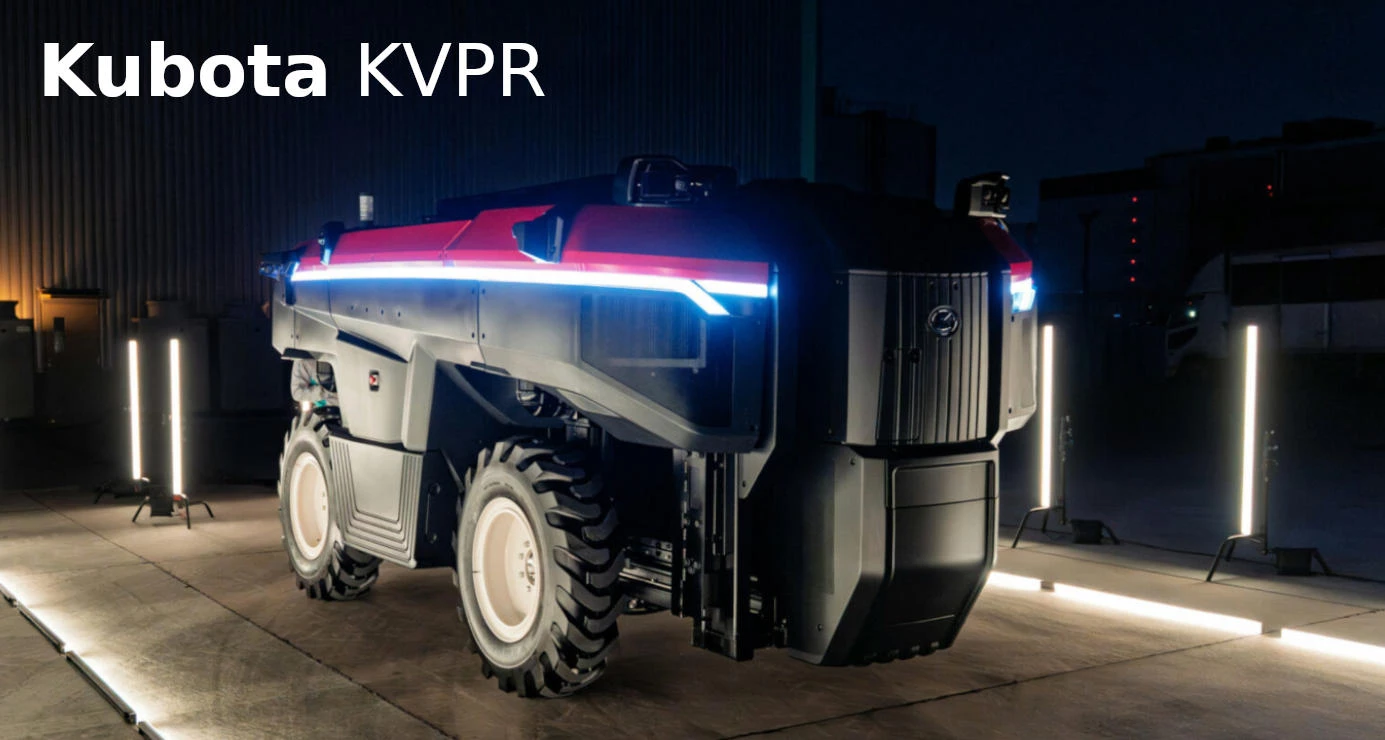
Kubota KVPR - Transformer Platform for Multi-Season Work: What Was Shown at CES 2026 and Why It Matters for Farmers
At CES 2026 in Las Vegas (January 6 - 9, 2026), Kubota emphasized technologies for specialty crops - vineyards, orchards, vegetables, nuts, and other high-value segments where labor shortages and the need for precise inter-row operations are especially acute. Among the company’s key exhibits was the KVPR (Kubota Versatile Platform Robot) concept - an autonomous transformer platform designed to change its geometry and operate with different interchangeable modules/attachments.
What KVPR Is, in Simple Terms
KVPR (Kubota Versatile Platform Robot) is a conceptual autonomous platform robot built around the idea of “one base - many roles.” Instead of maintaining separate specialized machines for different seasons and tasks, Kubota proposes a universal platform that:
- adjusts width and height (adapting to row spacing, beds/ridges, and crop growth stages);
- uses interchangeable modular tools/attachments for different operations;
- enables automatic attachment changes, along with “body transformation” of the platform for a specific task.
Kubota also notes that at CES 2026 all major exhibits were concept models, meaning the display illustrates a development direction rather than a ready-to-order production machine with a published specification sheet and pricing.
Key “Transformer” Capabilities Confirmed by Kubota
Based on Kubota’s official descriptions and CES coverage, the following KVPR capabilities are explicitly stated:
Variable platform geometry
Adjusting height and width is critical for work in orchards/vineyards, narrow operational lanes, and different growth stages.
Interchangeable attachments
KVPR is designed as a platform that can take different working tools for various tasks and seasons.
Automatic attachment changes and body transformation
Kubota directly highlights “automatic attachment changes” and “body transformation” as core demonstrated features.
High maneuverability: turning plus lateral/diagonal movement
CES materials emphasize KVPR’s ability to turn and also move laterally (sideways) and diagonally, which is particularly useful in tight inter-row environments and headlands.
Stated use cases: agriculture plus civil engineering
Kubota positions KVPR as a concept for agriculture and civil engineering/construction applications.
One more notable point: Kubota states KVPR was not only shown at CES - it had also been displayed at Expo 2025 Osaka, Kansai (Japan).
What We Know About Specs - and What Has Not Been Disclosed Yet
For KVPR at CES 2026, the open materials do not provide (at least publicly) key parameters such as:
- powertrain type (electric/hybrid, etc.) and battery capacity;
- payload/traction figures;
- operating speeds and runtime autonomy;
- commercialization timelines.
That is typical for a concept, but it also means farmers should treat KVPR as a technology roadmap signal, not as a machine that can be ordered immediately.
Why a “Platform” Concept Matters More Than Another Single-Purpose Robot
The challenge in specialty crops is that the season is divided into many short operational windows: mechanical weeding/cultivation, inter-row work, scouting/monitoring, localized treatments, and more. Machinery fleets often become oversized to cover peak windows.
KVPR’s concept aims to reduce this “zoo” of equipment through modularity.
Below is a practical comparison of the transformer-platform approach versus a traditional task-specific fleet (logic without tying it to specific numbers):
| Criteria | KVPR (transformer platform, concept) | Traditional task-specific fleet |
|---|---|---|
| Season coverage | 1 base + multiple modules | several machines/implements |
| Changeover | designed to be automated (attachment change) | manual/semi-manual, more downtime |
| Narrow-row suitability | width/height adjustment to conditions | limited by one machine’s geometry |
| Maneuvering | stated: turning + lateral/diagonal travel | typically classic kinematics only |
| Investment logic | “capital in the platform” + modules | “capital in multiple machines” |
Where This Logic Fits Ukrainian Farms (Even Before a Production Release)
Even if KVPR remains a concept for now, the broader “platform + modules + autonomy” logic is most applicable to:
- orchards and vineyards, where size, precise positioning, and maneuverability are critical;
- vegetable production, with diverse bed/track systems and frequent operation changes;
- farms facing operator shortages and looking to automate repetitive field passes.
It is also worth noting that Kubota showcased a more “near-term” autonomy direction at CES alongside KVPR - an Autonomous M5 Narrow Tractor (for specialty crops, in collaboration with Agtonomy) and a Kubota Digital Twin concept for field modeling and sensor-driven recommendations.
Practical Value for Service and Parts
Autonomy and modularity always raise requirements for technical readiness: component accuracy, running gear condition, tool quality, timely repairs, and correct parts selection directly affect reliable performance during the season.
If you need spare parts for agricultural machinery of different brands, you can purchase them from BAS-Agro LLC (Cherkasy, Ukraine) via https://bas.ua/ - with support in selecting parts that match your equipment and operational needs.
Add a comment
Comments
There are no comments yet. Be the first to comment.
You must be logged in to post a comment
Login