
Contactless Axle Steering: How KRONE Is Changing Trailer Maneuverability in Forage Harvesting
In modern agriculture, the demands placed on transport equipment are growing just as quickly as those placed on tractors, combines, and self-propelled machines. If not long ago a trailer or loading wagon was expected primarily to offer large capacity and a durable running gear, today the focus is increasingly shifting toward maneuverability, safety, high-speed stability, and precise movement in difficult conditions. That is exactly why the topic of contactless axle steering is attracting more and more attention.
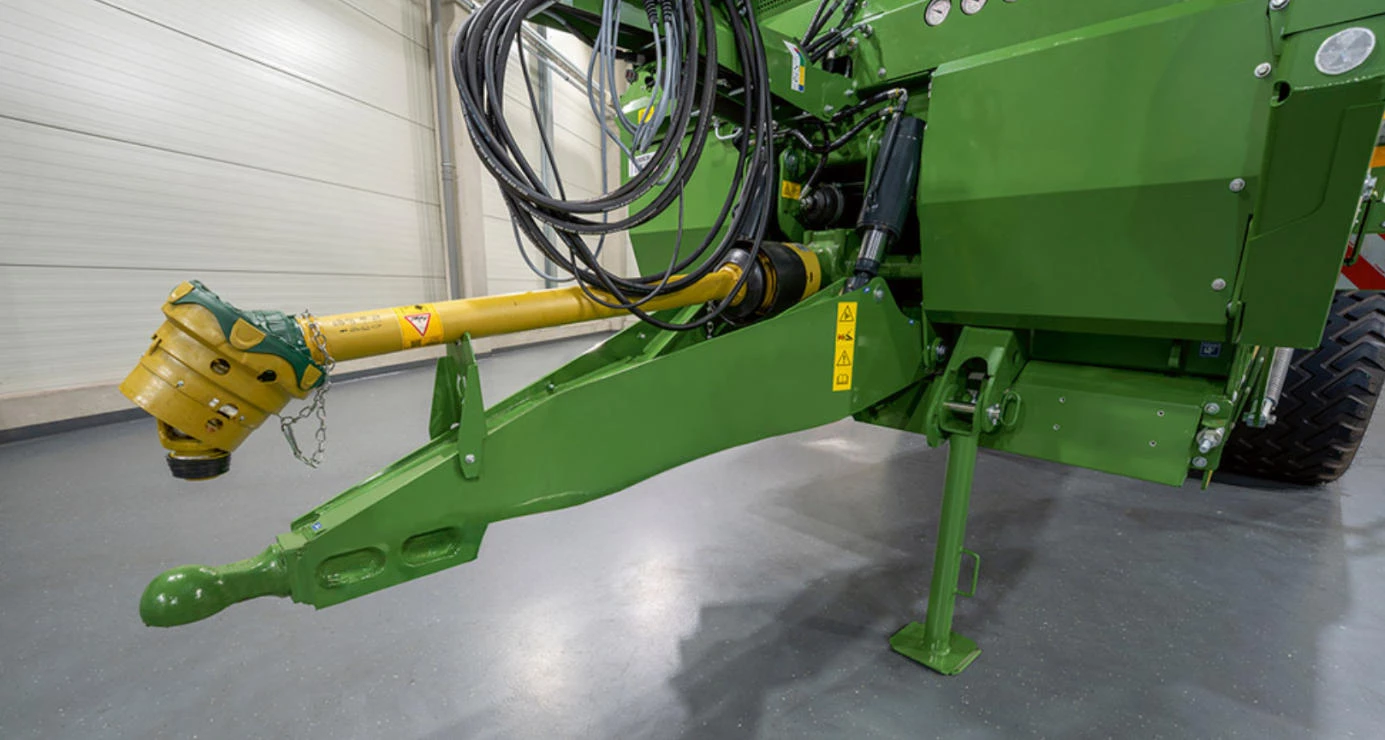
KRONE is actively developing this direction. According to the manufacturer’s official materials, its contactless electronic axle steering system had already been used on RX and ZX forage wagons and was later introduced for TX transport trailers as well. At the core of this concept is the rejection of traditional mechanical linkage elements, opening up new possibilities for steering control, a reduced turning radius, and greater convenience when working in the field and on silage sites.
What Contactless Axle Steering Means
In a conventional steered-axle setup, the system often depends on a mechanical connection between the tractor and the trailer. This may include rods, articulated linkage components, or other parts that physically transfer information about the vehicle’s trajectory. This approach has been proven in practice for many years, but it also has obvious limitations: more complicated coupling, more wear points, mechanical restrictions on large steering angles, and a greater risk of damage during tight maneuvers.
Contactless axle steering works differently. Instead of relying on a mechanical linkage, the system uses sensors and electronics that determine the machine’s movement parameters in real time and transmit commands to the axle steering actuators. In KRONE’s case, a gyroscope mounted on the first axle plays a key role. It detects when the machine enters a turn and helps the system calculate the optimal steering angle based on travel speed and direction - both forward and in reverse.
In practical terms, this means a transition from mechanical kinematics to sensor-based steering. For the farmer, this is not just “modern electronics,” but a set of real operational advantages: fewer limitations during maneuvering, higher steering precision, and better adaptation of the machine to actual field conditions.
The Main Advantage of This System
The most obvious benefit of contactless steering is improved maneuverability. According to KRONE, the absence of mechanical linkage elements allows for a greater steering angle at the axle. This becomes especially important wherever the transport unit operates in confined spaces: on narrow access roads, near silage pits, in tight turns at the edge of the field, or when entering storage areas.
Another major advantage is the lower risk of contact or interference between the trailer running gear and the tractor’s rear wheels during sharp maneuvers. KRONE’s official materials specifically note that this type of system helps avoid possible damage caused by contact with the tractor tire, because no steering rod prevents full use of the steering angle within the tractor-trailer combination.
Ease of operation should also be highlighted. During coupling, there is no longer any need for a special mechanical steering connection between the tractor and the machine. For the user, this means easier hitching, faster preparation for work, and fewer unnecessary operations during the season, when every minute matters. For the TX system, KRONE emphasizes that only a Load Sensing connection to the tractor is required.
How It Works in Real Field Conditions
It is in actual field use that contactless steering proves to be more than just a technological novelty - it becomes a tool for improving efficiency. When working on slopes or near the edge of a silage pit, it is important that the trailer does not drift sideways and that the operator can hold the desired line more accurately. KRONE states that the electrohydraulic steering system allows automatic counter-steering on slopes and can also guide the machine away from the edge of a silage trench. In tandem configurations, the rear wheels are usually steered, while in tridem setups the first and last axles are steered. This increases directional control and reduces unwanted lateral movement.
For forage harvesting, this has practical value in several ways at once. First, it becomes easier to work on narrow approaches to bunkers and trenches. Second, turf damage is reduced and tire wear is lowered when cornering. Third, the machine behaves more steadily in transport mode, which is a matter not only of productivity but also of safety. On the RX product page, the manufacturer separately emphasizes that contactless steering makes cornering easier, protects the grass cover, and reduces tire wear.
Road Safety: Why Electronics Make Sense Here
Electronic systems in heavy trailed equipment are sometimes met with skepticism. But in the case of steered axles, electronics actually help make movement more predictable. KRONE reports that as speed increases, steering intensity is automatically reduced. On the TX, the maximum steering angle is gradually limited, and the system is locked at speeds above 30 km/h. For the ZX, KRONE also describes a logic in which steering intensity is progressively reduced until it reaches zero at higher speeds, improving directional stability and smooth road behavior.
This is a very important point. In the field, machinery needs maximum maneuverability, but on the road the priorities are different - stability, predictable reactions, and safe transport behavior. That is why automatic steering adaptation to speed appears to be a logical and technically well-balanced solution.
In addition, the manufacturer notes that the operator can manually override or block the system when necessary. This means the person is not removed from the process, but instead receives a tool that assists without taking away control of the machine.
Why KRONE Is Betting on This Concept
The official materials make it clear that KRONE does not view contactless steering as a narrow option for a few individual models. On the contrary, the solution is being gradually scaled across different product lines. First, the concept was introduced on RX and ZX forage wagons, and later it was expanded to TX transport trailers. This points to a strategic approach: the company sees the future of transport equipment in more intelligent, sensor-controlled systems that combine maneuverability, adaptability, and simpler operation.
It is also telling that on the TX, the new steering system is paired with a weighing system. This combination looks highly modern: one subsystem is responsible for precise movement and maneuverability, while the other handles load control and logistics. As a result, the trailer becomes not just a transport body, but a smarter working tool that can better fit into the short and intense windows of forage harvesting.
What This Means for the Ukrainian Agricultural Sector
For Ukrainian farms, the topic of contactless axle steering is interesting not only as an example of technical progress in Western Europe. It is directly linked to practical challenges that are also familiar to local farmers: working within tight time windows, dealing with difficult seasonal logistics, and combining high productivity with soil protection, tire preservation, and overall machine longevity.
The larger the machine and the higher its transport speed, the more important proper chassis and steered-axle performance become. If a trailer follows a turn more accurately, shifts less on slopes, and does not require extra mechanical components to connect the steering system, this directly affects convenience, service life, and productivity.
This technology looks especially promising for large forage operations, dairy farms, and contractors, where transport distances, silage work, and intensive use of trailed equipment create increased loads on the chassis and steering components.
Machinery Is Becoming More Complex - and Demands on Parts Are Only Growing
As agricultural machinery incorporates more electronics, sensors, automation systems, and complex chassis assemblies, the requirements for the quality of components and spare parts also continue to rise. And this concerns not only original high-tech systems, but also the basic mechanical parts on which the reliability of the whole machine depends: shafts, bushings, brackets, suspension elements, hub assemblies, towing mechanism parts, and many other components.
That is why it is important for Ukrainian farmers to have a reliable partner from whom they can purchase spare parts for agricultural machinery of various brands, as well as order the production of individual parts based on a drawing or sample. BAS-Agro LLC from Cherkasy works precisely in this area: it offers a wide range of agricultural machinery components on bas.ua and also fulfills manufacturing orders for farms and service needs. As machinery becomes more technologically advanced, the importance of part quality, compatibility, and fast supply only increases.
Contactless axle steering is not just an elegant engineering concept - it is a logical stage in the development of modern trailed agricultural equipment. KRONE shows that replacing mechanical linkage with sensors, a gyroscope, and electronic control delivers tangible benefits: greater maneuverability, easier coupling, better control in the field, lower tire stress, and more stable behavior at transport speeds.
For the agricultural market, this is another sign that the future of farm machinery lies in the combination of strong mechanical design and intelligent control. And the more actively manufacturers implement such systems, the more important high-quality service, spare parts availability, and readiness to work with the next generation of machinery become.
Add a comment
Comments
There are no comments yet. Be the first to comment.
You must be logged in to post a comment
Login