
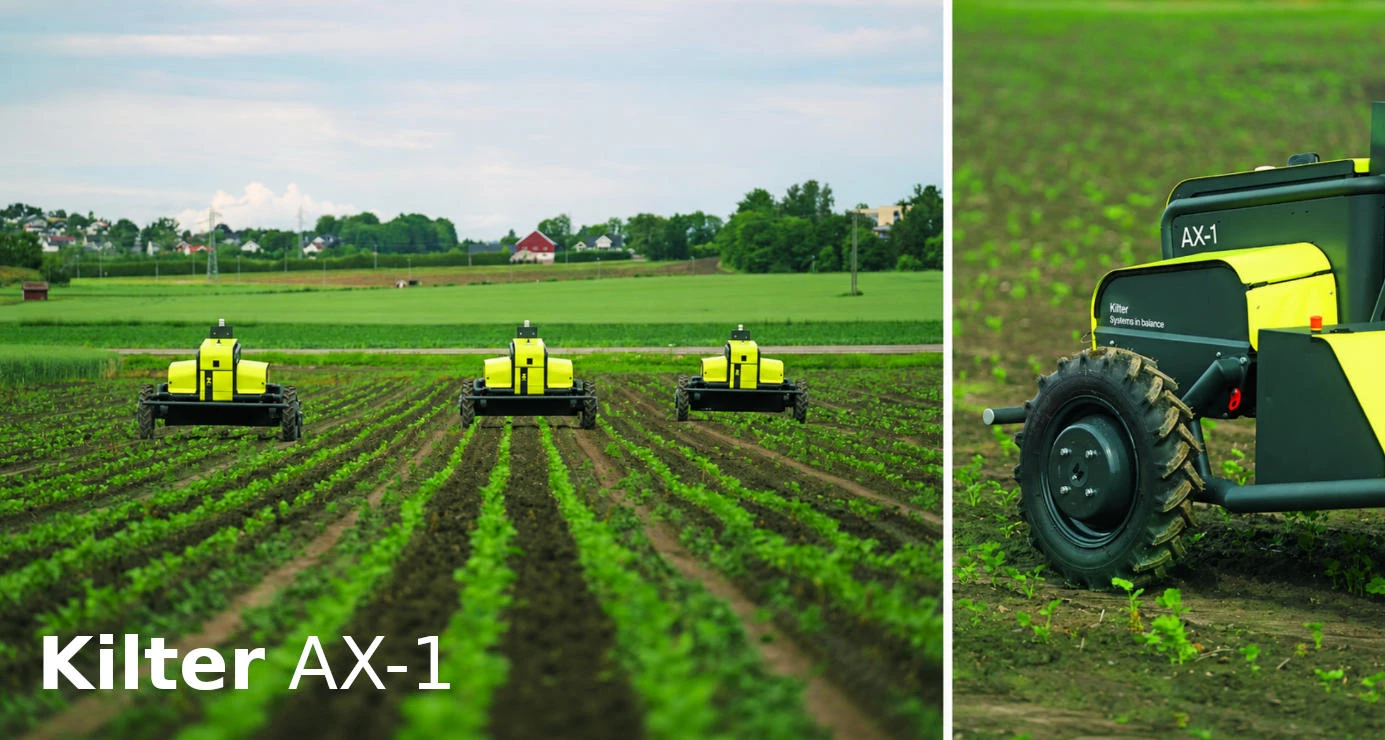
Spot Spraying Reduced Drift by 99%: Kilter AX-1 Achieves the Highest DRT99 Classification
The autonomous Kilter AX-1 spot-spraying system demonstrated a reduction in spray drift of more than 99% compared with the standard reference spraying technique. Following an independent study conducted by Wageningen University & Research, the robotic sprayer was classified as DRT99 — the highest category in the Dutch system for classifying drift-reducing technologies.
The result is significant not merely as another performance indicator for precision agriculture. The Kilter AX-1 trials show that moving from blanket field spraying to the treatment of individual plants can fundamentally change the way herbicides are applied. Instead of producing a continuous spray pattern, the system generates relatively large individual droplets and directs them precisely at detected weeds.
The figure of more than 99%, however, must be interpreted correctly. It refers to the potential reduction in spray drift determined using a specially adapted methodology combining laboratory measurements of droplet-size distribution with spray-drift modelling. This does not mean that drift will remain identical under all field conditions, but it officially confirms that the system meets the requirements of the highest DRT99 classification.
Why the Standard Nozzle Test Was Not Suitable
Methods used to assess drift-reducing nozzles are primarily designed for conventional field sprayers. Such machines operate with continuously activated nozzles and distribute spray liquid evenly across the entire working width.
The Kilter AX-1 operates according to a different principle. Its SDT-N2 module produces a sequence of relatively large droplets that are released only when commanded by the control system and directed at a specific target, such as a weed leaf. Consequently, the existing protocol for testing drift-reducing nozzles could not adequately represent the machine’s operation.
Specialists from Wageningen University & Research developed an adapted protocol in accordance with the requirements of the Dutch Technical Committee on Techniques Assessment, known as TCT. The study consisted of two main stages:
- measuring the size distribution of droplets produced by the SDT-N2 spray module;
- entering the collected parameters into the IDEFICS model to calculate droplet deposition beyond the treated area.
The modelling results showed that the system had the potential to reduce spray drift by more than 99%. This provided the basis for classifying it as DRT99 for downward application of plant protection products in field crops.
Large Droplets Instead of a Continuous Spray Pattern
The strong performance of the Kilter AX-1 is not related solely to the use of a particular nozzle type. The overall application architecture is the decisive factor.
The robot is equipped with a machine-vision system that captures images of the field surface and analyses them in real time. Its algorithms distinguish crops from weeds, after which the patented Single Drop Technology applies herbicide only to the identified target.
The stated spatial application resolution is 6×6 mm. The machine therefore operates not at the level of a general field zone or boom section, but at the level of a small area of an individual plant. According to Kilter, at a typical weed coverage of approximately 5%, this approach delivers an average reduction in chemical use of 96.6%. This is a separate indicator and should not be confused with the reduction in spray drift of more than 99%.
The first figure describes the volume of product that does not need to be applied to weed-free parts of the field. The second refers to the reduction in the amount of spray liquid capable of moving beyond the target zone under the influence of air currents.
Boom Stabilisation at a Height of 15 cm
Another factor contributing to lower drift is the limited operating height of the spray modules. During operation, the AX-1 automatically maintains the boom at approximately 15 cm above the soil surface.
Sensors installed in the spray modules continuously measure the distance to the surface and adjust the boom position when the machine passes over uneven ground. Reducing the distance that a droplet must travel before reaching its target shortens the time it remains airborne and consequently limits the influence of wind.
The machine is also equipped with a wind-speed sensor. The system can automatically suspend spraying when wind speed exceeds the configured permissible limit.
Kilter AX-1 Technical Specifications
The table presents the parameters of the current AX-1 configuration published by Kilter’s official technical and training platform. The machine has a modular design, so track width, the number of spray modules and the effective working width may vary depending on the selected configuration.
| Parameter | Specification |
|---|---|
| Machine type | Autonomous robot for spot application of herbicides |
| Application technology | Single Drop Technology |
| Spray module tested by WUR | SDT-N2 |
| Spatial application resolution | 6×6 mm |
| Length | 2,141 mm |
| Overall width | 1,826–2,276 mm |
| Height | 1,545 mm |
| Adjustable track width, measured between wheel centres | 1,550–2,000 mm |
| Track-width adjustment increment | 10 mm |
| Spraying working width | 1,307 or 1,572 mm |
| Maximum number of spray modules | 5 or 6 |
| Weight without operating liquids | 284 kg |
| Total weight with filled tanks | 362 kg |
| Usable spray-liquid tank capacity | 52 l |
| Total main-tank capacity | 55 l |
| Rinsing and dilution tank | 17 l |
| Clean-water tank | 15 l |
| Nominal boom height above the soil | 15 cm |
| Navigation | Autonomous, using two GPS antennas and RTK positioning |
| Plant detection | Cameras, machine vision and artificial intelligence algorithms |
| Wind monitoring | Integrated sensor with automatic application shut-off capability |
| Drift-reduction classification | DRT99 |
| Confirmed potential drift reduction | More than 99% compared with the reference system |
The manufacturer’s official marketing page rounds the dry weight of the AX-1 to 300 kg, while the current technical documentation provides the more precise figure of 284 kg. The latter should therefore be used as the primary technical specification.
Two Working-Width Configurations
In its standard configuration, the AX-1 can be fitted with five or six spray modules. The five-module version provides a maximum working width of 1,307 mm and can operate with a track width ranging from 1,550 to 2,000 mm.
A track width of at least 1,600 mm is required to install six modules. In this configuration, the maximum treatment width increases to 1,572 mm. Track width is adjusted using spacers in 10 mm increments, allowing the robot to be adapted to the production system of a particular farm.
Compared with large self-propelled sprayers, the working width of the AX-1 is limited. However, the machine is not intended for high-output blanket application with a wide boom. It is specialised for autonomous operation in vegetable and high-value crops, where precision, selectivity and the prevention of crop damage may be more important than maximum field capacity per hour.
Less Herbicide, but No Exemption from Application Rules
Kilter presents the AX-1 as a system that transfers selectivity from chemistry to software. A conventional selective herbicide must control weeds while remaining relatively safe for the crop. With the AX-1, crops and weeds are separated by the machine-vision system, while the chemical product is physically directed away from the crop.
In theory, this expands the potential use of contact herbicides in sensitive crops and allows weed control to begin at earlier growth stages. The robot, however, does not remove the requirement to comply with plant protection product registrations. Product selection, concentration, crop approval, application timing and weather conditions must comply with the legislation of the country in which the machine is operated.
The DRT99 classification also does not mean a complete absence of spray drift. It confirms a reduction of at least 99% compared with a defined reference technique under the conditions and assumptions of the approved assessment methodology.
Practical Significance of the DRT99 Classification
For the Netherlands, the result has direct regulatory significance. The country applies strict requirements intended to protect ditches, water bodies and surface water from pesticide contamination. The use of equipment in the highest drift-reduction class may potentially allow spraying closer to water bodies under local regulations and reduce the area occupied by untreated buffer zones.
For other European markets, the WUR tests provide an independent evidence base that may support the further evaluation and certification of the technology. As of June 2026, Kilter reported that AX-1 machines were operating on commercial farms in six European countries and Australia. The company is also expanding its market presence in cooperation with Kubota.
From Controlling a Spray Pattern to Controlling Every Droplet
The defining feature of the Kilter AX-1 is not an incremental improvement to a conventional sprayer, but a departure from the continuous spray pattern as the fundamental application principle.
Traditional technologies attempt to reduce drift through nozzle selection, pressure control, reduced boom height, air assistance or protective shields. The AX-1 reduces the amount of liquid present in the air in the first place: a droplet is generated only after the system has identified a weed and determined the required application point.
The DRT99 classification confirms that spot spraying can address two separate challenges simultaneously: reducing overall herbicide use and minimising the movement of spray liquid beyond the intended target zone. Nevertheless, the economic efficiency of the machine on a particular farm will depend on crop structure, weed pressure, labour costs, available herbicides, robot productivity and the ability to integrate autonomous equipment into the existing production system.
Add a comment
Comments
There are no comments yet. Be the first to comment.
You must be logged in to post a comment
Login