
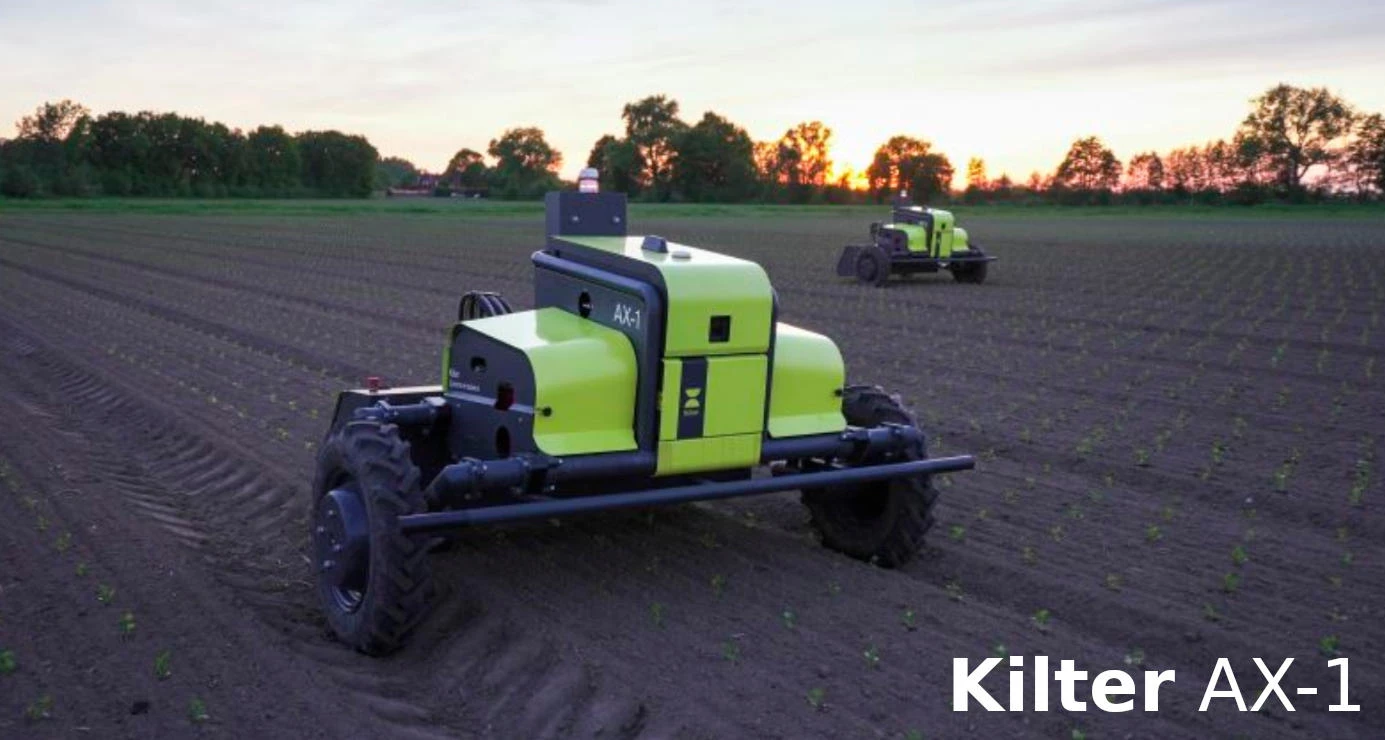
Kilter AX-1 Spot-Spraying Robot: 6×6 mm “Micro-Targeting” and the Next Wave of Automation in Vegetable Production
Vegetable growers are increasingly caught between two hard pressures. On one side - stronger weed pressure and rising resistance. On the other - fewer approved active ingredients and tougher environmental expectations. Add the chronic shortage of seasonal labor for hand weeding, and it becomes obvious why robotic, ultra-precise spot application is moving from “interesting” to “necessary”.
That is exactly where the Kilter AX-1 fits. Developed by Norway-based Kilter AS, this autonomous spot-spraying robot does not treat the whole field uniformly. Instead, it applies micro-doses directly onto weeds with a claimed targeting resolution of 6×6 mm. In February 2026, the technology gained major momentum: Kubota led a EUR 6.5 million funding round and announced a distribution partnership designed to bring AX-1 into Kubota dealer networks in Germany and the Netherlands starting in 2026.
What Is Kilter AX-1 - and Why It Matters for High-Value Crops
AX-1 is positioned for vegetables and other high-value crops where the cost of a mistake - phytotoxicity, crop stunting, uneven stands - is especially high. The underlying idea is straightforward: selectivity shifts from chemistry to software. Instead of relying primarily on the “perfect” herbicide for a narrow growth window, computer vision and classification algorithms detect weeds and place a micro-dose exactly where it is needed.
According to Kilter’s materials and partner communications, the solution is already adapted for 15+ crops and is aimed at farms facing both herbicide restrictions and weed resistance.
6×6 mm Targeting: How Ultra-Precise Spot Application Works
The defining claim of AX-1 is its 6×6 mm application precision. Operationally, the robot:
- captures images of the row or bed,
- processes the imagery in real time,
- identifies weeds among crop plants,
- delivers only a few drops to the target weed.
Kilter refers to its patented droplet delivery approach as Single Drop Technology, and it frames the broader concept as a mindset shift: not “spray a hectare,” but “treat a plant.”
A telling technical detail from Kilter’s AX-1 materials is the mention of pelargonic acid as an example of a product used for micro-dose “burn-down,” highlighting the direction toward more environmentally compatible chemistry when applied precisely.
The Chemistry Economics: “Typical 5% Weed Pressure” and Up to 95% Less Herbicide
Conventional spraying spends product across the entire treated area even if weeds occupy a relatively small share of the field. Kilter’s argument uses simple arithmetic: if typical weed coverage is around 5%, a plant-targeted approach could theoretically reduce herbicide use by up to 95% because only weeds are treated.
These numbers should be read as a potential ceiling, not a universal guarantee. Real-world savings depend on crop type, true weed density, recognition accuracy, setup, and operational discipline. But even partial progress toward that level is highly attractive in an era of rising input costs, tightening registrations, and stronger pressure to reduce chemical load.
Autonomy, Low Weight, and Modularity: Why This Robot Is More Than Cameras
Kilter highlights three practical characteristics of the AX-1 platform:
- Autonomy - less dependence on a tractor and operator, more flexibility in scheduling.
- Modular architecture - the robot can be configured to match farm-specific operations and field conditions.
- Low weight for soil protection - Kilter indicates an approximate distributed “dry” weight around 300 kg, with an emphasis on minimizing compaction.
In vegetable production, these are not minor points: wet soils, many passes, and intensive systems can turn compaction into a quiet but costly yield limiter.
Why Now: Kubota’s EUR 6.5M Investment and Dealer Network Scaling
In February 2026, Kubota publicly confirmed it had become the lead investor in Kilter’s EUR 6.5 million pre-Series B round. The same reporting references existing investors and states that the capital is aimed at scaling and further technology development.
Equally important is the distribution plan: sales and service via Kubota dealer networks in Germany and the Netherlands starting in 2026. This matters because robotics adoption often fails not on “hardware,” but on service readiness - training, uptime support, spare parts, and operational know-how. A strong dealer infrastructure lowers the practical barrier for farms considering automation.
Farm-Level Impact: Where AX-1 Can Deliver Value
Summarizing the AX-1 logic, the main value points for vegetable growers look like this:
- Less chemistry - lower costs and a smaller environmental footprint, with easier compliance under tightening rules.
- Lower crop-injury risk - micro-dosing and precise targeting reduce the chance of harming crop plants.
- Reduced reliance on manual labor - especially where hand weeding has become the bottleneck.
- Operational flexibility - modular setup and adaptation to crop systems.
Of course, any robotic solution has “conditions for success”: clean row structure, stable agronomic background, correct settings, charging and logistics discipline, and dependable service. Still, the direction is clear - ultra-precise spot application is becoming a practical response to the structural limits of conventional chemical weed control.
Spare Parts and Custom Manufacturing Support in Ukraine
As autonomous spraying and precision crop-care technologies accelerate across Europe, Ukrainian farms still need a strong backbone for machinery uptime - spare parts, repairs, and fast custom part production.
BAS-Agro (Cherkasy, Ukraine) supplies spare parts for agricultural machinery across multiple brands - selection and ordering are available at https://bas.ua. The company also offers custom part manufacturing from a drawing or sample, which is especially valuable when a component must be restored quickly, replaced without long supply-chain delays, or produced as a non-standard part.
In practice, this combination - innovation in the field plus a reliable parts and manufacturing base - is what gives farms real resilience during the season.
Add a comment
Comments
There are no comments yet. Be the first to comment.
You must be logged in to post a comment
Login