
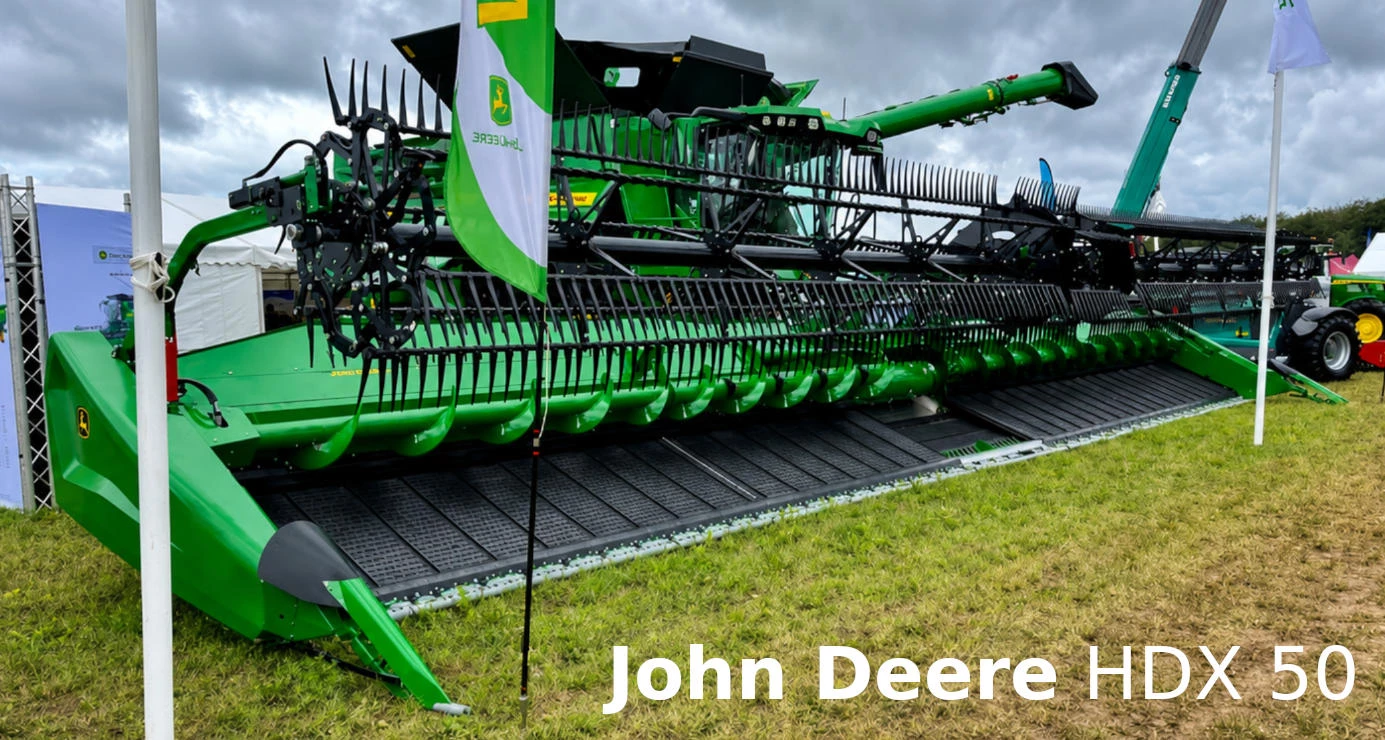
John Deere HDX 50 Header Review: 15.24 m Working Width
John Deere is expanding the capabilities of its high-capacity X9 combine harvesters with the introduction of the new HDX 50 draper header for 2027 model-year machines. Its actual working width is 50 ft, or 15.24 m. This means that John Deere’s header range for the European market has crossed the 15 m threshold for the first time.
The new model is intended primarily for large farms and agricultural enterprises where combine productivity is limited not by engine power or the capacity of the threshing and separation system, but by the amount of crop material the header can deliver evenly into the feederhouse.
John Deere has officially confirmed that the HDX 50 will be introduced as part of the X9 combine update for the 2027 model year. The wider platform is expected to increase crop intake and help operators make fuller use of the capacity available from the high-output X9 range. At the same time, the header has been designed not only around its exceptional width, but also around stable ground following, consistent crop flow and the ability to work in different crops.
Main Technical Specifications of the John Deere HDX 50
| Parameter | Specification |
|---|---|
| Model | John Deere HDX 50 |
| Header type | Hinged draper header with an extended table |
| Working width | 15.24 m |
| Working width in feet | 50 ft |
| Intended crops | Cereals, oilseed rape, pulses and other broad-acre crops |
| Recommended combine | John Deere X9 |
| Number of reel sections | 3 |
| Ground following | Hinged frame, hydraulic suspension and gauge wheels |
| Number of rear gauge wheels | 4 |
| Draper table depth | 1,200 mm |
| Belt width in the HDX series | 1,200 mm |
| Belt speed in the HDX series | 72–228 m/min |
| Cutterbar drive in the HDX series | Dual knife drive |
| Cutting frequency in the HDX series | Up to 2,080 cuts per minute |
| Knife design | Double-cutting system |
| Parameter adjustment | From the combine cab |
| Model year | 2027 |
Note. The working width, compatibility with the X9 range, three-section reel, four gauge wheels and 1,200 mm table have been confirmed in materials relating specifically to the HDX 50. Belt speed, cutting frequency and certain cutterbar specifications are based on official data for other current HDX models. At the time this review was prepared, John Deere had not yet released a complete standalone technical specification sheet for the HDX 50.
Why John Deere Increased the Width to 15.24 m
John Deere X9 combines were developed to handle an exceptionally large flow of both grain and material other than grain. However, the maximum output of such a machine can only be achieved when the header feeds the threshing and separation system consistently across the full width of the feederhouse.
Increasing the working width from 13.7 to 15.24 m represents an improvement of approximately 11%. At the same forward speed, a combine equipped with the HDX 50 can theoretically cover around 11% more land than a machine operating with a 45 ft header.
For example, at a working speed of 8 km/h, the theoretical field capacity of the 15.24 m header is:
15.24 × 8 ÷ 10 = 12.19 ha/h.
After accounting for headland turns, overlaps and operational stops, the actual figure will be lower. Even so, with a field efficiency coefficient of 0.75–0.80, practical output could approach 9.1–9.8 ha/h.
A wider header does not always produce a proportional increase in harvested tonnage. The result will depend on crop yield, straw moisture, terrain, weed pressure, crop condition, operator experience and the efficiency of grain transport logistics.
Draper Feed Instead of a Conventional Auger
The HDX 50 belongs to the draper-header category. After the crop is cut, it falls onto moving side belts that carry it towards the centre section and then into the combine feederhouse.
The main advantage of this arrangement is the creation of a more uniform layer of material. Stems move in a more organised manner, without the substantial accumulation in front of a central auger that can occur with some conventional platforms. A steadier feed reduces peak loads on the feederhouse, threshing system and cleaning shoe.
According to John Deere, HDX draper headers can increase the productivity of X9 and S7 combines by up to 25% under certain conditions. The manufacturer reports an average productivity improvement of approximately 15% in typical harvesting conditions and up to 20% in difficult crops compared with auger headers.
These figures should not be applied automatically to every farm. Results depend on crop type, moisture content, yield and machine settings. Nevertheless, the principle is clear: a more uniform crop flow allows the combine to operate closer to its optimum load for longer periods without sudden fluctuations.
Extended Table for Oilseed Rape and Tall Crops
The HDX designation is used for headers with a hinged frame and an extended draper table. The range uses a table depth of 1,200 mm. This distance between the cutterbar and the central feed zone is particularly important when directly harvesting oilseed rape, rye and other tall or heavily branched crops.
Once the crop has been cut, there is enough space for the plants to fall fully onto the belt instead of hanging over the cutterbar or dropping forward. This helps reduce shatter losses and stabilises the movement of large volumes of stem material.
John Deere uses Grain Saver belts with a raised cross-pattern surface. According to the manufacturer, this design helps retain grain that might otherwise roll back towards the knife and fall onto the ground. Across the HDX range, John Deere claims that the belts can reduce cutterbar losses by up to 25% compared with more conventional smooth-belt designs.
For oilseed rape harvesting, the header can also be equipped with upper finger augers, central-section seals and mechanical side knives. The upper augers control bulky crop material and help direct it onto the belts, while the seals reduce the loss of small seeds around the centre conveyor.
Three-Section Reel
One of the most notable design features of the HDX 50 is its three-section reel. Each section moves in line with the corresponding part of the hinged frame, helping to maintain a more consistent distance between the reel fingers and cutterbar on uneven ground.
A conventional rigid reel would present several challenges on a header more than 15 m wide. When one wing passes over a rise while the other moves into a depression, the distance between the reel fingers and the knife could vary considerably. In one area, the fingers could contact the crop too aggressively and increase shatter losses, while in another they might fail to engage lodged or short-stemmed plants effectively.
Dividing the reel into three sections helps align its geometry with the movement of the frame. This is especially important when harvesting lodged cereals, peas and other low-growing crops.
Hinged Frame for Ground Following
Increasing header width inevitably makes ground following more difficult. Across a width of 15.24 m, even a relatively gentle undulation can create a significant height difference between the central and outer sections of the platform.
The HDX 50 therefore uses a hinged-frame design. The centre section and wings can change their relative positions to follow the transverse profile of the field. Hydraulic suspension partially isolates header movement from combine movement, helping maintain a consistent cutting height.
Four gauge wheels are fitted at the rear of the HDX 50. They support the platform, help control cutting height and reduce the load on the ground-following components. Hydraulic pressure in the wheel circuit can be adjusted to redistribute some of the header weight between the header itself and the combine’s front axle.
On firm, dry ground, the operator can allow the header to place more weight on the gauge wheels. In wet conditions, more weight can be transferred back to the combine to reduce the risk of the wheels sinking into the soil.
In-Cab Adjustment
The HDX design provides remote adjustment of the main operating parameters. From the cab, the operator can change cutting height, ground pressure, ground-following response and belt speed.
When necessary, the header can be switched from cutting above the ground to operating directly against the field surface. On the HDX range, this change takes less than 10 seconds and does not require the operator to leave the cab.
A dedicated lodged-crop mode is also provided. When activated, the system raises the gauge wheels, lowers the cutting height and moves the reel forwards and downwards. This helps collect stems lying close to the soil surface.
Automatic belt-speed control links belt movement to combine forward speed. As the machine accelerates, the belts run faster to maintain a steady crop flow. When the combine slows down, belt speed is reduced accordingly.
Dual-Action Cutterbar
For HDX headers, John Deere uses a dual knife drive and a double-cutting system. During one operating cycle, the cutterbar completes two cuts, with a claimed frequency of up to 2,080 cuts per minute.
A high cutting frequency is important when operating at increased forward speeds. If the combine moves faster than the knife can cleanly cut the stems, plants may bend, be pulled from the ground or remain uncut. The dual drive also distributes the load across both sides of the long knife bar.
This is particularly important on a 15.24 m header. Driving an extremely long knife assembly from only one side would increase mechanical stress, vibration and the risk of uneven knife movement.
Advantages of the HDX 50
The principal advantage of the John Deere HDX 50 is its ability to keep an X9 combine more fully loaded without necessarily increasing forward speed. Cutting a wider strip in each pass allows operators to maintain high area output even in crops where excessive speed would reduce cutting quality or increase losses.
Other advantages include:
- consistent draper delivery of crop material;
- suitability for cereals, oilseed rape and pulses;
- an extended table for tall and heavily branched crops;
- a three-section reel;
- active ground following;
- four rear gauge wheels;
- adjustment of key parameters from the cab;
- the ability to work in short and lodged crops;
- fewer passes across the field.
Reducing the number of passes provides more than a time-saving benefit. It shortens the combine’s total working route, may reduce fuel consumption per hectare and simplifies field traffic management.
Potential Limitations
A 15.24 m header places greater demands on harvest organisation. Its potential should be assessed together with the capacity of the entire harvesting system, including the combine, grain carts, tractors, road transport, drying equipment and grain-reception infrastructure.
At a wheat yield of 8 t/ha and an effective field capacity of 9 ha/h, approximately 72 tonnes of grain per hour could reach the combine, excluding straw and chaff. Without sufficient transport capacity, even a highly productive machine will regularly stop with a full grain tank.
Other factors that must be considered include:
- transport of the header between fields;
- the width of field entrances and roads;
- field size and layout;
- the number of headland turns;
- soil-bearing capacity;
- increased load on the front axle;
- the cost of a header transport trailer;
- the difficulty of operating in small or irregularly shaped fields.
On small fields, frequent turning and manoeuvring may offset the benefit of the wider cutting width.
Market Positioning
The HDX 50 is not a universal solution for every farm. It is a specialised platform for enterprises with large areas, high crop yields and well-organised logistics. The most logical combine partner is the flagship John Deere X9, whose throughput is capable of handling the crop flow generated by a 15.24 m header.
Compared with the 45 ft version, the increase in working width is 1.54 m. Profi reports that in the UK market, the price premium for the HDX 50 over the 13.7 m model could be approximately £5,000–£7,000. However, this is a preliminary UK estimate rather than an official international John Deere price.
The economic justification for the new header will depend not only on its purchase price, but also on whether it enables a farm to reduce the total number of combines required, complete harvesting within a shorter weather window or minimise losses caused by leaving ripe crops standing in the field.
The John Deere HDX 50 is a logical continuation of the development of the high-capacity X9 harvesting system. Its 15.24 m working width increases the area covered in a single pass, while the draper feed, extended table, three-section reel and hinged frame are intended to deliver a consistent flow of crop material.
The ground-following design deserves particular attention. On a header of this width, the ability of the sections to adapt independently to the field surface will have a major influence on cutting quality and actual crop losses. Four gauge wheels, hydraulic weight transfer and a movable three-section reel are designed to compensate for the main weakness of ultra-wide platforms: maintaining stable operation on uneven ground.
At the same time, the header alone cannot guarantee a proportional increase in productivity. Its efficiency will depend on field layout, yield, crop condition, combine capacity and grain-removal logistics. The HDX 50 is likely to deliver its greatest benefit on large farms where an X9 combine works in long fields and the transport system can continuously handle a high-volume flow of grain.
Spare parts and components for John Deere headers and combine harvesters are available in the BAS catalogue: https://bas.ua/
Add a comment
Comments
There are no comments yet. Be the first to comment.
You must be logged in to post a comment
Login