
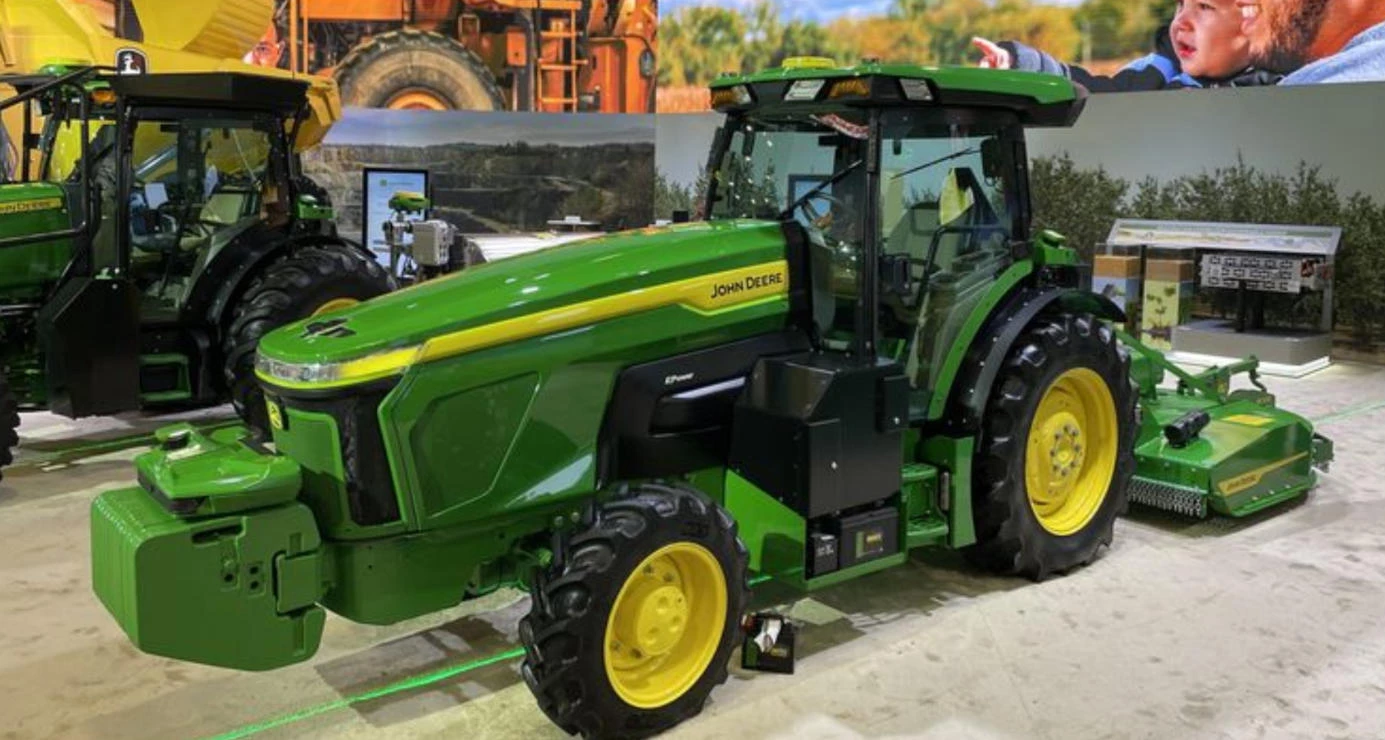
John Deere E-Power: the Electric Tractor Set to Reach the Market in 2027
Electrification in agricultural machinery is steadily moving from experimental prototypes to concrete market roadmaps. John Deere has confirmed its intention to bring the E-Power electric tractor to the market in 2027, with the initial release limited in volume, followed by broader global availability from 2028. This “controlled first batch, then scale” approach is typical for technologies where not only the machine must mature, but also the supporting infrastructure and service ecosystem.
Not a Hybrid - a Fully Battery-Electric Tractor
In the source, E-Power is described as a fully battery-electric tractor, not a hybrid. For farmers, this is a critical distinction: the drivetrain relies on battery modules, and the key practical considerations become battery capacity, charging accessibility, and how the machine fits into real operating cycles on the farm.
The stated output of the prototype is 130 hp. This indicates John Deere is not positioning E-Power as a “non-stop heavy draft” solution, but rather for tasks where electric traction can deliver tangible benefits - including low noise and zero local exhaust.
Kreisel Electric Batteries: a Modular 3 - 5 Pack Configuration
The energy system is based on Kreisel Electric technology, described as a John Deere subsidiary. The core concept is modularity: the tractor can be equipped with 3 to 5 battery packs, depending on user needs and configuration.
The maximum total battery capacity stated in the source is up to 195 kWh. This figure is central for understanding the machine’s class and concept: John Deere is emphasizing flexible configurations rather than a single fixed “one-size-fits-all” battery package.
Chimero Charging: Designed to Work Even Where Grid Power Is Limited
The source also references the Chimero charging solution, presented by John Deere and Kreisel as a practical enabler for electric machinery in settings where electrical supply may be constrained.
A confirmed detail is that Chimero includes an integrated 115 kWh battery, and it is explicitly noted that this battery is manufactured in Europe. The concept is straightforward for agriculture: an on-board buffer battery in the charging system can help provide more stable charging performance than relying solely on a limited grid connection.
Important: the source does not provide specific charging time figures or charger power ratings for the tractor, so it is not appropriate to speculate on those parameters.
Where E-Power Was Shown and How the Timeline Was Announced
The source provides clear context:
E-Power was first presented in November at Agritechnica;
the market timeline (2027 limited launch, 2028 wider rollout) was emphasized ahead of International Green Week in Berlin (listed in the source as January 16 - 25).
This matters because it shows the project has moved beyond an internal concept and is being positioned publicly at major international industry events.
What a “Limited Release in 2027” Typically Means
A limited-volume launch usually signals a real-world validation phase focused on:
- technical reliability in practical operation;
- service readiness and component supply logistics;
- charging infrastructure fit for typical farm use cases.
In other words, 2027 is likely a controlled market entry, while 2028 represents the intended scaling stage once supply and support chains are fully prepared.
Electric Tractors Still Depend on Reliable Parts Supply
Even as tractors become electric, many essential mechanical systems remain: running gear, bearing assemblies, hitch components, hydraulics, fasteners, seals, and wear parts on implements. In-season, it is often these “everyday” components that determine whether machinery stays productive or sits idle.
That is why dependable parts sourcing remains critical for any fleet, regardless of drivetrain type. Spare parts for agricultural machinery across different brands can be purchased from BAS-Agro (Cherkasy, Ukraine) via https://bas.ua - a practical option for farms that prioritize fast access to components and minimal downtime.
John Deere plans to launch the E-Power electric tractor in 2027 with a limited initial volume, followed by broader global availability from 2028. The key confirmed project parameters include 130 hp output, Kreisel Electric modular batteries (3 - 5 packs) with up to 195 kWh total capacity, and the Chimero charging solution featuring an integrated 115 kWh Europe-made battery, positioned as support for charging even where grid capacity is limited.
Electric tractors are not yet a universal replacement for conventional machines in every application, but the clear timeline, concrete numbers, and the parallel focus on charging infrastructure show that John Deere is moving E-Power from “demo” to “market reality” - and 2027 will be the first real test of its commercial viability.
Add a comment
Comments
There are no comments yet. Be the first to comment.
You must be logged in to post a comment
Login