
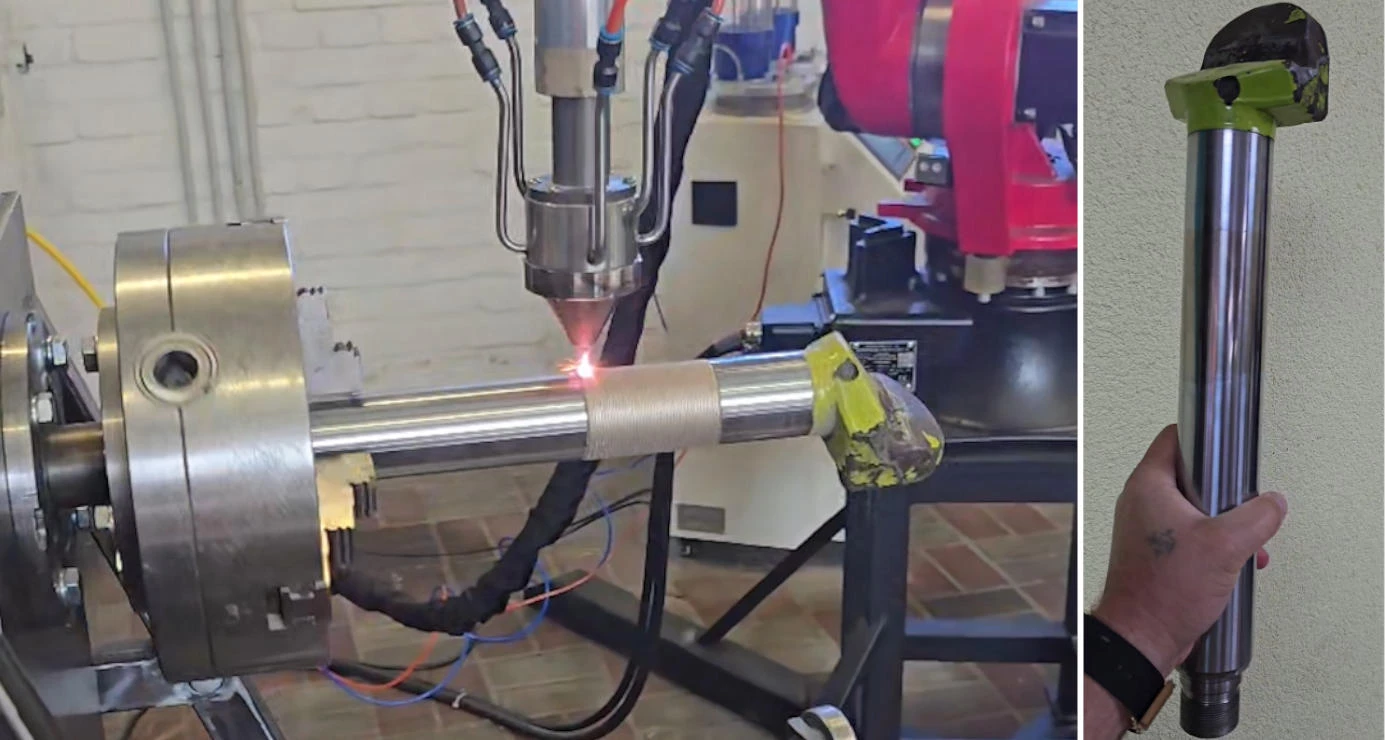
Hydraulic Cylinder Rod Restoration: Repairing Worn Dimensions by Laser Cladding
A hydraulic cylinder rod is one of the key components that directly affects the operation of the hydraulic unit. In agricultural machinery, hydraulic cylinders work in demanding conditions: dust, moisture, dirt, shock loads, intensive seasonal use, misalignment, and constant contact with seals. As a result, the rod surface may develop wear, scoring, corrosion damage, dimensional loss, or local defects.
If the rod has a damaged working or seating surface, this can lead to loss of hydraulic cylinder tightness, oil leakage, accelerated seal wear, and unstable operation of the mechanism. In some cases, the part does not have to be replaced completely — it can be restored. One practical method for this type of repair is laser cladding followed by turning and grinding to the final working size.
Video: https://youtube.com/shorts/rE9V6185bBI - Hydraulic Cylinder Rod Restoration.
When hydraulic cylinder rod repair is needed
Hydraulic cylinder rod repair is reasonable when the base of the part is preserved, but there is local surface damage or loss of the required dimension. Most often, this applies to worn areas where the rod contacts seals, guide elements, or other components of the assembly.
Typical signs of the problem include hydraulic oil leakage, uneven cylinder operation, damaged seals, visible scratches, pits, corrosion, or a reduced diameter in the working area. If such a rod continues to operate without repair, the damaged surface may quickly destroy new seals, and the hydraulic cylinder may soon require disassembly again.
Before restoration, it is important to assess the actual condition of the part: whether there is critical bending, deep cracks, significant damage to the rod body, or other defects that make repair impractical. Each part must be evaluated individually, because in some cases restoration is the right solution, while in others manufacturing or replacing the rod may be necessary.
The restoration process
Hydraulic cylinder rod restoration begins with inspection and surface preparation. The worn or damaged area is cleaned and, if necessary, pre-machined to remove irregularities, corrosion, and the defective layer. The purpose of preparation is to create a stable base for applying new metal.
After that, laser cladding is performed. A layer of metal is locally applied to the damaged area of the rod to compensate for the lost dimension and create machining allowance for the next stage. The advantage of laser cladding is that it allows work to be done exactly on the required area without unnecessary overheating of the entire part. For hydraulic cylinder rods, this is especially important because unwanted thermal deformation can affect geometry and further cylinder operation.
After cladding, the rod is transferred to turning. At this stage, excess metal is removed, and the correct diameter and surface geometry are formed. Then the part is ground to the final working size. Finishing is especially important because the rod surface must be even, smooth, and suitable for operation with seals.
As a result, the part receives a restored dimension and can be returned to further operation after the hydraulic cylinder is assembled.
Why final-size accuracy matters
For a hydraulic cylinder rod, it is not enough simply to “add metal”. After cladding, the surface must be machined to the correct technical dimension. If the diameter is too large, it may create excessive load on the seals. If it is too small, the hydraulic cylinder may lose tightness or operate unstably.
That is why hydraulic cylinder rod repair includes not only laser cladding, but also a complete machining cycle: turning and grinding. This approach makes it possible not just to cover the damaged area, but to restore the functional geometry of the part.
Services by Bas-Agro Group LLC
Bas-Agro Group LLC restores hydraulic cylinder rods, shafts, seating surfaces, and other parts for agricultural machinery. We use laser cladding with subsequent turning and grinding to the final working size.
This type of repair can be useful for agricultural enterprises, service workshops, and machinery owners when it is necessary to restore a part, reduce downtime, and avoid complete replacement of an expensive assembly.
The company website also includes a catalog of spare parts for agricultural machinery: https://bas.ua/
For a preliminary repair assessment, it is useful to provide photos of the rod, key dimensions, a description of the damage, or the part itself for inspection.
For inquiries, please call: +38 (067) 470-35-44
Add a comment
Comments
There are no comments yet. Be the first to comment.
You must be logged in to post a comment
Login