
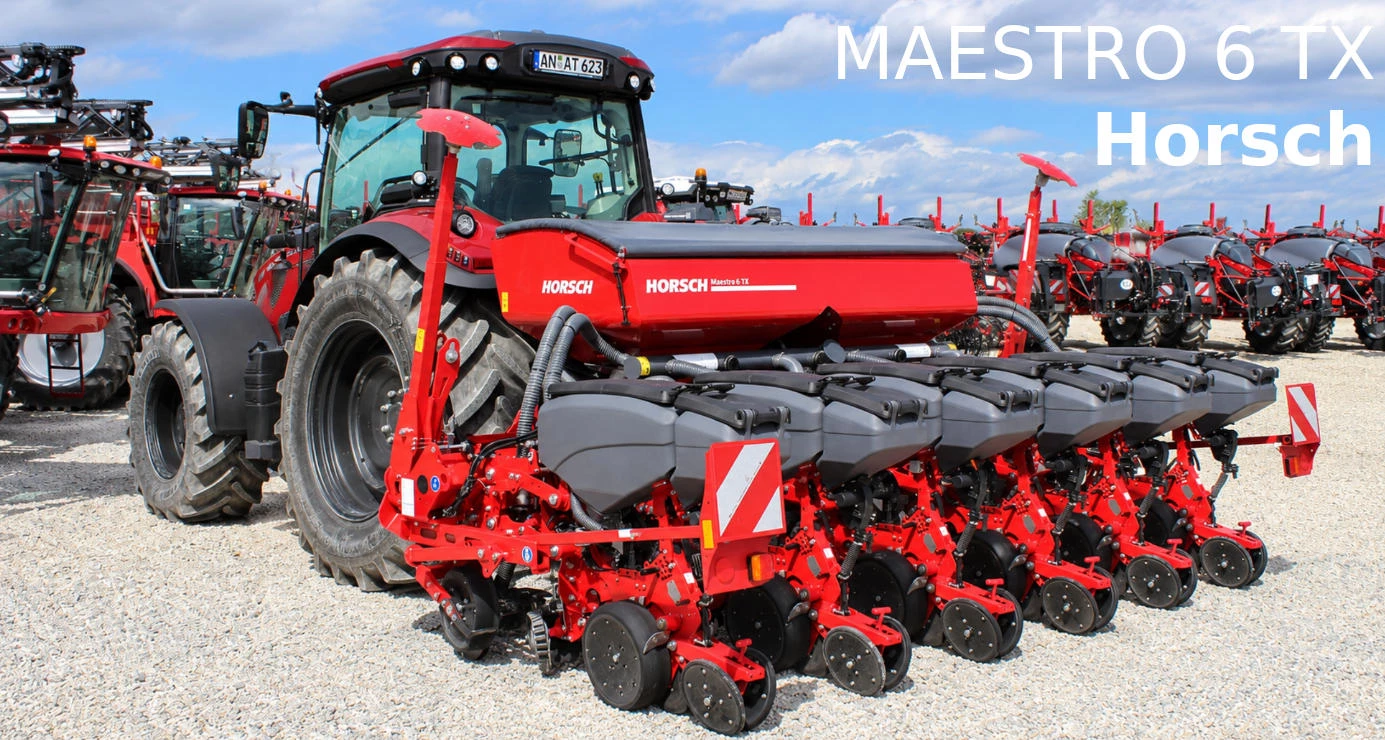
HORSCH MAESTRO TV / TX Review: Mounted Precision Planters with Adjustable Row Spacing
The HORSCH MAESTRO TV / TX is a family of compact mounted precision planters with a hydraulic telescopic frame. The design’s main feature is the ability to adjust the distance between row units for different crops. The range combines the AirVac vacuum metering system in the TV version with the AirSpeed positive-pressure system in the TX version.
This combination allows growers to select a machine according to two independent parameters: the required planting geometry and the method of seed metering and delivery. For farms growing several row crops, this has direct practical significance: one planter can operate at different row spacings without replacing the entire machine.
Models and Row Spacing Options
In its current description of the series, HORSCH highlights the six-row MAESTRO 6 TV / TX and the seven-row MAESTRO 7 TX. These machines attach via a three-point linkage. The family’s overall working width ranges from approximately 2.60 to 4.80 m.
| Model | Metering system | Row spacing |
|---|---|---|
| MAESTRO 6 TV | AirVac, vacuum | 45 / 50 / 55 / 60 / 65 / 70 / 75 / 80 cm |
| MAESTRO 6 TX | AirSpeed, positive pressure | 45 / 50 / 55 / 60 / 65 / 70 / 75 / 80 cm |
| MAESTRO 7 TX | AirSpeed, positive pressure | 37.5 / 40 / 45 / 50 / 55 / 60 / 65 cm in seven-row operation; 75 / 80 cm in six-row mode |
On the MAESTRO 7 TX, switching to six-row planting involves deactivating the central row unit. The 80 cm row spacing therefore applies specifically to operation with six rows.
The telescopic frame is standard equipment. To change row spacing, the operator adjusts the stops and then moves the row units hydraulically into the selected position. The working width is subsequently updated in the terminal. This sequence aligns the machine’s mechanical configuration with its electronic planting controls.
AirVac and AirSpeed: Fundamental Differences
In the AirVac system, vacuum holds seeds against the holes in the metering disc. After singulation, each seed travels through the seed tube towards the furrow under gravity. HORSCH specifies an operating speed of up to 12 km/h for this version.
AirSpeed uses positive pressure: seeds are pressed against the holes in the disc, and after metering, an air stream accelerates them and directs them into the furrow. A catching roller receives each seed and presses it into the soil. The TX version supports operating speeds of up to 15 km/h.
Both systems use interchangeable metering discs for different crops. The singulator requires no additional adjustment when changing crops, although selecting the correct disc remains essential for accurate metering.
The difference between TV and TX is particularly relevant when assessing work rate. AirSpeed’s higher permissible speed expands the opportunities for working within a short planting window, but actual operating speed must account for seedbed conditions, row-unit stability and seed placement quality.
Depth Control and Hydraulic Downforce
The MAESTRO TV / TX row units incorporate design features from larger machines in the MAESTRO family. A double-disc opener forms the furrow, gauge wheels establish planting depth, and V-shaped wheels at the rear close and firm the furrow. The planting depth range is 1.5–9 cm.
Row-unit downforce is generated hydraulically. The technical specifications for the TV / TX indicate a range of 150–220 kg, increasing to a maximum of 300 kg per row unit with the optional weight transfer system. AutoForce is available for automatic adjustment.
Downforce adjustment maintains the selected depth as soil resistance changes. In firm areas, the row unit requires more force to penetrate the soil; in loose areas, a lower load helps limit compaction. Maximum downforce therefore describes the machine’s capability, while the working setting is determined by conditions in the individual field.
Fertiliser and Microgranules
An optional 1,300-litre fertiliser hopper is available for these planters. Two metering units supply fertiliser to the fertiliser openers. In this configuration, half-width fertiliser shut-off is standard.
Optional microgranule hoppers with a capacity of 18 litres each can also be installed on the row units. Individual electric drives allow application to be switched off row by row. Material is delivered into the seed furrow or spread over the surface using deflectors, depending on the equipment and the selected application method.
Combining operations reduces the number of separate passes. Application rates and fertiliser placement must nevertheless be determined according to the crop, the product’s properties and soil conditions.
Electronic Planting Control
Electrically driven metering units allow independent control of individual rows. This provides the basis for SectionControl row shut-off, VariableRate seeding and tramline management. Sensors in the seed tubes monitor seed passage and transmit information about skips and doubles.
In its materials describing the development of the TX, HORSCH also highlights the I-Manager control system, which features a configurable interface and allows row spacing parameters to be updated. This is important for a machine with adjustable geometry: after repositioning the row units, the electronic configuration must match their actual arrangement.
Terminal readings describe seed metering and delivery performance. Physical checks of planting depth and furrow closure complement electronic monitoring, allowing the final planting result to be assessed.
Spare Parts for HORSCH Planters
Spare parts for HORSCH planters can be purchased from Bas-Agro in the “HORSCH-Compatible Spare Parts” section. The catalogue includes parts and components for servicing planting equipment. Selecting parts by catalogue number, machine model and assembly configuration helps ensure compatibility with the specific planter.
Farm Applications
The main advantage of the MAESTRO TV / TX is the ability to match row spacing to the crop production system while retaining a single mounted planting platform. The six-row versions cover common row spacings from 45 to 80 cm, while the MAESTRO 7 TX also enables planting at narrower spacings.
When choosing between TV and TX, growers assess the required work rate, planting conditions and seed characteristics. The telescopic frame provides flexibility in row arrangement, the metering units deliver singulated seeds, and downforce adjustment helps maintain planting depth. The agronomic result depends on these mechanisms working together.
Add a comment
Comments
There are no comments yet. Be the first to comment.
You must be logged in to post a comment
Login