
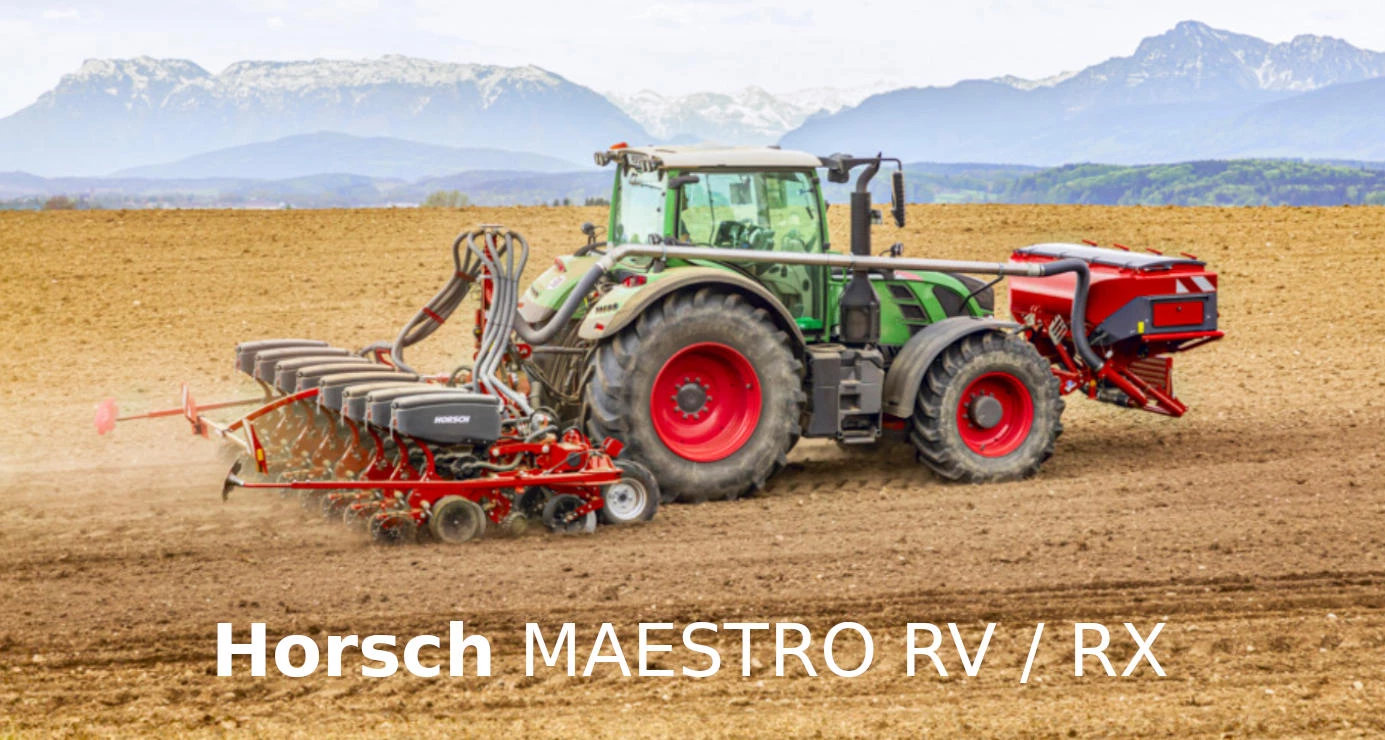
HORSCH MAESTRO RV / RX Review: Mounted Planters, Metering Systems and Implement Combinations
The HORSCH MAESTRO RV / RX is a family of mounted precision planters designed for different implement combinations and fertiliser supply arrangements. The planting frame can operate on the tractor’s three-point linkage in combination with a front hopper or form part of a compatible combined planting system. Each row unit has an individual seed hopper with a capacity of 70 litres.
This architecture separates the machine’s functions: the row units handle seed metering and placement, while fertiliser capacity and soil preparation depend on the selected equipment. Assessing the MAESTRO RV / RX therefore requires consideration of the entire implement configuration as well as the number of rows.
Model Range and Row Spacings
The range covers configurations with 6 to 12 rows. The RV and RX designations identify the metering system, while the number preceding the letters indicates the number of row units.
| Models | Number of rows | Row spacing, cm |
|---|---|---|
| MAESTRO 6 RV | 6 | 70 / 75 / 80 |
| MAESTRO 8 RV / 8 RX | 8 | 70 / 75 / 80 |
| MAESTRO 9 RV / 9 RX | 9 | 60 / 70 / 75 |
| MAESTRO 11 RV / 11 RX | 11 | 50 / 55 / 60 |
| MAESTRO 12 RV / 12 RX | 12 | 45 / 50 |
A 30-inch row spacing is also available for certain configurations. Working width is determined by the combination of row count and spacing: for example, eight rows at 75 cm spacing and twelve rows at 50 cm spacing both correspond to a planting width of 6 m.
The row units attach to the frame using a clamping profile. The design allows suitable configurations to be converted from twelve to eight rows. This enables the machine to be adapted to different crops, although changing the configuration requires repositioning the row units and adjusting the equipment.
Row spacing selection is linked to the entire crop production system. Alongside plant arrangement, growers must consider tractor track width, inter-row cultivation equipment and harvesting machinery specifications.
RV and RX: Differences Between AirVac and AirSpeed
The MAESTRO RV uses AirVac vacuum metering units. Vacuum holds seeds against the holes in a rotating disc, after which a singulator removes doubles. Individual seeds travel through the seed tube into the furrow under gravity.
The MAESTRO RX uses the AirSpeed system. Positive pressure holds seeds against the metering disc, and after singulation, an air stream accelerates them and directs them towards the furrow. A catching roller receives each seed and presses it into the soil.
Both systems use interchangeable metering discs selected according to the crop and seed characteristics. The singulator requires no additional adjustment when changing crops. Electric drives enable independent row control and support SectionControl, VariableRate seeding and tramline management.
HORSCH specifies operating speeds of up to 12 km/h for AirVac and up to 15 km/h for AirSpeed. These figures describe the systems’ technical capabilities. In the field, speed is set according to metering accuracy, row-unit stability, planting depth and furrow condition after closure. With AirSpeed, the operating conditions of the catching roller must also be considered, particularly in wet, sticky soils.
Seed Hoppers and Fertiliser Supply
In the standard RV / RX architecture, each row unit has its own 70-litre seed hopper. For localised fertiliser application, the mounted planter can be combined with a HORSCH Partner FT front hopper. Material is delivered to the fertiliser openers through a closed pneumatic system.
The current Partner FT family includes several capacities and hopper partition options.
| Front hopper | Total capacity | Partition options |
|---|---|---|
| Partner 1.7 FT | 1,700 litres | Single compartment or two compartments in a 90:10 ratio |
| Partner 2.1 FT | 2,100 litres | Two compartments — 60:40, or three — 60:30:10 |
| Partner 2.5 FT | 2,500 litres | Two compartments — 60:40, or three — 60:30:10 |
These figures refer to total capacity. In multi-compartment versions, the volume is divided between individual components, so the actual quantity of each material depends on the selected partition.
Positioning the hopper at the front changes the load distribution between the tractor’s axles. Equipment selection must account for front and rear linkage lifting capacities, permissible axle loads and material weight. Compatibility is assessed in the working configuration with fully filled hoppers.
Single-disc or double-disc fertiliser openers are available for placement in the soil. Application rate and placement are selected according to the crop, fertiliser properties and soil conditions.
Row-Unit Downforce and Conditions for Achieving Maximum Force
The MAESTRO RV / RX row units feature parallel-linkage suspension and hydraulic downforce adjustment. AutoForce is available for automatic load adjustment, adapting downforce as soil conditions change.
Downforce is required to maintain consistent opener penetration and the selected planting depth. In firm soil, insufficient load can cause the row unit to ride up. In loose soil, excessive force increases compaction and resistance to gauge-wheel movement.
HORSCH states that downforce of up to 350 kg per row unit can be achieved with an appropriate weight transfer or implement configuration. This maximum must not be applied indiscriminately to every mounted model and equipment package. Available downforce depends on machine weight, the number of row units and the equipment used to transfer load.
The hydraulic system regulates force, but sufficient load on the implement is required to generate it. Downforce specifications must therefore be considered together with the implement configuration when selecting an RV / RX.
Working with Pronto and Focus
The MAESTRO RV / RX can be used beyond direct attachment to the tractor. HORSCH provides for combinations with the Pronto 6 AS in compatible configurations. This arrangement can combine seedbed preparation and precision planting in a single pass.
The MAESTRO RV is also described in combination with the Focus TD, allowing strip cultivation, fertiliser placement and planting to be combined. With StripTill, soil disturbance is concentrated in the future crop row, while the inter-row areas remain less disturbed.
HORSCH’s Agritechnica 2025 materials also describe the option of attaching a MAESTRO RV / RX planting frame to the Focus ST F for maize or sugar beet. The mounted planting platform can therefore form part of different crop establishment systems.
These combinations are selected according to the specific frame configuration, row spacing, coupling components and tractor requirements. Combining operations increases the demands on the tractor and implement, so power and hydraulic capacity must be assessed for the complete system.
Applications Across Different Crops
The MAESTRO RV / RX is designed for precision planting of maize, sunflowers, sugar beet, soybeans, sorghum, rapeseed and other legumes using the appropriate metering discs. The choice of row spacing allows plant arrangement to be matched to the farm’s crop production system.
The manufacturer provides for use after ploughing, in mulch planting and in direct planting with suitable equipment. Surface conditions, crop residue levels, soil resistance and furrow closure quality are important in each application. The design’s versatility is realised through the selection of working tools and row-unit settings suited to actual field conditions.
Spare Parts for HORSCH Planters
Spare parts for HORSCH planters can be purchased from Bas-Agro in the “HORSCH-Compatible Spare Parts” section. The catalogue includes parts and components for servicing planting equipment. Selection by part number, machine model and assembly configuration helps ensure compatibility with the specific planter.
Practical Significance of the MAESTRO RV / RX
The series’ defining feature is the combination of a mounted planting frame with several options for configuring the complete planting system. Farms can choose between AirVac and AirSpeed, use a front hopper for fertiliser and select compatible combinations with soil cultivation equipment.
When selecting a machine, row count is considered alongside row spacing, fertiliser application method and the load available to the row units. Matching these parameters determines the system’s productivity and the conditions under which it can maintain consistent depth and accurate seed placement.
Add a comment
Comments
There are no comments yet. Be the first to comment.
You must be logged in to post a comment
Login