
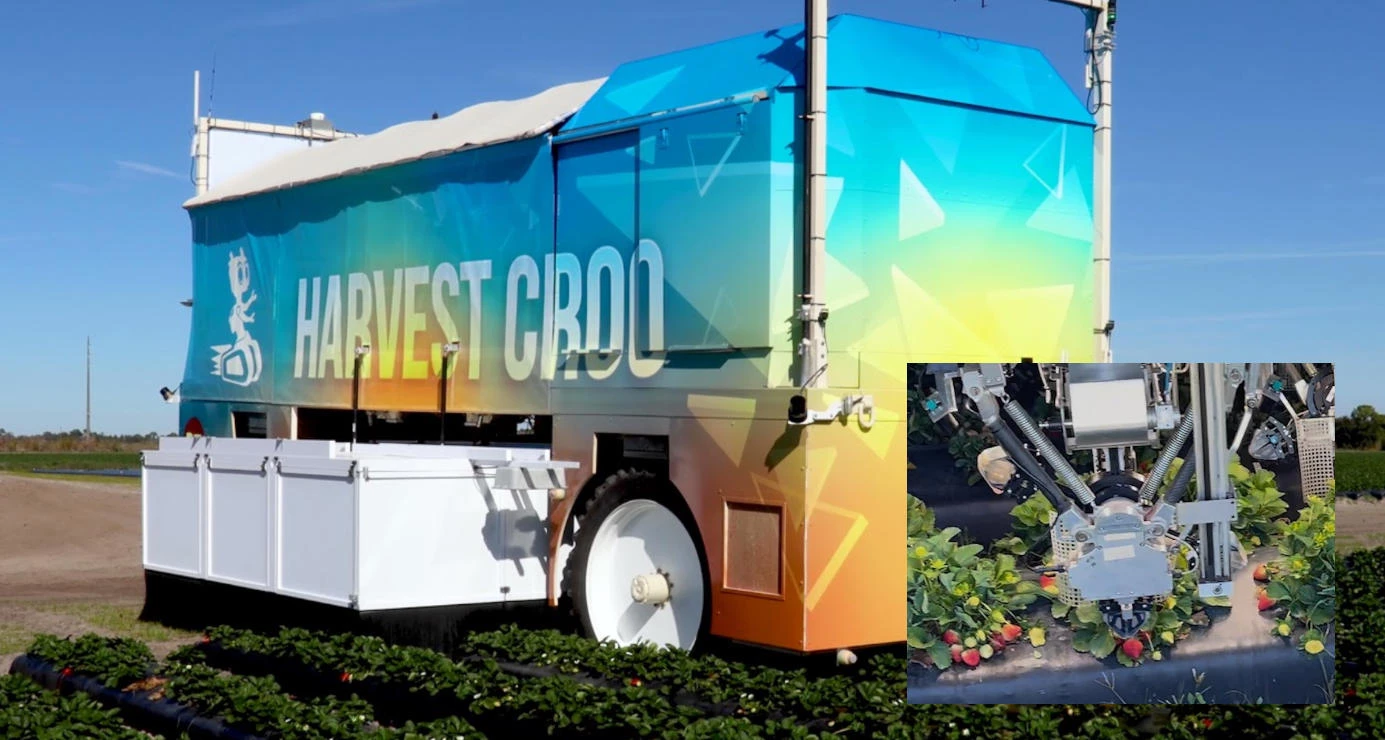
Harvest CROO B8 Robot - What Commercially Viable Autonomous Strawberry Harvesting Looks Like
At the end of the strawberry season in Florida, Harvest CROO reported a milestone the produce industry has been waiting years to see: field demonstrations of its B8 robotic harvester showed commercial viability for automated strawberry harvesting - with a picking rate comparable to human crews in a real commercial operation.
For the berry sector, this is not “just another prototype.” Strawberries are among the hardest crops to automate: the fruit is delicate, ripeness varies berry by berry, many targets are partially hidden under foliage, and harvesting must deliver consistent quality without bruising. That is why reaching human-comparable performance in real field conditions is the critical line between interesting R&D and a platform that can scale commercially.
What Was Demonstrated in Florida
Harvest CROO’s update describes a field event in Duette, Florida on April 24, 2025, where industry stakeholders watched the B8 Harvester navigate autonomously down strawberry rows, while robotic modules beneath the chassis picked fruit as the machine advanced.
The company emphasizes that the initial driver was to address farm labor shortages, but the current iteration has evolved into a broader platform combining AI, machine learning, food safety innovation, and breeding approaches as part of a system-level path toward mechanized harvesting.
One detail that helps explain the step-change: Harvest CROO says that over the last year they achieved a dramatic leap in compute capacity - by adopting a new generation of NVIDIA chips, the vision processing capability on the platform became 200 times more powerful. In combination with their patents and robotics IP, this contributed to reaching human-level productivity.
B8 Architecture - 16 Robots in One Harvester
The core idea behind B8 performance is parallelism. On Harvest CROO’s technology pages, the company states that each Harvester integrates 16 independently working robots that pick while the machine autonomously covers acreage.
In a separate company post focused on AI and computer vision, Harvest CROO again notes that 16 robots are built into each B8 Strawberry Harvester, and that their Computer Vision and AI systems power a pick-to-pack approach.
In practical terms, it behaves more like a moving micro-production line with many small, coordinated “hands,” rather than a single complex arm trying to keep up with field throughput. For strawberries, that architecture often makes more sense: distribute the work across multiple lightweight robotic pickers instead of relying on one ultra-complicated manipulator.
Navigation and Safety: LiDAR With 360° Field Awareness
For an autonomous machine in a commercial field environment, picking is only half the battle. It must also drive consistently and safely. Harvest CROO describes an onboard LiDAR system that provides a 360-degree 3D view, helping the platform navigate accurately and avoid collisions with rows, people, or unexpected obstacles.
This matters for commercialization: the fewer “manual interventions” required to keep the machine productive, the closer the system gets to a reliable operational tool - and ultimately to a service model where the manufacturer can standardize outcomes.
Computer Vision: Scanning Every Berry and Selecting by Ripeness
The second foundation is perception and decision-making: “pick or don’t pick.” Harvest CROO says its AI and machine-vision system scans every berry on the plant to determine whether the fruit is ripe, healthy, and ready for harvest, and then the robot executes the pick without damaging the berry.
Operationally, that implies two things:
- The platform is optimized for quality consistency, not just volume.
- The system can accumulate plant-level and field-level data - and Harvest CROO explicitly positions analytics as part of the product.
Software Ecosystem: Web and Mobile Apps for Control and Analytics
Harvest CROO presents its software as an ecosystem built “from the ground up” to deliver data that supports management decisions and improves the customer’s day-to-day harvesting experience. The company states that its suite of web and mobile applications provides monitoring and control of harvesters, plus insights from the robots and the field.
Among the capabilities described are live harvesting monitoring, system and real-time monitoring, analytics and planning, plant-level data capture for auditability, autonomous inspection related to packing/processing/sorting outcomes, direct harvester control, and software used for testing and operational training.
For large-scale operations, this layer can be as important as the hardware: scaling automation typically depends on dispatching, quality control, forecasting, and service workflows - not only on mechanical performance.
Patents, Modularity, and Scale
Harvest CROO also emphasizes a modular and scalable ecosystem architecture and notes that it has 13 issued patents in the U.S. and internationally, with more in progress.
That signals a long-cycle strategy: protect the core IP, push toward repeatable commercial deployment, and expand capabilities over time.
ESG Angle: Lower CO2 and the “Unharvested Crop” Problem
On its sustainability page, Harvest CROO states that its new Harvester reduces CO2 emissions by 96% compared to traditional hand harvesting.
The company also argues that due to severe labor shortages, some growers leave around 20% of the crop unharvested each year, positioning B8 as a way to reduce that loss.
Even without unpacking the full methodology behind these numbers, the economic logic is familiar in high-value crops: the biggest risk is often not just harvesting cost, but failing to harvest within the narrow ripeness window.
Why It Matters - and What It Could Mean Beyond the U.S.
Historically, automation in delicate crops has been constrained by three factors: ripeness identification accuracy, gentle manipulation, and the economics of throughput. If B8 truly delivers human-comparable performance in field conditions, it implies:
- Autonomous strawberry harvesting can move from experimentation into day-to-day operations.
- “Field data” becomes part of the business model - not as an add-on, but as a product core.
- A credible precedent emerges that can accelerate automation in other labor-intensive, high-value crops.
Even if B8 is designed around U.S. strawberry production realities, the underlying blueprint - multi-robot harvesting architecture plus computer vision, a control-and-analytics software layer, and modular scalability - is the part that can travel across regions and crop systems.
Bottom Line
Harvest CROO B8 is notable not simply because it “picks strawberries,” but because the company is positioning it as commercially viable, with picking speed comparable to human labor, supported by a system design that includes 16 integrated robots, autonomous navigation with LiDAR, computer vision that scans and selects fruit at the berry level, and a web-and-mobile software ecosystem for monitoring and analytics.
If the performance claims hold as deployments scale, B8 could become one of the first widely cited examples of autonomous berry harvesting moving into regular commercial practice - with real implications for cost structure, crop reliability, and the competitive pace of ag-robotics innovation.
Add a comment
Comments
There are no comments yet. Be the first to comment.
You must be logged in to post a comment
Login