
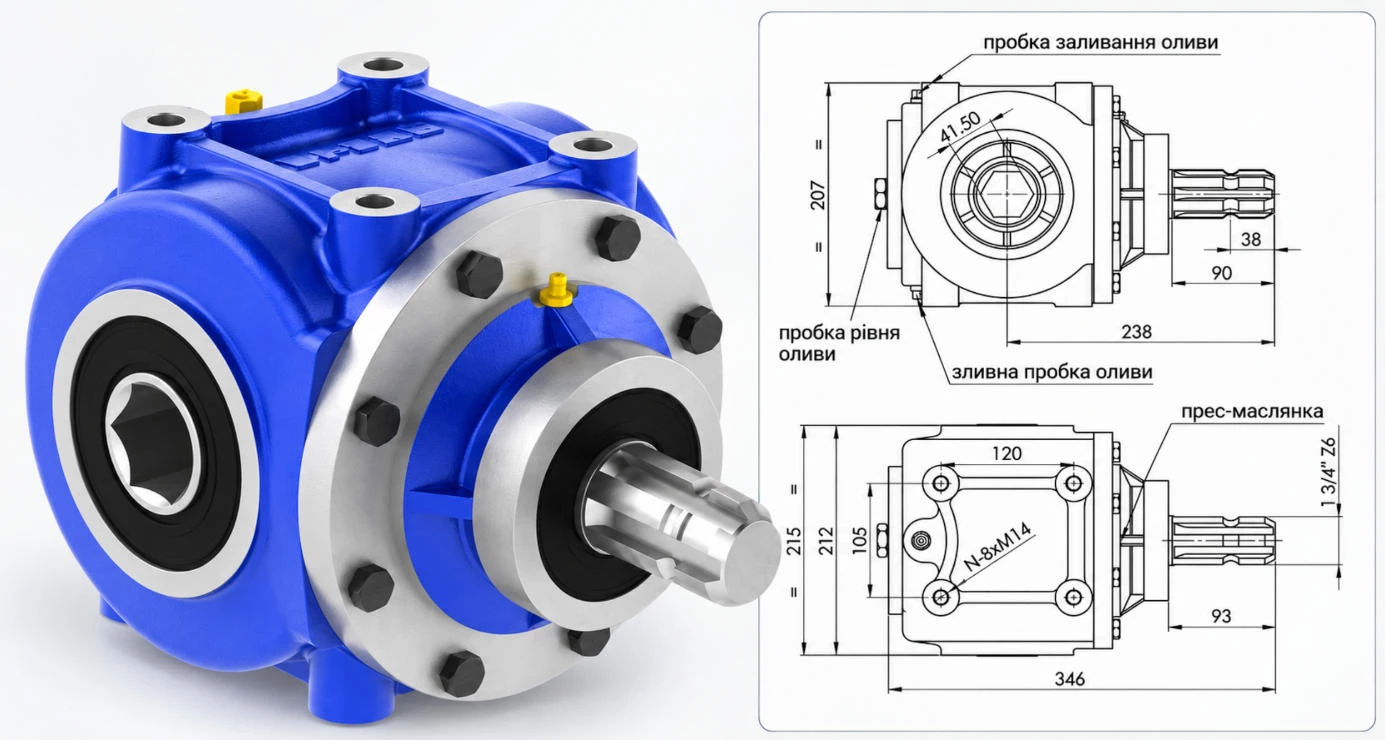
Gearbox for an Organic Fertilizer Spreader: DI-SAN DS400
A solid organic fertilizer spreader handles material that is considerably more difficult to distribute evenly across a field than dry mineral granules. Manure and compost have an irregular structure, varying moisture content and different densities. They can become compacted inside the body and create fluctuating loads on the conveyor and spreading components. The machine’s mechanical drivetrain must therefore do more than transmit power: it must also maintain the required operating speed during prolonged use.
The DI-SAN DS400 is a specialised gearbox for trailed solid organic fertilizer spreaders. The manufacturer identifies its application as a Manure Spreader. The gearbox is designed for an input speed of 334 rpm and increases it to 540 rpm to drive the working components of a standard spreader.
What Machines Is the DI-SAN DS400 Designed For?
DI-SAN’s technical documentation classifies the DS400 as a gearbox for trailers used to apply solid organic fertilizers. This category includes machines working with materials such as:
- bedding manure;
- partially decomposed manure;
- compost;
- organic mixtures;
- other solid and non-uniform fertilizer materials.
The DS400 should not be confused with the smaller gearboxes used on single-disc and twin-disc mineral fertilizer spreaders. Those machines handle granular material and usually have a different drivetrain design, lower power requirements and different gear ratios.
A trailed organic fertilizer spreader is a considerably heavier machine. Material is moved along the body by a conveyor and then delivered to the spreading mechanism. Depending on the machine’s design, this mechanism may consist of vertical or horizontal beaters, bladed rotors or spreading discs.
Where Is the DS400 Installed?
According to DI-SAN’s official gearbox application scheme, DS400 gearboxes are used to drive the left and right spreading discs in the standard manure-spreader configuration. A different gearbox is assigned to the central disc, while a separate model with a substantially lower output speed drives the conveyor.
The DS400 should therefore not be regarded as a single central gearbox that simultaneously drives every mechanism on the machine. In DI-SAN’s standard configuration, it forms part of a distributed drivetrain and powers the side spreading components.
The gearbox’s precise location depends on the design of the particular spreader. Before ordering, the drivetrain arrangement, direction of rotation, shaft configuration and mounting dimensions must be checked. A matching general machine application alone is not sufficient to confirm compatibility.
Technical Specifications of the DI-SAN DS400
| Specification | Value |
|---|---|
| Application | Solid organic fertilizer spreader |
| Gear ratio | 1:1.61 |
| Input speed | 334 rpm |
| Output speed | 540 rpm |
| Rated input power | 50 hp / 37 kW |
| Output torque | 635 Nm |
| Recommended oil | SAE 90 / SAE 140 |
| Oil capacity | 1.50 liters |
| Weight | 30 kg |
Why the DS400 Actually Increases Speed
Despite sometimes being described as a reduction gearbox, the DS400 does not reduce rotational speed. It increases the speed from 334 rpm at the input to 540 rpm at the output. Its 1:1.61 gear ratio means that the rotational speed is increased by approximately 1.61 times.
Multiplying 334 rpm by 1.61 gives approximately 538 rpm. The manufacturer specifies 540 rpm, with the small difference resulting from the rounding of the published gear ratio.
This characteristic is crucial when selecting and installing the gearbox. The DS400 is not designed to receive the tractor’s standard 540 rpm PTO speed directly at its input shaft. With the same gear ratio, an input of 540 rpm would theoretically produce approximately 869 rpm at the output, substantially exceeding the intended operating speed.
The required input speed of 334 rpm must therefore be generated by an earlier stage of the spreader’s transmission. The DS400 is a component of the machine’s internal drivetrain rather than a universal gearbox intended for direct connection to a tractor PTO.
Power and Torque
DI-SAN specifies a rated input power of 37 kW, or 50 hp, and an output torque of 635 Nm. These figures describe the load capacity of the gearbox itself but do not determine the tractor power required to operate the entire spreader.
The tractor drives much more than a single DS400 gearbox. It powers the PTO shafts, distribution drives, body conveyor and spreading components. Part of the available power is also required to overcome friction and move the heavy organic material through the machine. Selecting a tractor solely according to the gearbox’s 50 hp rating would therefore be technically incorrect.
The required tractor power should be determined from the operating instructions for the specific spreader. It depends on the body capacity, payload, conveyor design, spreading mechanism and required application rate.
Why the Spreader Drivetrain Experiences Variable Loads
Solid organic fertilizers rarely have a completely uniform structure. A single load may contain loose and compacted sections, long fibrous crop residues, dense lumps and material with different moisture levels.
When a dense mass reaches the spreading components, resistance rises sharply. Once the lump is broken apart, the load decreases again. The gears, shafts and bearings are consequently exposed not only to continuous loading but also to repeated dynamic forces.
The presence of stones, pieces of metal, wood or other foreign objects in the material is particularly dangerous. If one of these objects reaches a working component, it can stop the shaft abruptly and cause a short but severe torque spike.
The condition of the PTO shafts, protective clutches and other safety components is therefore just as important as the rated strength of the gearbox itself.
Why the DS400 Cannot Be Replaced by a Visually Similar Model
The DI-SAN range includes several gearboxes for solid manure spreaders. Their housings may look similar, but the models differ in gear ratio, rated power, torque and position within the machine’s drivetrain.
A conveyor gearbox, for example, must produce a very low output speed and high torque. A spreading-disc gearbox operates at a considerably higher speed. A conveyor gearbox therefore cannot replace a disc-drive gearbox, or vice versa, even if some of their external dimensions appear to match.
Before selecting a DS400, verify:
- The make and model of the spreader.
- The designation of the original gearbox.
- The gearbox’s position within the drivetrain.
- The actual input speed.
- The required output speed.
- The gear ratio and whether it increases or reduces speed.
- The rated power and torque.
- The direction of shaft rotation.
- The design and dimensions of the spline connections.
- The position of the input and output shafts.
- The mounting dimensions and bolt-hole spacing.
- The installation position on the machine frame.
If the identification plate or original marking is damaged, photographs of the housing, shafts, mounting points and installation location should be provided together with the principal dimensions.
Common Causes of Spreader Gearbox Damage
The service life of the DS400 depends not only on manufacturing quality but also on the condition of the complete drivetrain. Even a correctly selected gearbox can fail prematurely if it is repeatedly exposed to loads outside its intended operating range.
Common causes of damage include:
- stones or metal objects entering the spreading mechanism;
- blockage of a disc or another working component;
- excessive material density or uneven feeding;
- overloading the spreader body;
- engaging the PTO abruptly at high engine speed;
- a seized or incorrectly adjusted protective clutch;
- using an unsuitable shear bolt;
- PTO shaft misalignment;
- poor alignment between drivetrain components;
- loose gearbox mounting bolts;
- operation with damaged bearings;
- insufficient oil;
- oil loss through worn seals;
- a blocked or damaged breather;
- prolonged operation with excessive vibration.
Metallic noise, noticeable shaft play, oil leakage or excessive housing temperature requires the machine to be stopped and inspected. Continuing to operate it may turn limited damage to a bearing or seal into failure of the entire gear set.
Oil and Maintenance of the DS400
DI-SAN specifies SAE 90 or SAE 140 oil for the DS400. The nominal oil capacity is 1.50 liters.
The publicly available DI-SAN documentation does not specify a universal oil-change interval, an API service classification or exact temperature ranges for choosing between SAE 90 and SAE 140. The maintenance schedule and specific lubricant should therefore also be checked against the machine’s operating manual and the supplier’s recommendations.
An API GL-4 or GL-5 classification should not be assigned without confirmation. Oils with the same viscosity can contain different extreme-pressure additive packages and may differ in their compatibility with the gearbox materials.
Before the beginning of the operating season, inspect:
- the oil level and condition;
- the housing for cracks or other damage;
- seals and potential leakage points;
- the condition of the breather;
- play in the input and output shafts;
- the tightness of mounting connections;
- the condition of the PTO driveline;
- the operation of the protective clutch;
- free rotation of the spreading components;
- the working area for foreign objects.
The PTO should be engaged at a low engine speed, after which the drivetrain can be brought gradually to the required operating speed. Abrupt engagement under load creates an impact that is transmitted simultaneously through the universal joints, shafts, gears and bearings.
Where to Buy the DI-SAN DS400 Gearbox
BAS-Agro offers the DI-SAN DS400 gearbox for solid organic fertilizer spreaders. Current pricing, availability, photographs and specifications can be found on the product page:
Buy the DI-SAN DS400 gearbox from BAS
Delivery is available throughout Ukraine. Before placing an order, customers should provide the spreader model, the marking of the original gearbox and photographs of its connection points. This information allows technical compatibility to be checked and reduces the risk of ordering the wrong unit.
The DI-SAN DS400 is a specialised gearbox for driving the spreading components of a trailer designed to apply solid organic fertilizers. In DI-SAN’s standard application scheme, DS400 gearboxes drive the left and right spreading discs.
The gearbox increases the input speed from 334 to 540 rpm, has a rated input power of 37 kW and provides an output torque of 635 Nm. It should therefore not be selected solely by housing appearance or connected directly to a 540 rpm PTO.
Reliable operation depends on the correct gear ratio, matching shafts and mounting points, a functional protective clutch, smooth drivetrain engagement and regular oil-level inspections. Accurate identification by model marking, technical drawing and installation position remains essential for a safe replacement.
Add a comment
Comments
There are no comments yet. Be the first to comment.
You must be logged in to post a comment
Login