
Gaspardo CHRONO Planters Review: Precision Planting at Speeds of 15 km/h and Above
Increasing a planter’s operating speed only makes sense if it does not compromise seed spacing or planting-depth consistency. MASCHIO GASPARDO developed the CHRONO range of pneumatic precision planters around this principle. Their defining feature is not simply their ability to travel quickly across the field, but the controlled movement of each seed from the metering disc directly into the furrow.
CHRONO is not a single machine but a technology platform used across planters with different frames, row configurations and loading systems. The manufacturer’s product materials cover everything from relatively compact six-row machines to wide planters designed for large-scale farming operations. All of them employ the same fundamental principles of high-speed singulation and seed placement.
Why Gravity-Based Seed Delivery Has Its Limitations
In a conventional precision planter, the seed generally moves down the seed tube under the force of gravity after being released from the metering disc. As operating speed increases, vibration and movement of the planting unit can cause the seed to strike the walls of the tube. This affects the moment at which it reaches the furrow and may result in skips, doubles and irregular spacing between plants.
The CHRONO system manages this stage differently. A vacuum holds the seeds against the holes in the metering disc. Once released, each seed enters a stream of compressed air generated by a rotary lobe compressor. This pneumatic flow propels the seed through a short delivery channel towards the furrow, reducing the effects of vibration and seed bounce.
The vacuum inside the metering unit and the pressure used for seed transport are controlled independently. The system can therefore be adjusted according to the size, weight and shape of the seed. According to MASCHIO GASPARDO, CHRONO planters can work not only with maize and soybeans but also with sunflower, sorghum, sugar beet and rapeseed.
The CHRONO Planting Unit
Each planting unit has its own electric motor driving the metering disc. This electric drive allows the rows to be controlled independently, supports variable-rate planting and enables individual sections to be switched off automatically where the field has already been planted.
The metering unit is positioned at an angle of 15°, allowing the seed to enter the delivery channel with minimal friction. An integrated seed sensor monitors the process. After reaching the furrow, the seed is secured by a soft, self-cleaning rubber press wheel, reducing the risk of displacement. Mechanical adjustment allows the planting depth to be set between 1 and 11 cm.
Each individual seed hopper has a capacity of 60 litres. Depending on the configuration, every row can also be equipped with an electrically driven 16-litre microgranule hopper.
A high-speed metering unit alone, however, cannot guarantee good planting results. Performance still depends on selecting the correct seed disc, adjusting the singulator, setting the appropriate vacuum and air pressure, using suitable seed, preparing the field correctly and selecting an appropriate forward speed.
Working with Different Soil-Tillage Systems
The CHRONO planting unit is connected to the frame through a double-parallelogram linkage and is equipped with the AIR SPRING pneumatic system. The operator can adjust row-unit downforce centrally from the tractor cab. Maximum downforce reaches 300 kg per planting unit.
This level of pressure helps the openers penetrate the soil consistently under minimum-tillage or no-till conditions. Downforce must nevertheless be selected carefully. Excessive pressure in a loose seedbed may compact the sides of the furrow and increase rolling resistance.
Independent gauge wheels follow the field surface and help maintain the selected planting depth. MASCHIO GASPARDO positions CHRONO as a versatile system for conventional tillage, minimum tillage and direct planting. The final row-unit configuration must still be selected according to residue levels, soil density and the conditions of the individual field.
A Speed of Around 15 km/h Is Not the Only Objective
MASCHIO GASPARDO specifies an operating speed of around 15 km/h for the CHRONO family, while some models are designed to work at more than 15 km/h. In principle, this can substantially increase daily output and help farmers complete planting within a narrow agronomic window. The manufacturer states that productivity may increase by more than 50% compared with conventional technology under suitable conditions.
This figure should not be interpreted as a guaranteed result for every field. Actual output depends on working width, field length, loading time, terrain, headland manoeuvres and the proportion of time spent travelling without planting. On rough or inadequately prepared fields, the operator may need to reduce speed to maintain the required depth and ensure stable row-unit performance.
The agronomic value of CHRONO therefore extends beyond its maximum working speed. More importantly, forced pneumatic seed transport creates the conditions needed to increase speed without causing a corresponding deterioration in seed-placement accuracy.
Electronic Control and Precision Farming
CHRONO planters use the electrically driven ISOTRONIC system and support the ISOBUS communication protocol. Through a compatible terminal, the operator can monitor planting parameters, individual row units, fertiliser application and the distribution of microgranular products.
Depending on the equipment package, the planter can support variable-rate planting based on prescription maps, automatic row shut-off, application-rate monitoring and work-data recording. Section control is especially valuable in wedge-shaped fields and on headlands, where overlapping passes can waste seed and produce uneven plant populations.
Electronic control does not eliminate the need for mechanical inspections. Before the planting season begins, the metering discs, seals, singulators, openers, bearings, seed tubes, sensors and press wheels should all be checked. Even a precisely calibrated control system cannot compensate for worn working components.
Main Models in the Gaspardo CHRONO Range
CHRONO 300
The CHRONO 300 is a mounted six-row planter with a double-telescopic frame. The official brochure lists row spacings of 70, 75 or 80 cm. The machine folds to a transport width of 3 m and can be equipped with a 1,200-litre fertiliser hopper. The stated minimum tractor power requirement is 120 hp.
This configuration is intended for farms seeking modern high-speed planting technology without moving to a large, wide trailed planter.
CHRONO 500
The CHRONO 500 features a mounted folding frame with floating side wings. It is offered as an eight-row planter with 70 or 75 cm row spacing and as a 12-row machine with 45 or 50 cm spacing. Its transport width is 3 m.
The convertible frame version is particularly noteworthy. An eight-row planter can be transformed into a 12-row machine by adding four planting units and repositioning the existing units. According to the manufacturer, two operators can complete the conversion in less than two hours.
The floating wings help the frame follow the field contours. When the planter is raised, the WINGS UP system lifts the side sections above the central frame, making headland turns and manoeuvres over uneven ground easier - Official CHRONO 500 information.
CHRONO 700
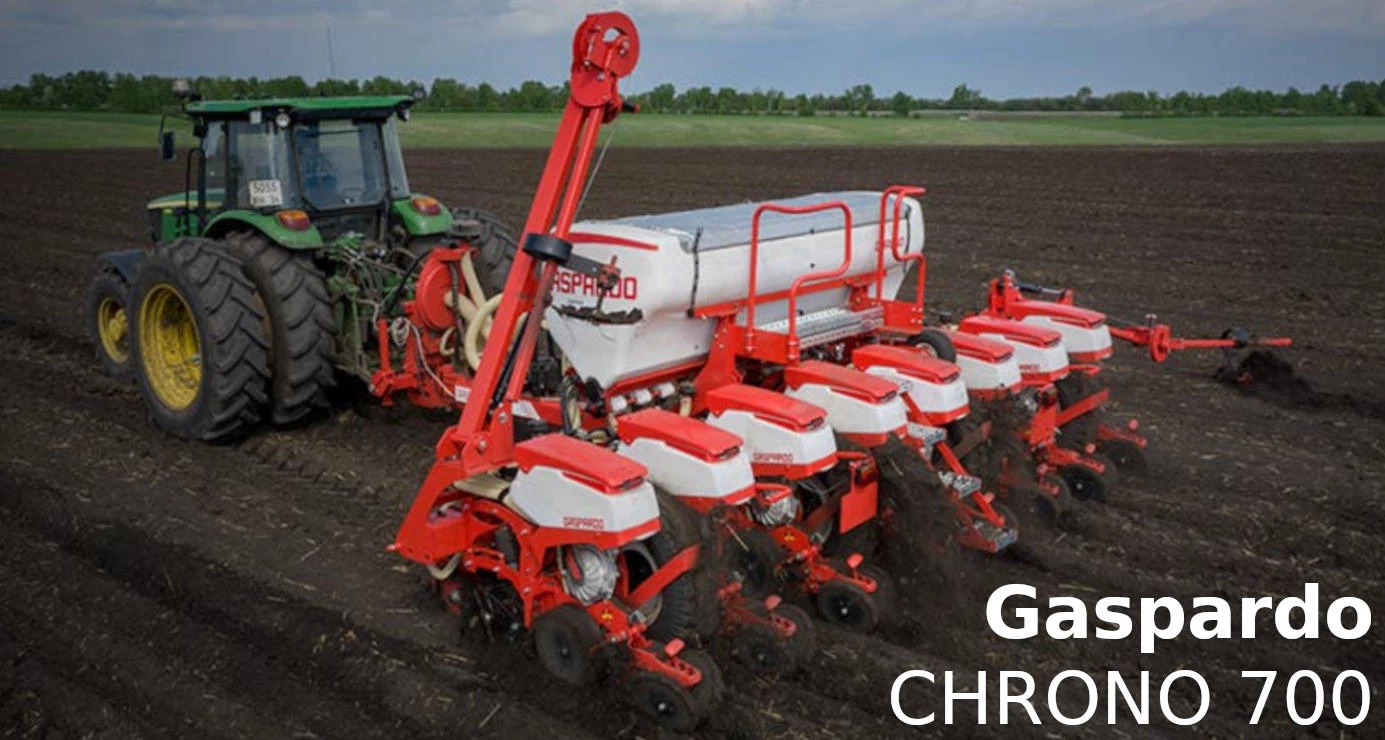
The CHRONO 700 is a trailed eight-row planter with forward hydraulic folding. It is available with row spacings of 70 or 75 cm, has a transport width of 3 m and can be equipped with a 1,600-litre fertiliser hopper. The stated minimum tractor power requirement is 130 hp.
Its trailed design, large fertiliser capacity and ability to apply substantial row-unit downforce make it suitable for intensive seasonal work, including minimum-tillage and no-till applications - CHRONO 700 specifications.
CHRONO 800
The CHRONO 800 is a new wide trailed planter developed for large areas. It is available with 12 or 16 planting units and row spacings of 70 or 75 cm. Depending on the number of rows, its working width can reach approximately 12 m.
The planter has a folding frame with floating wings capable of moving through an angle of up to 10° to follow field contours. The central fertiliser hopper has a capacity of 3,000 litres. In configurations with central seed delivery, an additional seed hopper with a capacity of approximately 950–960 litres is installed.
The pneumatic system distributes seed, fertiliser and microgranular products among the working units. According to the manufacturer, the pressurised central-hopper design reduces the load on the hydraulic fan, while the large filling opening is suitable for loading from big bags - Official CHRONO 800 page.
Spare Parts for Gaspardo Planters in Ukraine
Spare parts for Gaspardo planters can be selected and ordered from the BAS-AGRO Group website in the parts compatible with Gaspardo section. The catalogue includes components for maintaining and repairing different models of planting equipment.
If the required component is not available among the standard catalogue items, BAS-AGRO Group can manufacture it to order at its own production facility. A new part can be produced from a supplied sample, technical drawing or catalogue part number. Before manufacturing begins, the design, dimensions, material and operating conditions are clarified.
This service is particularly valuable when the original component has a long delivery time and planter downtime could result in the loss of the optimum planting window.
Conclusion
Gaspardo CHRONO is a family of high-speed precision planters in which higher productivity is achieved through a combination of interconnected technologies: vacuum seed metering, forced pneumatic seed transport, individual electric row-unit drives, AIR SPRING downforce control and ISOBUS-based electronic management.
The selection of frames and configurations allows CHRONO technology to be used on both six-row mounted machines and large 12- or 16-row planting systems. Its high-speed potential, however, can only be realised with proper field preparation, accurate metering-system calibration, sufficient tractor power and hydraulic capacity, and timely maintenance of all working components. Ultimately, it is the combination of advanced technology and good mechanical condition that determines the uniformity of crop emergence.
Add a comment
Comments
There are no comments yet. Be the first to comment.
You must be logged in to post a comment
Login