
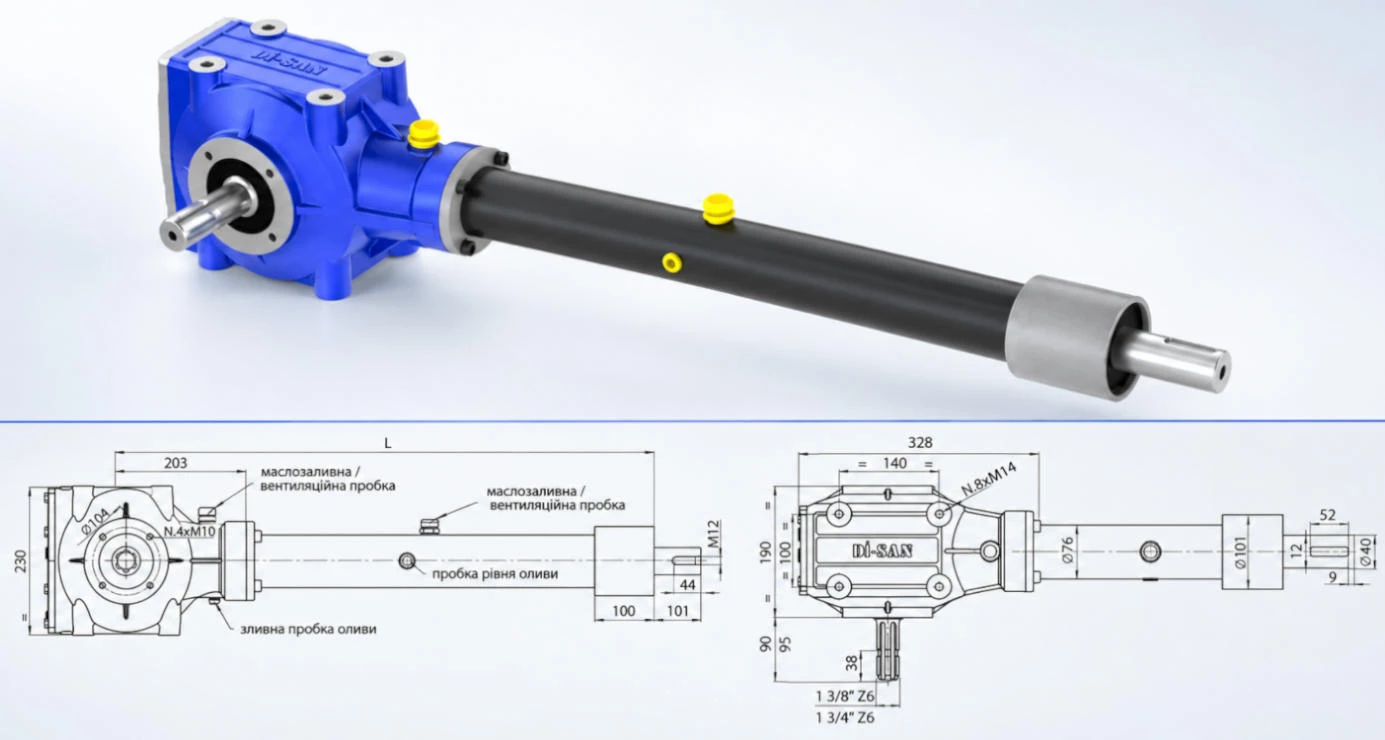
DI-SAN DS406 Gearbox for Flail Mulchers and Crop Residue Shredders
A flail mulcher operates under continuously changing loads. When grass or dry stalks are being shredded evenly, rotor resistance remains relatively stable. However, when a dense mass of vegetation, a lump of soil, a stone or another obstacle enters the working area, resistance can increase abruptly. The gearbox must maintain the required rotational speed, transmit power and withstand repeated dynamic loads.
The DI-SAN DS406 is a right-angle speed-increasing gearbox for flail mulchers and crop residue shredders. It receives the standard input speed of 540 rpm from the machine’s driveline and increases it to 1,620 rpm. The manufacturer specifies a rated input power of 52 kW, or 70 hp, and an output torque of 298 Nm.
What Machines Is the DI-SAN DS406 Designed For?
In the Turkish documentation, the application of the DS406 is identified as Sap Parçalama Makinası, meaning a machine for shredding stalks and crop residues. The English-language catalogue uses the more precise international term Flail Mulcher.
This type of mulcher usually has a horizontally positioned rotor fitted with pivoting flails or hammer blades. As the rotor turns, these working elements shred the vegetation and distribute the resulting material across the ground.
The DS406 can be used in the drivetrains of machines intended for:
- shredding stubble;
- processing maize and sunflower stalks;
- cutting grass and weeds;
- shredding crop residues;
- maintaining pastures and overgrown areas;
- mulching between rows in orchards and vineyards;
- preparing fields for subsequent operations.
The machine’s capabilities depend not only on the gearbox but also on the rotor design, blade type, working width, cutting height and maximum permitted residue diameter.
How a Flail Mulcher Differs from a Rotary Mower
DI-SAN classifies the DS406 as a gearbox for a Flail Mulcher. This distinction is important because rotary mowers, disc mowers and flail mulchers may appear to perform similar work but use fundamentally different working components.
In a flail mulcher, the rotor is positioned horizontally across the direction of travel. Flails or hammer blades rotate around the horizontal axis and strike the vegetation repeatedly. The machine is designed not merely to cut vegetation but to shred it intensively and distribute it evenly across the surface.
In a rotary mower, the cutting blades generally rotate in a horizontal plane around a vertical axis. Rotary disc mowers also use their own driveline arrangements and specialised gearboxes.
The DS406 should therefore not be installed automatically in place of a mower gearbox solely because its power rating or output speed appears to match.
Technical Specifications of the DI-SAN DS406
| Specification | Value |
|---|---|
| Application | Flail mulcher and crop residue shredder |
| Transmission type | Right-angle speed-increasing gearbox |
| Gear ratio | 1:3 |
| Input speed | 540 rpm |
| Output speed | 1,620 rpm |
| Rated input power | 70 hp / 52 kW |
| Output torque | 298 Nm |
| Recommended oil | SAE 90 / SAE 140 |
| Oil capacity | 2.50 liters |
| Dimension L | Can be produced to order |
The gearbox listed on the BAS website has an L dimension of 744 mm. This dimension must be checked against the design and dimensions of the gearbox installed on the particular machine.
How the DS406 Gearbox Works
The DS406 input shaft is designed for a rotational speed of 540 rpm. Inside the housing, a bevel gear set changes the direction of power flow while increasing the speed threefold. The gearbox therefore produces an output speed of 1,620 rpm.
Technically, the DS406 is not a reduction gearbox but a speed-increasing transmission, or multiplier. However, agricultural parts catalogues traditionally use the general term “gearbox” for units of this type.
The high output speed is required for the intensive operation of flails or hammer blades. As the rotor turns, the working elements must not only cut the vegetation but strike it repeatedly, reducing the length of the residues and helping them decompose more easily.
The specified 1,620 rpm is the speed of the DS406 output shaft. It can only be described as the rotor speed if there is no additional transmission stage between the gearbox and the rotor. If the machine uses a belt drive or another intermediate transmission, the actual rotor speed is also determined by the ratio between its pulleys or gears.
Why the 1:3 Gear Ratio Is Critical
With an input speed of 540 rpm, the 1:3 gear ratio produces an output speed of 1,620 rpm:
540 × 3 = 1,620 rpm.
Installing a gearbox with a different ratio changes the operating speed of the working unit. Insufficient rotor speed can reduce shredding quality, leave untreated strips and increase the load on the tractor. Excessive speed can overload the bearings, blades, mounting points and rotor itself.
A matching input speed of 540 rpm does not mean that any visually similar gearbox will be suitable. The output speed, direction of rotation, shaft configuration and installation geometry must also be verified.
Rated Power of 52 kW and Output Torque of 298 Nm
The DS406 has a stated input power rating of 52 kW, or 70 hp. This figure describes the load capacity of the gearbox rather than providing a complete recommendation for tractor selection.
The tractor power must meet the requirements of the entire mulcher. Working width, rotor mass, blade number and type, vegetation density, forward speed and the presence of an additional belt drive all influence the power requirement.
If the machine manufacturer specifies a higher tractor power requirement, this does not necessarily mean that the full amount of power is continuously transmitted through a single gearbox. Nevertheless, the permissible load of the DS406 itself must not be exceeded.
The output torque of 298 Nm must be considered together with the output speed of 1,620 rpm. Selecting a gearbox based solely on torque without considering speed and power can result in an incorrect choice.
How the DS406 Differs from the DI-SAN DS205
The DS406 and DS205 share several specifications:
- a 1:3 gear ratio;
- an input speed of 540 rpm;
- an output speed of 1,620 rpm;
- an oil capacity of 2.50 liters.
Despite these similarities, the two models are not interchangeable.
The DS205 is intended for rotary mowers and has a rated input power of 37 kW and an output torque of 212 Nm. The DS406 is designed for flail mulchers, is rated for 52 kW and provides an output torque of 298 Nm.
The models also differ in housing design, shaft arrangement, mounting geometry and connection to the working mechanism. The DS205 must therefore not be installed in place of the DS406, or vice versa, without checking the technical drawings.
Difference Between the DS406 and the DS407 Forestry Mulcher Gearbox
In the DI-SAN catalogue, the DS406 and DS407 are assigned to different machine types. The DS406 is intended for a conventional crop residue flail mulcher, whereas the DS407 is identified as a gearbox for a Forestry Mulcher.
Forestry equipment is designed for heavier work involving woody vegetation, branches and shrubs. It may use a different rotor design, a reinforced frame and a different driveline arrangement.
Even if some specifications of the two gearboxes are identical, this does not confirm interchangeability. Shaft length, spline dimensions, mounting points and housing position must still be checked.
What Does L=744 mm Mean?
The official DI-SAN documentation states that dimension L for the DS406 can be manufactured to order. The gearbox may therefore be supplied with different values of this dimension to suit different machine designs.
The BAS website lists a DI-SAN DS406 gearbox with an L dimension of 744 mm.
L=744 mm is not merely a reference measurement. It is part of the specific gearbox configuration and must match the requirements of the machine. The DS406 should not be selected solely by model designation and gear ratio without checking dimension L.
The published DI-SAN drawing also shows 1⅜-inch Z6 and 1¾-inch Z6 spline connections. Before ordering, these specifications must be compared with the actual shafts of the existing equipment.
How to Select a DS406 for a Particular Mulcher
The following parameters must be checked before ordering:
- The make and model of the mulcher.
- The designation of the original gearbox.
- The required input speed of 540 rpm.
- The required output speed of 1,620 rpm.
- The 1:3 gear ratio.
- The permitted power and torque.
- The direction of rotation of the input and output shafts.
- The position of the shafts relative to the housing.
- The type and dimensions of the spline connections.
- The value of dimension L.
- The spacing between the mounting holes.
- The installation position on the machine frame.
- The presence of an additional belt or gear transmission.
If the marking on the original gearbox is no longer visible, photographs should be provided from several angles together with images of the shafts and mounting points. The principal dimensions, particularly dimension L and the mounting-hole spacing, should also be measured.
Why a Flail Mulcher Gearbox Fails
A flail mulcher operates under repeated impact loads. Pivoting flails can partially absorb contact with an obstacle by swinging backwards, but they cannot completely protect the drivetrain from overload.
Common causes of damage include:
- stones, metal objects or large pieces of wood entering the working area;
- the rotor becoming blocked by dense vegetation;
- engaging the PTO abruptly at high engine speed;
- operating with a PTO speed above 540 rpm;
- a seized or incorrectly adjusted slip clutch;
- using an unsuitable shear bolt;
- operating with missing flails or flails of unequal weight;
- worn blade or flail mounting points;
- a bent or unbalanced rotor;
- excessive belt tension where a belt drive is used;
- an incorrect PTO shaft operating angle;
- loose gearbox mounting bolts;
- insufficient oil;
- damaged seals;
- a blocked breather;
- prolonged operation with excessive vibration.
Operation with an unbalanced rotor is particularly dangerous. Vibration is transmitted to the output shaft, bearings and gearbox housing, accelerating wear of the bearing seats, gear teeth and seals.
Oil and Maintenance of the DI-SAN DS406
DI-SAN specifies SAE 90 or SAE 140 oil for the DS406. The nominal oil capacity is 2.50 liters.
The publicly available DI-SAN documentation does not specify a universal oil-change interval, an API service classification or precise temperature ranges for selecting between SAE 90 and SAE 140. The specific oil and replacement interval should therefore be determined from the mulcher manufacturer’s operating manual and the supplier’s recommendations.
Before the beginning of the operating season, inspect:
- the oil level and condition;
- the housing and seals for leakage;
- the gearbox breather;
- play in the input and output shafts;
- the tightness of the mounting connections;
- the condition of the PTO driveline;
- the operation of the protective clutch;
- the condition of the flails and their mountings;
- rotor balance;
- the condition of belts and pulleys, where fitted.
The PTO should be engaged at a low engine speed. After engagement, the driveline should be brought gradually to the working speed of 540 rpm. Abrupt engagement under load creates an impact that is transmitted simultaneously through the PTO shaft, gears, shafts and bearings.
Unusual noise, excessive vibration, oil leakage or excessive housing temperature requires the machine to be stopped and the driveline inspected.
Where to Buy the DI-SAN DS406 Gearbox
BAS-Agro offers the DI-SAN DS406 gearbox in the L=744 mm configuration. Current pricing, availability, photographs and technical specifications are provided on the product page:
Buy the DI-SAN DS406 L=744 mm gearbox from BAS
Delivery is available throughout Ukraine. Before placing an order, customers should provide the mulcher model, the marking of the original gearbox and photographs of the connection points. This information allows the gear ratio, shaft dimensions, dimension L and mounting compatibility to be checked.
The DI-SAN DS406 is a right-angle speed-increasing gearbox for flail mulchers and crop residue shredders. It operates with an input speed of 540 rpm, increases it to 1,620 rpm and has a rated input power of 52 kW. The specified output torque is 298 Nm.
The model is designed specifically for a Flail Mulcher with a horizontal rotor and should not be replaced automatically with a gearbox for a rotary mower or forestry mulcher. Even where the gear ratio is identical, the power rating, shaft configuration, mounting geometry, direction of rotation and dimension L must be considered.
Correct selection, smooth PTO engagement, a functional protective clutch, proper rotor balance and regular oil-level inspections directly affect gearbox reliability and the service life of the entire mulcher.
Add a comment
Comments
There are no comments yet. Be the first to comment.
You must be logged in to post a comment
Login