
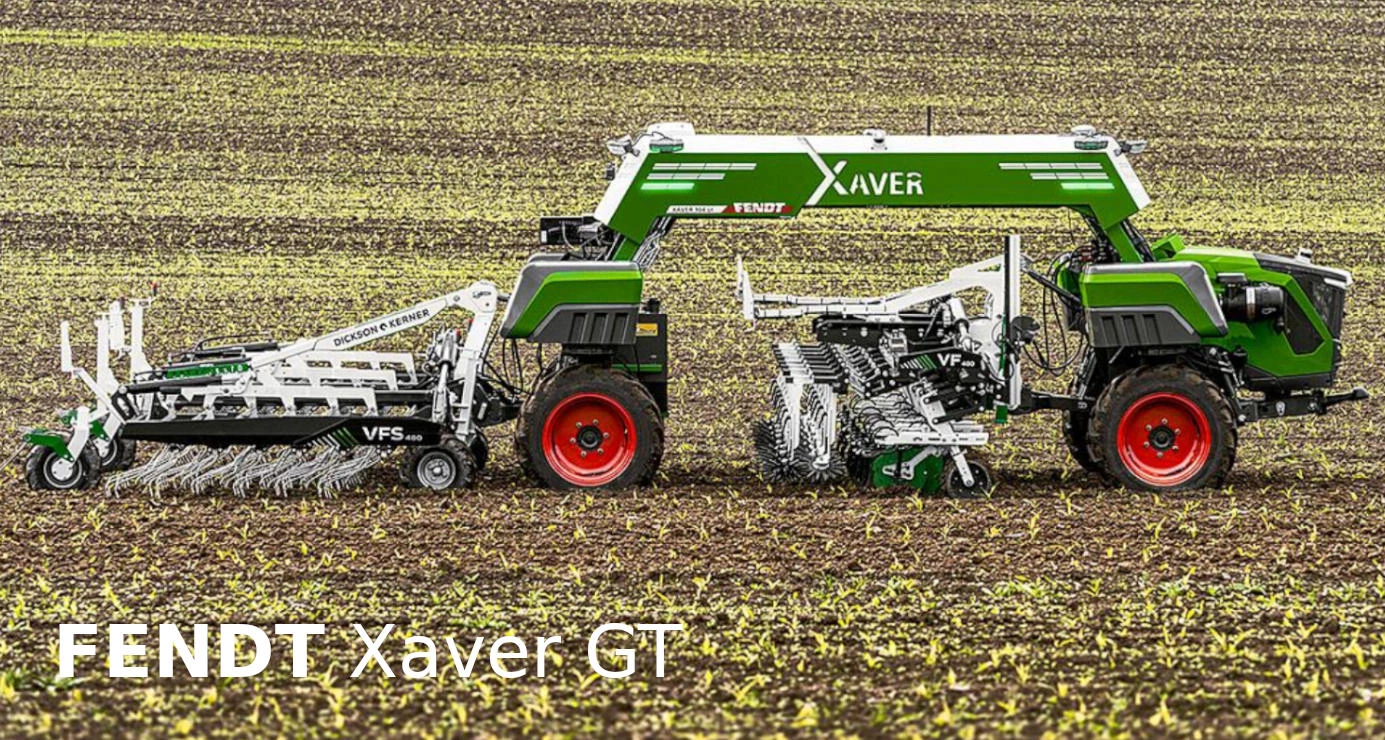
Fendt Xaver GT for Vegetable Farming: An Autonomous Implement Carrier for Precision Inter-Row Cultivation
Vegetable farms face the same pressure points every season - labor shortages during peak periods, the need for multiple passes across the field, tighter requirements to reduce chemical load, and a higher risk of soil compaction when working in wet conditions. In response to these challenges, Fendt in 2025 presented an evolution of the Xaver concept in the form of an autonomous implement carrier - Fendt Xaver GT (an unmanned system), positioned specifically for operations such as mechanical crop care and inter-row work that are common in vegetable production.
Why Xaver GT is relevant to vegetable growers
At the core of the project is mechanical weed control in row crops (including root crops), which is gaining renewed attention both in organic and conventional farming due to herbicide resistance and the broader demand to reduce pesticide use. For these systems, accurate guidance along the crop row is critical to work very close to plants without damage.
For vegetable production, two priorities stand out:
- minimal soil compaction across repeated passes;
- stable operation with precision implements at low speeds and high accuracy.
These are the key arguments highlighted by Fendt in its official communications around Xaver GT.
Machine concept: a “system carrier” with two implement zones
Fendt Xaver GT is designed as an autonomous system carrier vehicle with two attachment points - mid-mount and rear-mount. Both are implemented with standardized interfaces (three-point linkage and hydraulic connections), which is essential for compatibility with existing implements in the farm fleet.
A major engineering idea for inter-row operations is the central placement of the implement between the axles. Compared with a rear-mounted setup, this reduces the impact of steering corrections on lateral implement movement, which improves accuracy when working close to the row.
What is known from official specifications (Xaver GT)
Based on Fendt’s official materials (Agritechnica 2025) and the described concept data:
- the (empty) machine mass is presented as lightweight, around 3 t, with emphasis on balanced weight distribution to reduce soil compaction;
- wheelbase - 3.4 m (stability and smooth running);
- lifting capacity of both three-point linkages - 2.0 t (mid-mount and rear);
- adjustable track width for different cropping systems: 1.5 m / 1.8 m / 2.0 m / 2.25 m;
- ground clearance - 50 cm, enabling work at later crop stages with reduced plant damage risk.
These parameters fit well with vegetable rotations where multiple operations are carried out on the same field throughout the season (crop care, inter-row cultivation, nutrient applications, mechanical weed control).
Powertrain and mobility: diesel-electric hybrid and four-wheel steering
One of the most notable engineering features of Xaver GT is a series diesel hybrid concept. Officially described elements include:
- a 25 kW (48 V) generator driven by a diesel engine;
- a 9 kWh buffer battery to provide short-term peak power;
- electric wheel drive, with all four wheels independently steerable.
For field work, a maximum operating speed of up to 10 km/h is stated, and several steering modes are referenced (including full four-wheel steering and “crab” movement / combinations intended to improve handling on slopes). This directly supports the needs of inter-row operations where precise trajectories and tight headland maneuvers matter.
Guidance, safety, and “smart” inter-row control
Fendt describes a two-level safety concept:
- a baseline layer with monitoring and control features, including geofencing and status supervision;
- an advanced layer using lidar and cameras for early obstacle detection and automated responses.
For inter-row cultivation, the mid-mount implement system is described as follows:
- the mid-mount lifting unit is built on a sliding frame;
- guidance along the crop row is linked to RowPilot, developed in cooperation with PTx, positioned as a robust row-detection capability even in challenging field conditions (wind, uneven terrain).
Operation and job planning are associated with the FendtONE ecosystem, enabling remote access via phone, tablet, or PC, and combining satellite guidance with visual and lidar systems that apply AI-based functions to recognize crop rows and tramlines even when GNSS quality degrades.
Application scenarios in vegetable production
From the official concept description, Xaver GT is designed as an autonomous “executor” for repetitive seasonal tasks. Fendt illustrates a workflow where heavy operations remain with the tractor, while Xaver GT is dedicated to seeding and crop-care work (including inter-row operations).
In practical vegetable-farm terms, that translates into:
- inter-row loosening and mechanical weeding (mid-mount linkage + row-accurate guidance);
- harrowing and light soil cultivation passes when minimizing compaction is critical;
- repetitive crop-care operations where autonomy can deliver measurable labor savings.
Important context: Xaver is not a single robot - it is a platform direction
The Xaver name at Fendt is historically tied to field robotics. Alongside Xaver GT, Fendt has also developed a smaller concept direction focused on swarm-based seeding robots. In an earlier official Xaver communication (seeding concept), parameters such as a 20 L seed hopper (roughly 0.5 ha at 90,000 seeds/ha), a 2.6 kWh battery (around 1.5 hours of operation before returning to base), and a six-unit swarm capacity of about 3 ha/h (considering charging cycles) were mentioned. This context shows Fendt’s broader trajectory - from precision seeding concepts toward wider crop-care autonomy.
What this may mean for Ukrainian vegetable farms
In Ukrainian conditions (labor shortages, higher input costs, narrow weather windows, and difficult moisture regimes), the potential practical advantages of this machine class look straightforward:
- consistent repeated passes with a lower risk of soil compaction;
- reduced reliance on operator availability and human factor in inter-row operations;
- a path toward lower-chemical crop-care approaches where economically justified (vegetables, root crops, seed production, niche crops).
At the same time, it is important to note that Xaver GT is presented as a concept / development direction and a technology demonstrator linked to Agritechnica 2025 and Fendt’s communications in 2025.
Where to buy spare parts and manufacture components in Ukraine
If your machinery fleet is already working in the field and needs reliable spare parts support, spare parts for agricultural machinery of various brands can be purchased from BAS-Agro (Cherkasy, Ukraine) via https://bas.ua. BAS-Agro also offers manufacturing of parts based on drawings or physical samples, which is particularly useful when a non-standard component is required, a unit must be restored quickly, or small-batch production is needed for a specific technical task.
Add a comment
Comments
There are no comments yet. Be the first to comment.
You must be logged in to post a comment
Login