
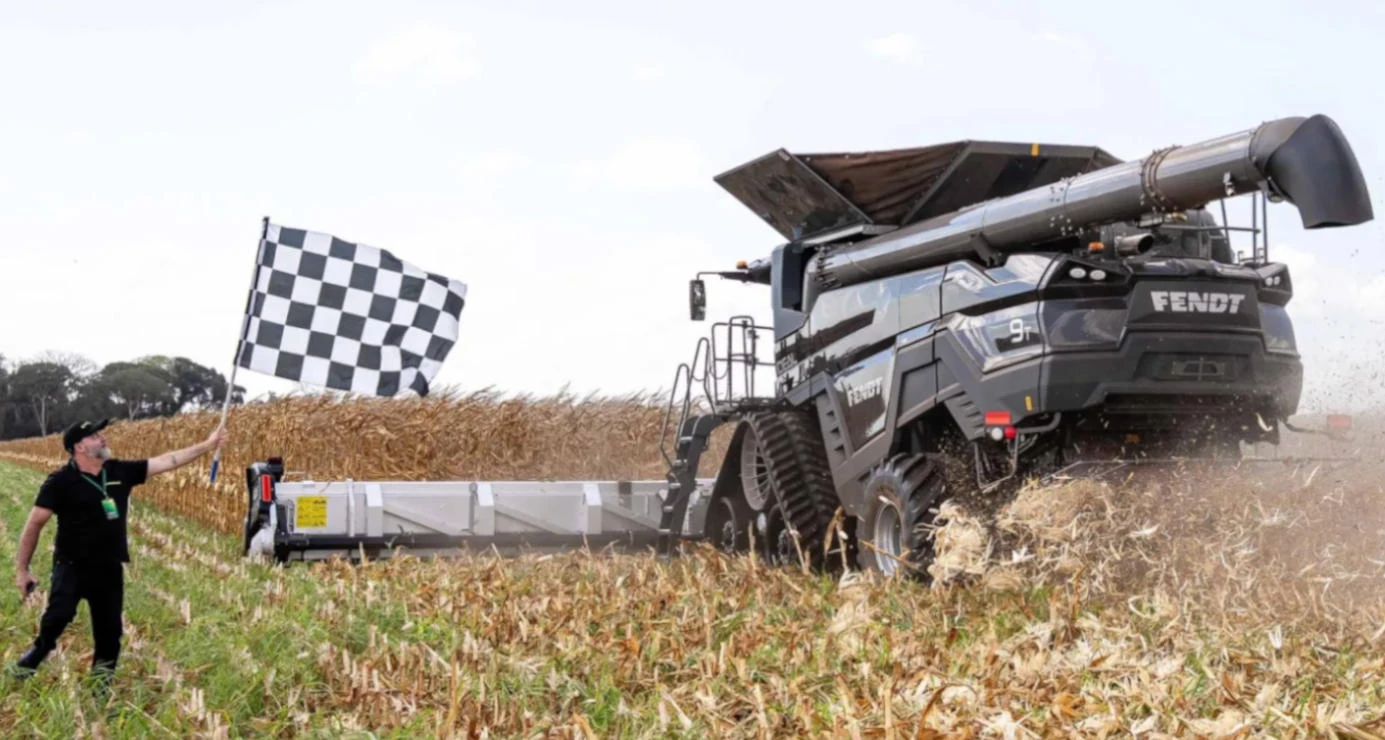
Fendt IDEAL 9T Harvests 2,599 Tonnes of Corn in 24 Hours, Setting a New Brazilian Record
One combine harvester, one header and 24 hours of continuous operation — under these conditions, a Fendt IDEAL 9T harvested 2,599 tonnes of second-crop corn grain. The record was set on 8–9 August 2026 at Fazenda Recanto near Sidrolândia in the Brazilian state of Mato Grosso do Sul.
The result was officially verified by RankBrasil. The achievement was recognised as the largest volume of second-crop corn harvested by a single combine in 24 hours in Brazil. It is important to clarify that this was a Brazilian national record, not a world record.
Three Records During a Single Harvesting Operation
The challenge began at noon on 8 August and ended at noon the following day. During the same 24-hour cycle, the Fendt IDEAL 9T set three separate records covering 8, 12 and 24 hours of operation.
| Harvesting period | Grain harvested | Average output |
|---|---|---|
| 8 hours | 912.72 tonnes | 114.09 t/h |
| 12 hours | 1,247.7 tonnes | approximately 104 t/h |
| 24 hours | 2,599 tonnes | approximately 108.3 t/h |
The final volume was equivalent to approximately 43,300 standard Brazilian 60 kg sacks. The RankBrasil record states that the official result of 2,599 tonnes was rounded, so the equivalent number of sacks should also be regarded as an approximate figure.
Teylor Olbermann operated the combine during the first 12 hours. Once the 12-hour record category had been completed, Adilson Pereira took over and continued until the end of the 24-hour challenge. The same combine and corn header were used throughout the entire operation. These details are confirmed by the RankBrasil record.
235.2 Hectares of Corn Harvested in 24 Hours
During the 24-hour period, the combine harvested 235.2 hectares of corn. This produced an average field capacity of 9.8 ha/h across the full duration of the challenge. Dividing the 2,599 tonnes of harvested grain by the total area gives a calculated average field yield of approximately 11.05 t/ha, equivalent to about 184 sacks of 60 kg per hectare.
RankBrasil reports slightly different figures for the periods when the machine was actively harvesting: an average operating speed of approximately 8.4 km/h and an effective capacity of around 10.8 ha/h. The difference between this figure and the full-period average of 9.8 ha/h can be explained by headland turns, movements across the field and other operational activities included in the overall timing.
In this case, continuous operation means that the same combine and header remained within a single uninterrupted harvesting cycle. It does not necessarily mean that the header was cutting crop during every minute of the 24-hour period.
A 27-Row GTS X25 Corn Header
The Fendt IDEAL 9T was equipped with a 27-row GTS X25 corn header. Row spacing was 50 cm, giving the header a nominal working width of 13.5 m.
A header of this size allowed a substantial volume of crop material to enter the threshing and separation system. At the same time, maintaining such a high output required accurate row guidance, consistent crop feeding and carefully coordinated harvest logistics.
The record would not have been possible without enough grain carts and trucks. Transport vehicles had to receive the grain, deliver it for weighing and return to the field without forcing the combine to wait. RankBrasil specifically highlighted the contribution of the Fazenda Recanto team, which coordinated the grain carts, trucks, routes and weighing facilities needed to support the 24-hour operation.
Technical Features of the Fendt IDEAL 9T
The letter T in the model name identifies the TrakRide tracked undercarriage. The system increases the machine’s contact area with the ground, improves traction and distributes its weight more evenly across the soil.
According to the technical specifications for the Brazilian Fendt IDEAL 9T, the combine is powered by a MAN engine with a maximum output of 485 kW, or 660 hp. It is also equipped with a 17,100-litre grain tank.
The Dual Helix threshing and separation system uses two longitudinal rotors. Fendt lists the following specifications for the IDEAL 9T:
- threshing area — 1.66 m²;
- separation area — 2.88 m²;
- total ventilated cleaning area — 6.79 m²;
- grain tank capacity — 17,100 litres;
- fuel tank capacity — 1,500 litres;
- maximum engine output — 485 kW, or 660 hp.
The rotors are 4.84 m long. Their design keeps the crop material within the processing area for an extended period, supporting effective grain separation even when the combine is operating under a heavy and continuous load.
Grain Losses Were Described as Negligible, but No Exact Figure Was Published
RankBrasil representatives and the technical team monitored grain losses during the challenge. According to the published information, losses were considered negligible despite an average 24-hour output exceeding 108 t/h.
However, the available reports do not provide an exact loss percentage or a figure expressed in kilograms per hectare. The description of the losses as “negligible” therefore remains a qualitative assessment and cannot be used for a direct comparison with independently tested combines.
The reports also do not disclose the average moisture content of the harvested corn or whether the recorded grain mass was adjusted to a standard moisture level. RankBrasil states that the result was determined from monitored truck weighings. The record therefore confirms the physical mass collected during the operation, but the available data are insufficient for detailed comparisons based on dry matter or energy consumption.
A Record for the Combine or the Entire Harvesting System?
The result of 2,599 tonnes in 24 hours demonstrates the capabilities of the Fendt IDEAL 9T, but it cannot be attributed solely to engine power or rotor design. The final output also depended on the field’s high yield, the 27-row header, the operators’ experience, the machine’s technical reliability and the uninterrupted removal of grain.
In practice, the challenge tested the entire harvesting system — from cutting the crop to unloading, transporting and weighing the grain. A delay in any part of this chain would have reduced the final result.
For this reason, the Brazilian Fendt IDEAL 9T record has practical significance for large agricultural enterprises. It demonstrates that during a narrow harvesting window, success depends not only on the combine’s maximum processing capacity but also on the farm’s ability to maintain a high operational pace over an extended period.
Add a comment
Comments
There are no comments yet. Be the first to comment.
You must be logged in to post a comment
Login