
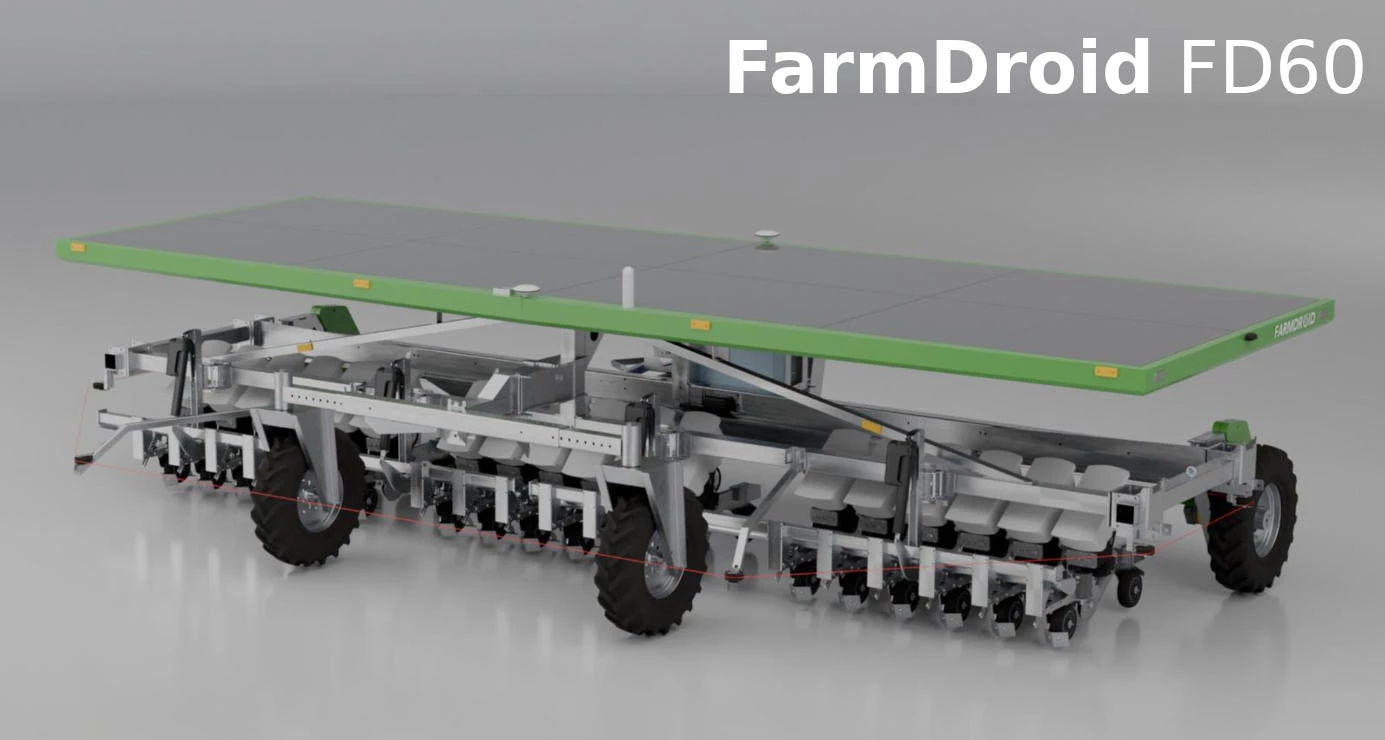
FarmDroid FD60 Review: An Autonomous Robot for Seeding and Mechanical Weeding
Danish company FarmDroid has introduced the FD60, a new autonomous field robot designed for farms that require more capacity than the smaller FD20 can provide. The machine can independently perform two consecutive operations: seeding row crops and then mechanically removing weeds between and within the rows. It does not use cameras to recognise plants and does not require an operator to remain continuously present in the field.
The model was officially unveiled on 1 September 2026. Orders are already open, while the first deliveries are scheduled for January 2027. Detailed information about the new machine is available on the official product page: https://farmdroid.com/products/farmdroid-fd60/
From a Niche Robot to a Machine for Larger Areas
The original FarmDroid was developed primarily for vegetable production, seed growing and organic farms, where manual weeding requires considerable labour. The FD60 develops the same concept but applies it on a larger scale. Its working width reaches 6.75 metres, and the machine can handle up to 20 rows in a single pass.
The FD60 has a nominal seasonal capacity of approximately 60 hectares, about three times the recommended capacity of the FD20. Under favourable conditions, the robot can cover up to 18 hectares within 24 hours, while its maximum travelling speed is 2 km/h. This is not particularly fast by conventional tractor standards, but an autonomous machine compensates for its relatively low speed by working for extended periods throughout the day and night.
Nevertheless, the figure of 18 hectares should be understood as a maximum daily capacity. Actual output will depend on working width, row configuration, field layout, run length, the number of headland turns, soil conditions and the duration of operational stops.
How the FD60 Finds Crops Without Cameras
FarmDroid’s technology is based on high-precision positioning rather than computer vision. During seeding, the RTK GPS system records the coordinates of every seed with an accuracy of 8 mm. When the machine returns to the field for weeding, it follows the previously created seeding map and knows where each crop plant should be located.
This enables the FD60 to work not only between the rows but also within the rows, removing weeds from the spaces between individual plants. The robot does not need to be trained to recognise a particular crop, leaf colour or weed shape. Dust, uneven lighting and changes in plant appearance during the growing season do not affect its operating principle in the same way that they can affect camera-based systems.
However, this technological advantage also determines how the machine must be used. The best results are achieved when the same robot first performs the seeding operation and later works from its own map of seed positions. The FD60 does not identify weeds by their biological characteristics. Instead, it distinguishes protected and workable areas using the recorded coordinates of the crop seeds.
Flexible Configuration for Different Seeding Patterns
The FD60 offers a working width of up to 6.75 metres, while its wheel track can be adjusted from 4.60 to 6.70 metres. Row spacing starts at 25 cm. These parameters allow the machine to be configured for different bed layouts, tramlines and row arrangements.
As one example, the manufacturer describes simultaneous operation across several vegetable beds. Another possible configuration uses 12 rows spaced 50 cm apart across an overall working width of 6 metres. The final arrangement of the working units must be determined before ordering, taking into account the crops, rotation and production system used on the farm.
FarmDroid identifies onions, sugar beet, red beet, maize, soya beans, field beans, green beans, chickpeas, endives, chicory and spinach as suitable crops for the FD60. However, compatibility with a particular crop must be assessed not only according to row spacing but also according to seed size and the availability of an appropriate seed disc.
A Seeding System for Seeds Up to 14 mm
The FD60 is equipped with the +Seed 14 mm system, designed for seeds measuring from 0.8 to 14 mm in diameter. This allows the robot to work not only with relatively small vegetable and beet seeds but also with maize, soya beans, chickpeas and various types of beans. The seed hopper has a capacity of 14 litres.
The system can perform single-seed, line or cluster seeding. The position of each seed is recorded as it is placed in the soil, meaning that the map required for subsequent weeding is created without an additional field pass.
It is important to note that the FD60 does not support the smaller +Seed 6 mm system, which allows the FD20 to handle seeds as small as 0.5 mm. Consequently, the larger model is not a direct replacement for the FD20 when working with crops whose seeds are smaller than 0.8 mm.
Mechanical Weeding Without the +Spray System
The FD60 removes weeds mechanically, both between and within the crop rows. This operation requires no herbicides, which is particularly important for organic production and for crops where manual weeding remains one of the most expensive field operations.
Unlike the FD20, the new model is not compatible with the +Spray spot-spraying system. The FD60 is therefore not an autonomous sprayer and cannot apply crop-protection products locally. If the farm’s production system requires chemical control of weeds, diseases or pests, these operations must be performed using other equipment.
For this reason, describing the FD60 as operating “without chemicals” is accurate only in relation to mechanical weed control. It does not mean that the robot independently provides a complete crop-protection programme.
Solar Panels, Battery and Petrol Generator
The FD60’s energy system differs considerably from the fully solar configuration of the smaller FD20. Eight solar panels with a combined output of 3.7 kW are installed on the roof. According to the manufacturer, they can generate up to 24 kWh of energy per day.
Electricity is stored in a 23.5 kWh lithium battery. The stored energy can provide approximately 10 hours of operation, although actual runtime will depend on workload, travelling speed, terrain and weeding conditions.
For night work, prolonged cloudy weather or intensive operation, the FD60 is equipped with an integrated Range Extender: a 3 kW petrol generator with a 12-litre fuel tank. The generator does not directly drive the wheels or working units. Its sole function is to recharge the battery, while propulsion and field operations remain electrically powered.
The FD60 is therefore more accurately described as a solar-first robot rather than a completely energy-independent solar machine. FarmDroid states that petrol consumption can be approximately 1–1.5 litres per hectare when the generator is used. The battery level can be monitored through the FarmDroid app, enabling the operator to plan refuelling without having to stop the robot immediately.
Main Technical Specifications of the FarmDroid FD60
| Specification | Value |
|---|---|
| Recommended seasonal area | Approximately 60 ha |
| Maximum daily capacity | Up to 18 ha per 24 hours |
| Working width | Up to 6.75 m |
| Number of rows | Up to 20 |
| Minimum row spacing | 25 cm |
| Adjustable wheel track | 4.60–6.70 m |
| Maximum speed | Up to 2 km/h |
| RTK GPS accuracy | 8 mm |
| Compatible seed size | 0.8–14 mm |
| Seed hopper capacity | 14 L |
| Solar panels | 8 panels, 3.7 kW combined |
| Battery | 23.5 kWh lithium battery |
| Range Extender generator | 3 kW |
| Generator fuel tank | 12 L |
| Spraying capability | Not supported |
| Weed control | Mechanical, between and within rows |
How the FD60 Differs from the FD20
FarmDroid does not position the FD60 as a complete replacement for the earlier model. The FD20 remains suitable for smaller areas, narrow production layouts, very small seeds and farms that require the optional +Spray spot-spraying system. The FD60 is intended for larger, more standardised fields where working width and daily output are the main priorities.
| Specification | FarmDroid FD20 | FarmDroid FD60 |
|---|---|---|
| Working width | Up to 3.5 m | Up to 6.75 m |
| Number of rows | Up to 12 | Up to 20 |
| Daily capacity | Up to 6 ha | Up to 18 ha |
| Recommended seasonal area | Approximately 20 ha | Approximately 60 ha |
| Seeding systems | +Seed 6 mm or 14 mm | +Seed 14 mm only |
| Seed hopper capacity | 5–8 L | 14 L |
| Power supply | Solar panels and optional Power Bank | Solar panels, battery and Range Extender |
| +Spray system | Available as an option | Not supported |
Economics Require an Individual Calculation
FarmDroid estimates that the combined cost of seeding and weeding can start from €304 per hectare across a full season. However, this figure represents a scenario calculated by the manufacturer rather than a universally guaranteed operating cost.
The economic result will depend on the price of the selected robot configuration, actual seasonal utilisation, the number of field passes, labour costs, fuel expenses and the weed-control system currently used on the farm. The most favourable conditions for achieving a return on investment arise when the robot can be used across several crops with different sowing periods and kept productively occupied throughout the season.
The Practical Significance of the FarmDroid FD60
The FD60 demonstrates how autonomous field robots are gradually moving beyond specialised equipment for small organic farms and becoming more productive machines. Its working width of up to 6.75 metres and capacity to handle as many as 20 rows make the technology potentially relevant to commercial production of onions, beet, maize and grain legumes.
At the same time, the new robot should not be regarded as a universal replacement for a tractor, seeder and complete crop-protection system. The FD60 specialises in two closely connected operations: precision seeding and subsequent mechanical weeding based on the recorded seed-position map. This specialisation is what allows the system to work without cameras, complex plant-recognition software or the continuous involvement of a machinery operator.
The principal innovation of the FarmDroid FD60 lies not in an individual working unit but in combining two stages of crop production. The robot first creates an accurate digital map during seeding and then uses it throughout the growing season. For farms where mechanical weed control is restricted by labour shortages or the high cost of manual work, this approach could become a practical route towards greater field automation.
Add a comment
Comments
There are no comments yet. Be the first to comment.
You must be logged in to post a comment
Login