
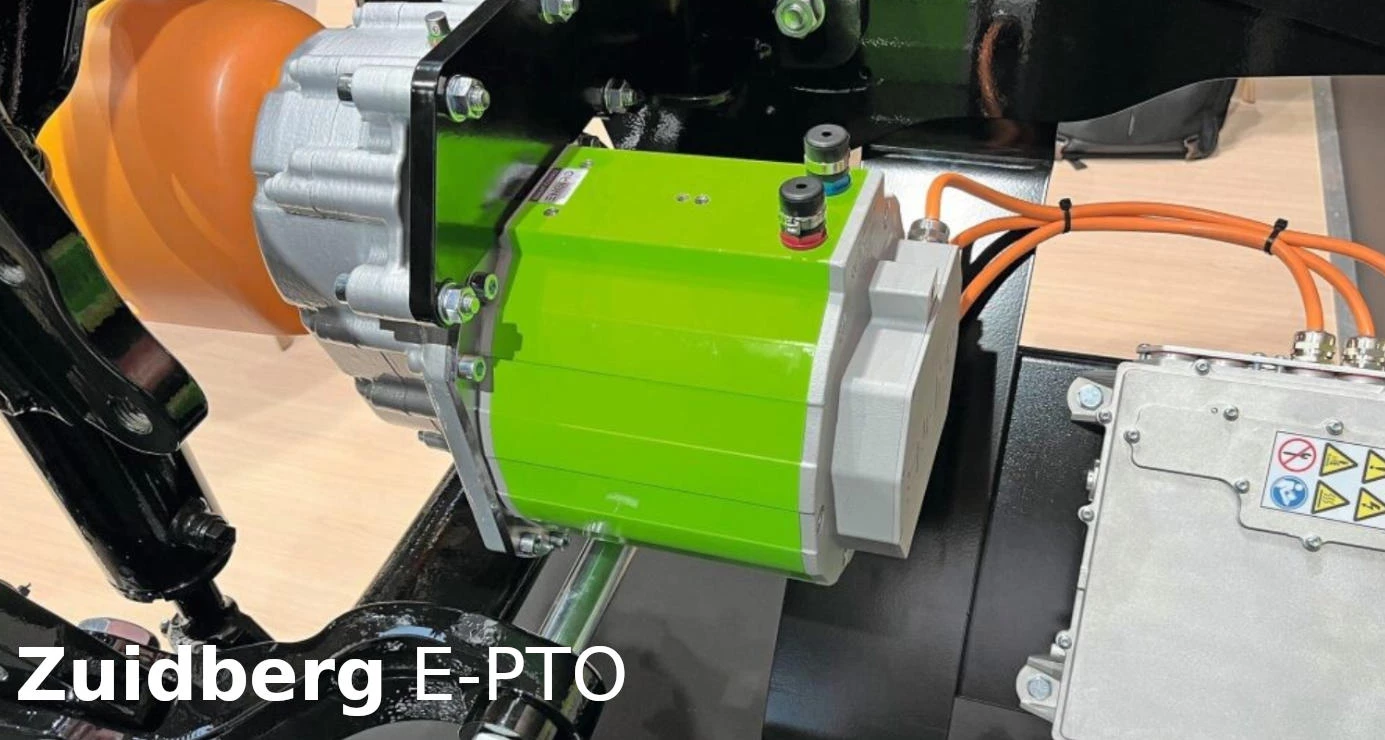
Electric Power Take-Off Shaft - a New Step in the Development of Agricultural Machinery
Zuidberg has introduced its own solution in the field of agricultural machinery electrification - the E-PTO, or electric power take-off shaft. The idea behind this development is to preserve the standardized PTO interface familiar to farmers while adapting it to new machinery where an electric motor replaces the diesel engine and a battery pack replaces the fuel tank. This approach makes it possible to combine traditional implements with new energy concepts without completely abandoning the existing fleet of mounted and trailed equipment.
In practice, this means one very important thing: the electrification of machinery does not require the immediate replacement of all working machines on the farm. Previously, switching to electric drive could imply the need for special implements with their own electrical system, but E-PTO makes it possible to use conventional implements as well, now with electric drive. For the agricultural sector, this is a serious advantage, since the cost of fully renewing the machinery fleet has always been one of the main barriers to innovation.
According to the manufacturer, the E-PTO system is connected to the machine’s electrical system and makes it possible to change the shaft’s direction of rotation and rotational speed thanks to an electric motor installed directly near the gear transmission. In addition, Zuidberg emphasizes continuous control of power, torque, and speed. This allows for more precise control of the implement, improves the quality of the operation, and increases overall efficiency. Reduced noise through transmission optimization is also highlighted, which matters both for operator comfort and for the overall working culture of the machine.
Another strong advantage of the electric PTO is that its operation is independent of the machine’s travel speed. In traditional systems, many processes are tightly linked to engine operating mode and transmission kinematics. With E-PTO, it becomes possible to run the working unit at variable drive speeds independently of the machine’s ground speed. This opens up new opportunities for more accurate process adjustment, especially where stable speed, load adaptation, and flexible implement control in different conditions are important.
Importantly, Zuidberg sees E-PTO not simply as a standalone component, but as part of a broader architecture of electric drives. The company explicitly states that it can also create transmission solutions for powering additional functions - hydraulics, pneumatics, and other auxiliary systems. Moreover, the manufacturer mentions the possibility of traction drive solutions as well. In other words, this is not just about one new component, but about the gradual formation of an entire class of transmission solutions for future machinery with low or zero local emissions.
In more recent materials, Zuidberg has already specified the system’s potential in greater detail. In particular, the company describes E-PTO as a solution for electric tractors that can operate in front or rear configuration, supports different mounting arrangements, and offers independent control of both speed and direction of rotation. Indicative power parameters are also mentioned - up to 50 kW in continuous operation and up to 110 kW of peak power, making the system suitable for a wide range of mounted implements. An inverter with CAN bus integration is also provided for connection to the onboard architecture.
For the agricultural market, this is not simply another technical novelty, but a sign of changing approaches to power transmission in farming. If the power take-off shaft was previously associated exclusively with a mechanical link to an internal combustion engine, it is now gradually becoming a universal interface that can preserve the familiar compatibility of machinery while operating within a new electric logic. That is why E-PTO can be seen as a transitional but very important technology between the classic tractor and a completely new generation of energy-efficient machines.
For Ukrainian farms, such solutions currently look more like a technological benchmark for the future than a mass-market tool of today. However, the trend is obvious: manufacturers are already preparing the technical foundation for an era when electrification will affect not only compact municipal equipment, but also the full-scale agricultural segment. And while the market moves toward new concepts, high-quality components and assemblies remain essential for the stable operation of existing agricultural machinery. You can browse a catalog of spare parts for agricultural equipment at https://bas.ua/.
Add a comment
Comments
There are no comments yet. Be the first to comment.
You must be logged in to post a comment
Login