
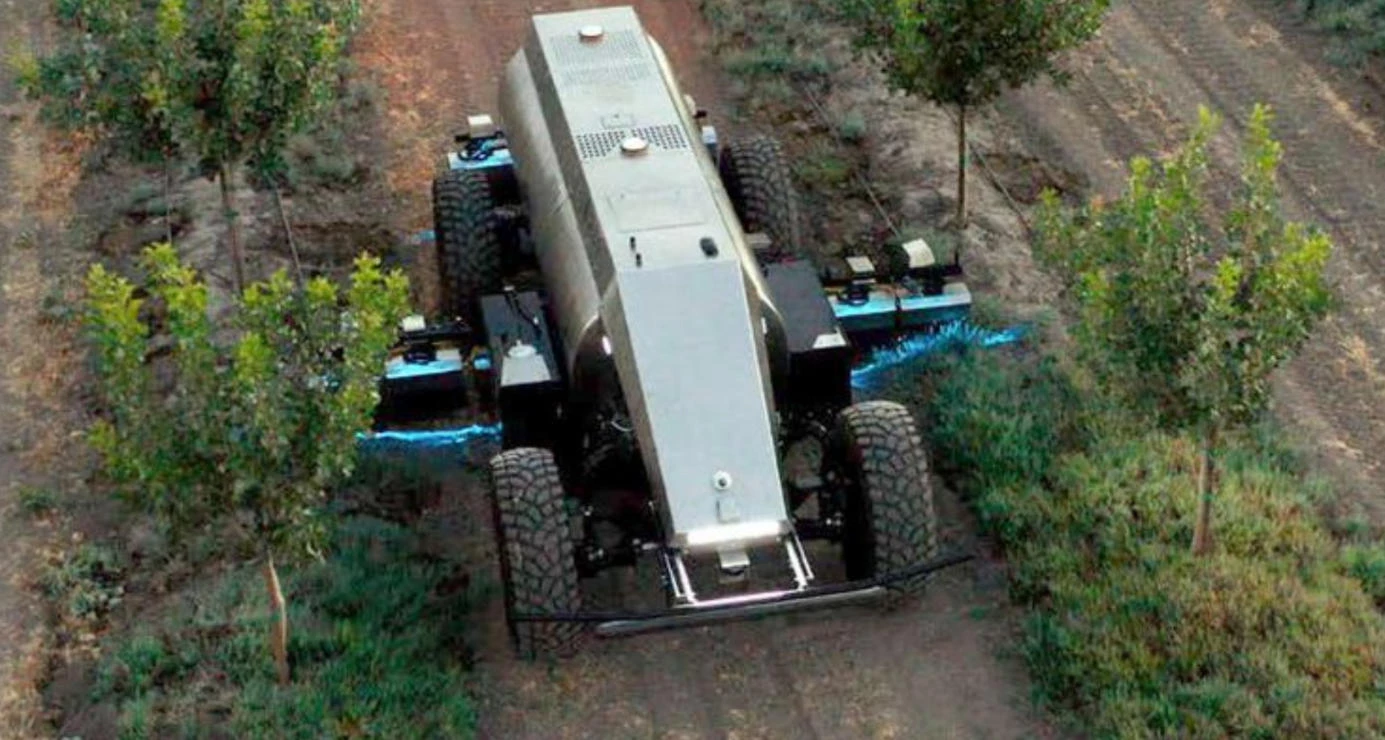
Electric GUSS Autonomous Sprayer: Where Orchard Spraying Is Heading
More and more solutions are appearing on the horticultural machinery market that combine three key trends in modern agriculture at once: autonomy, spot application, and lower operating costs. Electric GUSS belongs precisely to this category - an electric autonomous orchard sprayer that has become a logical continuation of the GUSS platform for high-value fruit crops. In the trade show announcement, the model is presented as a 100% electric autonomous herbicide orchard sprayer.
At the same time, it is important that the technological foundation of this new machine is clearly reflected on the manufacturer’s own website through the Herbicide GUSS and Technology pages. There, the company explains its approach: GUSS builds autonomous sprayers for orchard work without an onboard operator, using remote supervision, navigation based on GPS, LiDAR, machine sensors, and proprietary software. The manufacturer also emphasizes that one person can monitor up to eight machines at the same time from a laptop while sitting in a pickup truck, and that the system is designed to improve efficiency, accuracy, and safety.
In essence, Electric GUSS is not just another “battery-powered robot.” It is an attempt to bring a new working model into real-world orchard farming, where the operator no longer sits in the sprayer cab, does not directly interact with the spray zone, and does not spend the entire shift making repetitive passes between rows. This is exactly the approach GUSS promotes as a response to labor shortages, human error, and rising operating costs. The company directly states that its machines help eliminate operator mistakes, reduce downtime, and improve application consistency.
Why Electric GUSS Has Drawn Attention
The main reason Electric GUSS has attracted attention is obvious: it combines autonomous movement with electric drive in a segment that has traditionally been dominated by diesel solutions. The trade show release states that the electric version was designed as a fully electric machine capable of operating through a full work shift, while also combining low operating costs and zero exhaust emissions with weed-detection and spot-application technology.
What is especially important here is that this new machine did not appear out of nowhere. The GUSS website already describes in detail the overall operating architecture of the brand’s autonomous sprayers: field mapping, spray-parameter setup, route assignment for each machine, real-time monitoring, and automatic alerts in the event of problems. In other words, Electric GUSS is not an experimental concept with no practical foundation - it is the evolution of a commercially proven platform.
What the GUSS Technology Is Built On
The manufacturer explains that GUSS autonomy is based on a combination of GPS, LiDAR, onboard sensors, and proprietary software. A specific challenge in orchard conditions is that satellite navigation does not work perfectly under tree canopies, so the company had to supplement GPS with other orientation tools. This is a very telling point: an orchard is a much more complex environment for autonomous machinery than an open field. There are narrow row spacings, irregular planting layouts, changing canopy density, shade, dust, turns at the ends of blocks, and a need for highly precise movement without damaging the plants.
Another interesting detail from the GUSS website is the Safety Vest system. The company states that when team members are near the machine wearing a special safety vest, the motion system is locked and the machine will not begin moving until the worker leaves the risk zone. For autonomous equipment, this is not a minor feature but one of the fundamental elements of real-world implementation. It is exactly this kind of solution that determines whether a robot will truly be useful on a farm rather than simply impressive at an exhibition.
Spot Application - Not Marketing, but Economics
In the case of Herbicide GUSS, the manufacturer directly refers to multiple weed-detection sensors, meaning a sensor set for accurate weed identification, as well as spot spraying technology. On the GUSS Technology page, the company adds that the Select Spray system identifies the target object and delivers exactly the amount of spray solution needed to cover a specific plant while simultaneously reducing material use and drift.
For orchard farming, this is especially important. If conventional broadcast application often works “with a safety margin,” a spot-application approach makes it possible to reduce chemical overuse, place less stress on the soil and the row middle environment, and control herbicide treatment more precisely. The exhibition release for Electric GUSS states this even more clearly: the system detects chlorophyll in weeds and sprays only where weeds are identified, which under certain conditions can reduce material usage by up to 90% depending on the level of weed pressure.
This is where the new machine has its greatest potential. Not only because it is electric, but because it combines electric drive with spot herbicide application. If a grower gets lower energy costs, lower chemical costs, and less dependence on labor all at once, then such a machine moves from the category of “interesting innovation” into the category of “a tool that directly affects farm economics.”
How the Human Role Is Changing
GUSS promotes the concept of supervised autonomy. In other words, people do not disappear from the process, but their role changes radically. Instead of constantly driving, they focus on supervision, refill logistics, responding to system alerts, and coordinating several machines at once. The company repeats several times on its website that one operator can monitor up to eight sprayers simultaneously.
For agribusiness, this is a highly practical argument. In many farms, the problem is no longer only labor cost but also the availability of people willing to perform repetitive and responsible work during narrow agronomic windows. If one person can manage several machines at once, that means a completely different shift structure, a different level of productivity, and greater resilience to labor shortages. GUSS directly describes this as an answer to labor challenges.
What the Manufacturer Says About Efficiency
The official GUSS materials include several illustrative testimonials and use cases. The company states that most operators see payback within one to three years. The brochure also provides comparisons for farms of different scales, showing that GUSS can reduce the number of machines required, lower labor demand, reduce refill downtime, and generally simplify work organization.
One particularly telling example describes a small-scale scenario: while the autonomous sprayer is working in the row, the operator can simultaneously bring in spray mix for refilling, and the downtime required to refill the tank can be reduced from a typical 45 minutes to about 3 minutes. Even if these figures are treated as a scenario rather than a universal standard for all farms, the logic is very clear: the value of an autonomous machine lies not only in travel speed, but in how it restructures the entire service cycle.
How Mature the Technology Already Is
According to the GUSS-hosted release about the company’s acquisition by John Deere, as of August 2025 more than 250 GUSS machines had been deployed worldwide, collectively covering 2.6 million acres and logging 500,000 autonomous hours. This is a very important indicator of maturity. It means we are not talking about a laboratory prototype, but about a platform with a substantial real-world field history.
The same release adds another significant detail: John Deere emphasizes that GUSS has become part of its strategy for autonomous solutions in high-value crops, and that integration with other precision agriculture tools is expected to accelerate further innovation. For the market, this is a signal that autonomous orchard spraying is moving from a niche segment toward more systematic industrial adoption.
What This Means for the Industry
Electric GUSS is interesting not only as a standalone machine, but as an indicator of change in the entire orchard protection model. In the past, discussion focused mainly on power, fan output, mobility, or tank size. Now other criteria are moving to the forefront: can the machine operate autonomously, how accurately can it identify the target, how much chemical can it actually save, how many people are needed per shift, and what footprint does it leave in terms of emissions and worker safety.
That is why the arrival of Electric GUSS looks like a sign of a broader shift. The orchard sprayer is gradually ceasing to be just a self-propelled machine for applying spray solution. It is becoming a robotic platform that combines navigation, sensors, weed-detection algorithms, remote supervision, and a new energy concept.
Spare Parts for Sprayers
Despite the active development of autonomous and electric solutions, conventional sprayers are still widely used on farms, and the timely replacement of working assemblies and wear parts remains extremely important for them. If spare parts are needed for conventional sprayers, they can be selected and purchased in the relevant section of the BAS-Agro catalog: https://bas.ua/shop/spare-parts-for-sprayers-000000033-1. This is a convenient option for farms that maintain an existing machinery fleet and are interested in the stable operation of spraying equipment during the season.
In short, Electric GUSS is one of the clearest examples of how orchard machinery is entering a phase of true autonomy. The exhibition announcement emphasizes its electric nature, full-shift operation, and zero exhaust emissions, while the GUSS manufacturer materials confirm a mature technological foundation: autonomous navigation, remote supervision of up to eight machines by a single operator, safety systems, spot application, and a clear focus on real farm economics.
For orchard growers, this means one thing: the future of crop protection will depend less and less on the traditional model of “tractor - operator - broadcast application” and increasingly on autonomous platforms that work more precisely, more consistently, and potentially more economically over the long operating cycle. And Electric GUSS is a very convincing sign that this future has already begun.
Add a comment
Comments
There are no comments yet. Be the first to comment.
You must be logged in to post a comment
Login