
Spot Spraying Technologies: How a Drone, Artificial Intelligence and a Sprayer Are Changing Crop Protection
Spot spraying is gradually moving from the category of demonstration agrotechnologies into a practical tool for large and medium-sized farms. Its logic is simple: the crop protection product is applied not across the entire field, but only where weeds or local problem areas are actually present. Behind this simplicity, however, stands a complex technological chain — high-precision imaging, plant recognition algorithms, digital application maps, accurate navigation, section or individual nozzle control, and stable operation of the sprayer itself.
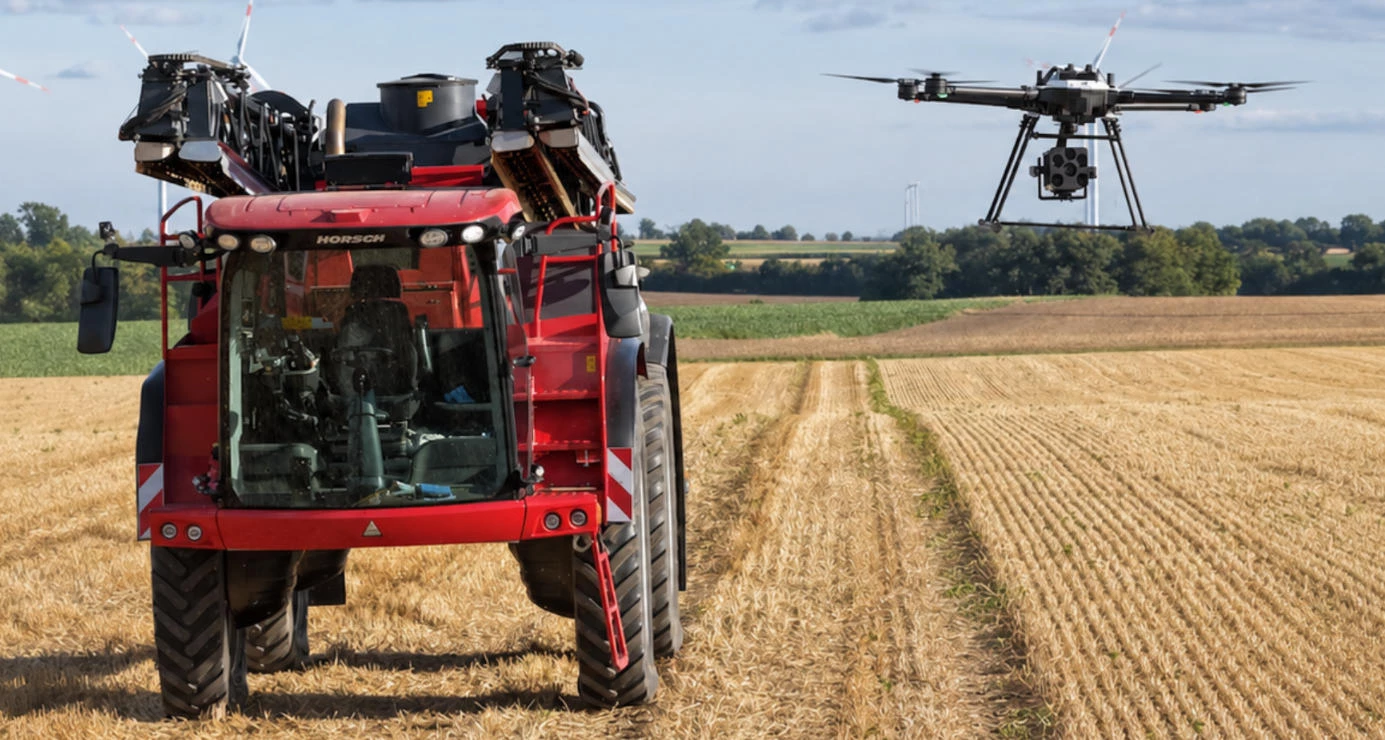
Another signal that the market is becoming ready for the practical adoption of such systems is the news about stronger cooperation between HORSCH and the German company SAM-Dimension. HORSCH is acquiring a strategic stake in SAM-Dimension, while the partners’ shared focus is the further development of SpotSpraying and PatchSpraying — that is, spot and zone-based spraying with deeper integration into HORSCH Leeb sprayers.
From Blanket Application to Weed Maps
Conventional spraying is based on the assumption that the entire field area requires the same treatment. In many cases, this is technologically justified, especially when dealing with a uniform infection background, preventive fungicide treatments, or even application of soil-applied products. But weed control is often different: weed pressure is patchy, certain species appear in local clusters, and parts of the field may be almost clean.
This is where SpotSpraying gains both economic and agronomic value. If the system can accurately determine where a weed is located and transmit this information to the sprayer, there is no need to cover the entire field with spray solution. Herbicide consumption decreases, chemical pressure on the crop is reduced, cultivated plants experience less stress, and the operator can understand how much spray solution needs to be prepared even before entering the field.
In the case of SAM-Dimension, the principle is not based on cameras mounted directly on the sprayer boom, but on a preliminary drone flight over the field. This is the so-called offline approach: first, the field is mapped; then the images are processed by artificial intelligence; and only after that is an application map created for the sprayer.
How the SAM-Dimension Solution Works
The core of the system is the SAM-CAM AI camera, which is mounted on a drone. According to the manufacturer, the system uses six-lens optics, enabling high mapping productivity — more than 60 hectares per hour. In Spot-Spray mode, the stated resolution is 1.6 mm per pixel, which means the system is not merely assessing general biomass, but recognizing individual plants.
After the drone flight, the system identifies weeds, including at early growth stages, starting from the cotyledon stage. SAM-Dimension declares the ability to distinguish between broadleaf weeds and grass weeds, as well as to create separate or combined treatment maps depending on the task. This is important because, for an agronomist, it is not enough to know that a green object is present in the field. Its biological identity and the relevance of a specific chemical action also matter.
The data is pre-processed using Edge AI, meaning that part of the analytics takes place already at the camera or field data collection level. The information is then processed in the cloud infrastructure, after which a Spot-Spray Map is generated. According to SAM-Dimension, the digital map is available within 24 hours and can be transferred in a format compatible with the sprayer terminal.
The practical advantage of this approach is that a farm does not necessarily need to immediately purchase a new “smart” sprayer with a boom-mounted camera system. If the machine has ISOBUS, accurate GPS guidance, SectionControl and a terminal capable of working with application maps, it can potentially perform spot application using a previously created map.
What HORSCH Adds
For HORSCH, this cooperation is logical: the company has long worked with high-precision Leeb sprayers, where application quality depends not only on the pump or nozzle, but on the entire architecture of the machine — boom stability, height above the target surface, section control, navigation, terminal performance, application rate control and system response speed.
HORSCH states that SAM-Dimension maps can be transferred from the SAM portal to HORSCH terminals via myHorsch. For large SpotSpraying maps, the computing capacity of the terminal is important, and HORSCH specifically emphasizes the role of the eos T10. In other words, this is not just a “map file”, but a full digital route: the drone collects data, the algorithm creates the map, the map enters the machine system, and the sprayer performs the task.
Technically, HORSCH notes that spot and zone-based spraying require SectionControl with precise GPS guidance and a terminal capable of working with SpotSpraying. The product can be applied either to individual points or to larger problem patches. In the HORSCH range, this can be performed on sprayers with pneumatic nozzle control or via PrecisionSpray — a PWM system for pulse-width nozzle control.
PrecisionSpray operates on the principle of pulse-width modulation: the nozzles open in pulses at a frequency of 20 Hz, while the application rate is controlled by changing the duty cycle. This makes it possible to adjust spray output without changing pressure or droplet spectrum. For spot spraying, this is critical, because the system must respond quickly to the application map without compromising spray quality.
Why a Drone Is Not Just a “Picture from Above”
In the early versions of digital farming, drones were often perceived as tools for attractive images or general crop condition assessment. Spot spraying places completely different demands on them. It is not enough to see that “the field is uneven”. The system must generate georeferenced information with enough accuracy for the sprayer boom to open the required sections or nozzles in exactly the right place.
The advantage of SAM-Dimension’s offline approach is that the camera is not limited by the sprayer’s travel speed during application. The drone can follow a pre-planned flight route, collect highly detailed images, and complex data processing can be completed before spraying begins. The operator receives not just a signal that “weeds are present” or “weeds are absent”, but a map with application zones and a calculation of the area to be treated.
This is especially important for work organization. If the map shows in advance that not 100% of the field needs treatment, but only 20–30% or even less, the spray solution can be prepared more accurately, unnecessary tank residues can be avoided, and water and product logistics can be planned more efficiently. For large farms and service contractors, such predictability is almost as valuable as direct herbicide savings.
Where the Technology Has the Greatest Potential
HORSCH and SAM-Dimension see the greatest potential in traditional row crops — particularly sugar beet, maize and soybean. This is logical: in row crops, it is easier to distinguish the crop from weeds, and the economic effect of reducing herbicide pressure can be clearly visible.
At the same time, the technology is gradually moving into cereal crops as well. Here, the task is more complex, especially in “green-on-green” conditions, when both the crop and the weed are green and the system has to distinguish one object from the other. But it is precisely under such conditions that artificial intelligence becomes most important: the more field data the system receives, the more accurately models can be trained for different crops, growth stages, soil types, lighting conditions and weed spectra.
Another direction is the control of local perennial weeds, such as thistle, bindweed, sorrel and other species that often develop in patches. In such cases, PatchSpraying may be no less practical than treating individual plants. The sprayer does not operate across the entire field, but only over local polygons where weed concentration really requires intervention.
Analogues and Related Solutions
SAM-Dimension is not the only company developing the logic of “drone or aerial imaging → map → sprayer”. A similar direction is promoted by Sentera with its SMARTSCRIPT Weeds: drones detect and map weeds, and within 24 hours a herbicide prescription map is generated for spot application. This approach is designed for sprayers equipped with individual nozzle or section control.
CultiWise also works with maps for Green-on-Brown and Green-on-Green spot spraying. In this case, a drone or another source of field data is used to create a map, which is then uploaded to the sprayer terminal. The company declares compatibility with various machine brands, and its cases mention John Deere, Agrifac, Amazone and other manufacturers.
Proofminder offers a similar logic: a drone or service operator collects field images, the AI platform determines weed coordinates, and then a map is generated in a format suitable for use with a conventional sprayer or a spraying drone. This is an interesting option for farms that already have machinery but want to improve precision without fully replacing their fleet.
At the same time, another class of systems is developing — online spot spraying, where cameras are mounted directly on the sprayer boom. This direction includes John Deere See & Spray, ONE SMART SPRAY by Bosch BASF Smart Farming, Greeneye Technology, WEED-IT and other solutions. Their difference is that the weed is recognized in real time while the sprayer is moving, and the nozzle opens almost instantly. This is technologically very complex, but convenient where “here and now” application is required without preliminary mapping.
Thus, the market is forming two main architectures. The first is offline: a drone or aerial imaging creates a map before application, and the sprayer performs the task according to that map. The second is online: a camera on the machine recognizes weeds during movement and controls the nozzles in real time. Both models have prospects, but their effectiveness depends on the crop, growth stage, weed pressure, sprayer type, precision requirements and the economics of a particular farm.
Limitations That Should Not Be Ignored
Spot spraying is not a universal replacement for all treatments. It works best where the problem is spatially uneven and can be reliably recognized. If the field has a uniform and high level of weed pressure, the savings will be lower. If the crop and the weed look very similar at a certain growth stage, a more accurate recognition model or additional agronomic verification is required.
The technical condition of the sprayer is also highly important. Even the most accurate map will not deliver results if the GPS is unstable, sections open with delay, nozzles are worn, the boom is unstable, or the terminal cannot process the file correctly. For SpotSpraying, not only the digital part matters, but also the mechanics: pump, valves, nozzles, filters, boom, rinsing system, sensors, lines and pressure stability.
That is why spot spraying technologies do not eliminate the need for quality service. On the contrary, they increase the requirements for the proper condition of every machine component. When a sprayer works according to a map with accuracy down to individual zones or plants, any mechanical error directly turns into a loss of application quality.
Sprayer Spare Parts on Bas.ua
For farms that operate sprayers and prepare machinery for precision application, timely maintenance of the machine’s working units is essential. On the website of LLC “Bas-Agro Group”, customers can buy spare parts for sprayers — both original parts and alternatives produced in-house. This is relevant for repair, seasonal preparation and maintaining stable sprayer operation in the field, especially when the machine is expected to deliver precision, uniform application and reliable performance of sections or nozzles.
The strategic cooperation between HORSCH and SAM-Dimension shows that spot spraying is no longer perceived as a separate experimental module. It is becoming part of an integrated crop protection system in which a drone, artificial intelligence, an application map, a terminal and a sprayer work as one technological chain.
The most interesting aspect of this trend is not only product savings, although they can be significant. The main point is a change in the very approach to field treatment. The farmer moves from an average “per hectare” rate to a specific action “in a specific place”. In the future, this logic — precise, mapped, controlled and technically executable — may become one of the key directions in the development of crop protection.
Add a comment
Comments
There are no comments yet. Be the first to comment.
You must be logged in to post a comment
Login