
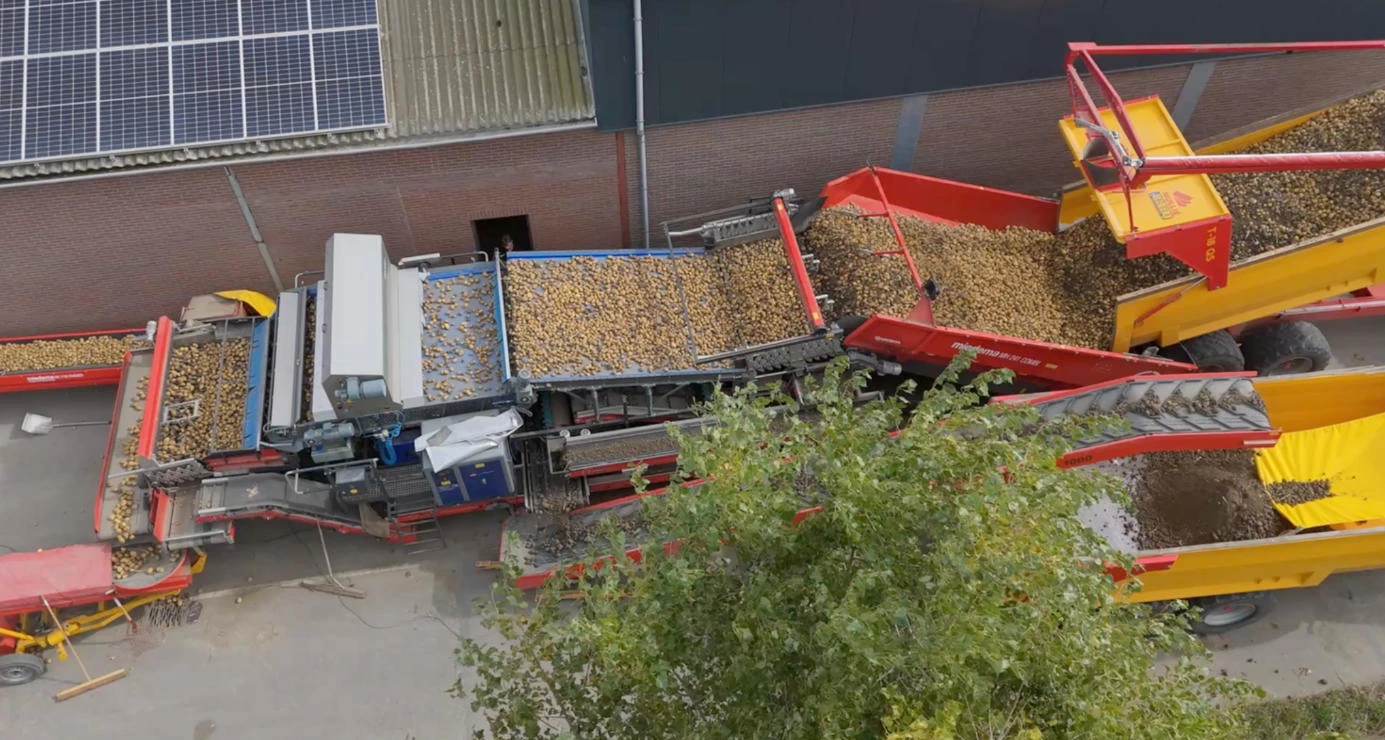
Divider Select Optical Pre-Sorter for Potatoes and Onions by Flikweert Vision - Industrial-Grade Quality for Farm Operations
During potato and onion harvest, the biggest storage problems often start right in the field - soil clods, stones, plant residue, and other foreign material enter the crop flow. From there, they “travel” through the entire handling chain, creating multiple risks at once: bruising and mechanical damage to tubers and bulbs, a higher share of waste, faster spoilage in storage piles, and additional strain on both labor and equipment. Flikweert Vision’s new solution, the Divider Select optical pre-sorter, is designed specifically as this “first line of defense” for practical on-farm use.
What Is Divider Select and Why It Matters
Divider Select is a compact optical sorter (pre-sorter) engineered for potato and onion streams. Its primary job is to remove what should not continue into storage or further processing: stones, soil clods, unwanted contaminants, and the most severe product defects - before the main grading stage.
In real farm terms, Divider Select addresses three common operational needs:
- Protecting crop quality during handling - fewer mechanical injuries, less contamination, and more consistent lot quality.
- Reducing manual labor - less time spent on inspection tables and fewer subjective decisions.
- Protecting downstream equipment - stones and hard clods are among the leading causes of unplanned downtime, conveyor wear, and damage to subsequent machines in the line.
The Idea: From Industrial Lines to Farm-Yard Practicality
Flikweert Vision is known for optical sorting solutions used by large packhouses and industrial processing lines. The original “industrial” Divider platform is recognized as a high-capacity machine with throughput around 120 t/h. In the updated product positioning, this heavy-duty class is typically associated with a “Pro” segment - essentially Divider Pro as the industrial variant.
By contrast, Divider Select was developed as a farm-oriented model: more compact, easier to integrate, and built around the same concept of industrial-grade optical analysis, but in a format suited to everyday agricultural practice.
Key Specifications That Matter on a Farm
For on-farm users, the decisive factors are not marketing claims but the “physics” of the machine - footprint, throughput, and compatibility with existing handling systems.
- Working width of Divider Select is approximately 1 meter, making it suitable for many farm setups and conveyor layouts without major rebuilding.
- Throughput is targeted at around up to 40 t/h, typically sufficient for farm-level harvesting and pre-storage handling flows.
- Placement in the line - the pre-sorter can be installed in an infeed or outfeed line (e.g., during crop intake or before storage/loading), where it removes the most problematic inclusions early.
This matters operationally: 40 t/h is high enough to avoid becoming a bottleneck for many farms, while still keeping the solution compact and economically sensible.
How Optical Pre-Sorting Works: Cameras, AI, and Ejection
Divider Select follows a standard optical-sorting architecture used in Flikweert Vision systems:
- Even product distribution on a flat conveyor so each item is clearly visible to the system.
- Industrial camera imaging captures the flow in real time with enough resolution to evaluate shape, color cues, and surface characteristics.
- AI-based classification analyzes each object and decides whether it should remain in the marketable stream.
- Physical separation mechanism (ejection fingers/pushers) removes unwanted objects - stones, clods, foreign materials, and a share of clearly defective items.
For the farm operator, this means sorting becomes a repeatable process with consistent decision logic from morning to evening - independent of staff fatigue and shift changes.
Why Potatoes and Onions Benefit Most
Potatoes and onions behave differently in a crop stream, but both are highly sensitive to foreign material and mechanical stress:
- Potatoes bruise easily and can suffer sub-skin damage. Stones and hard clods are major contributors to micro-injuries that later show up as rot and weight loss in storage.
- Onions are also vulnerable to damage and contamination. In addition to stones and clods, soft bulbs or off-grade fractions can reduce lot value and complicate further handling.
Pre-sorting at an early stage reduces the “chain reaction” - fewer injuries on the line, fewer infection sources in storage, and a cleaner stream for subsequent processing steps.
Practical Integration: Typical Use Scenarios
Divider Select is positioned as a solution for real-world agricultural practice - where lines are often configured “for the season,” fast commissioning matters, and overly complex settings are undesirable.
Common scenarios include:
- During harvest intake - remove stones/clods before the crop enters temporary storage or further handling.
- Before storage - improve lot cleanliness and reduce risks of self-heating and rot development.
- Before shipping - stabilize quality and reduce customer complaints related to contamination.
A key advantage is that the farm gains an “industrial” level of quality control without needing to build a full industrial packhouse.
The Economics: Where Payback Comes From
Return on investment in optical pre-sorting typically comes from several smaller effects that add up:
- Lower storage losses (less damage - fewer rots and write-offs).
- Reduced manual labor (fewer people on sorting tables or reallocation to other tasks).
- Less downtime (stones and hard contaminants often trigger stoppages and repairs).
- More consistent lot quality (potentially better pricing and fewer penalties/claims).
For farms with short, high-pressure harvest windows, the decisive benefit is often simple: getting through the season without quality breakdowns and without equipment disruptions.
Divider Select by Flikweert Vision is a practical step toward making optical sorting a standard not only for large sorting centers but also for farm-level operations. With a compact footprint (about a 1-meter working width), throughput up to around 40 t/h, and a focus on early-stage pre-sorting, it offers potato and onion producers a real tool to control quality from the first meters of the conveyor belt - long before problems enter storage or spread across the entire batch.
Add a comment
Comments
There are no comments yet. Be the first to comment.
You must be logged in to post a comment
Login