
Die Restoration Using Laser Metal Deposition
A local chip on a working surface does not necessarily mean that the die must be scrapped and manufactured again. If the main body of the tool has retained its geometry and has no critical damage, the defective area can be restored using laser metal deposition.
Bas-Agro LLC provides die restoration services involving the local build-up of metal followed by machining of the damaged area to the required dimensions. This technology can return the tool to operation without the need to manufacture a new and costly component.
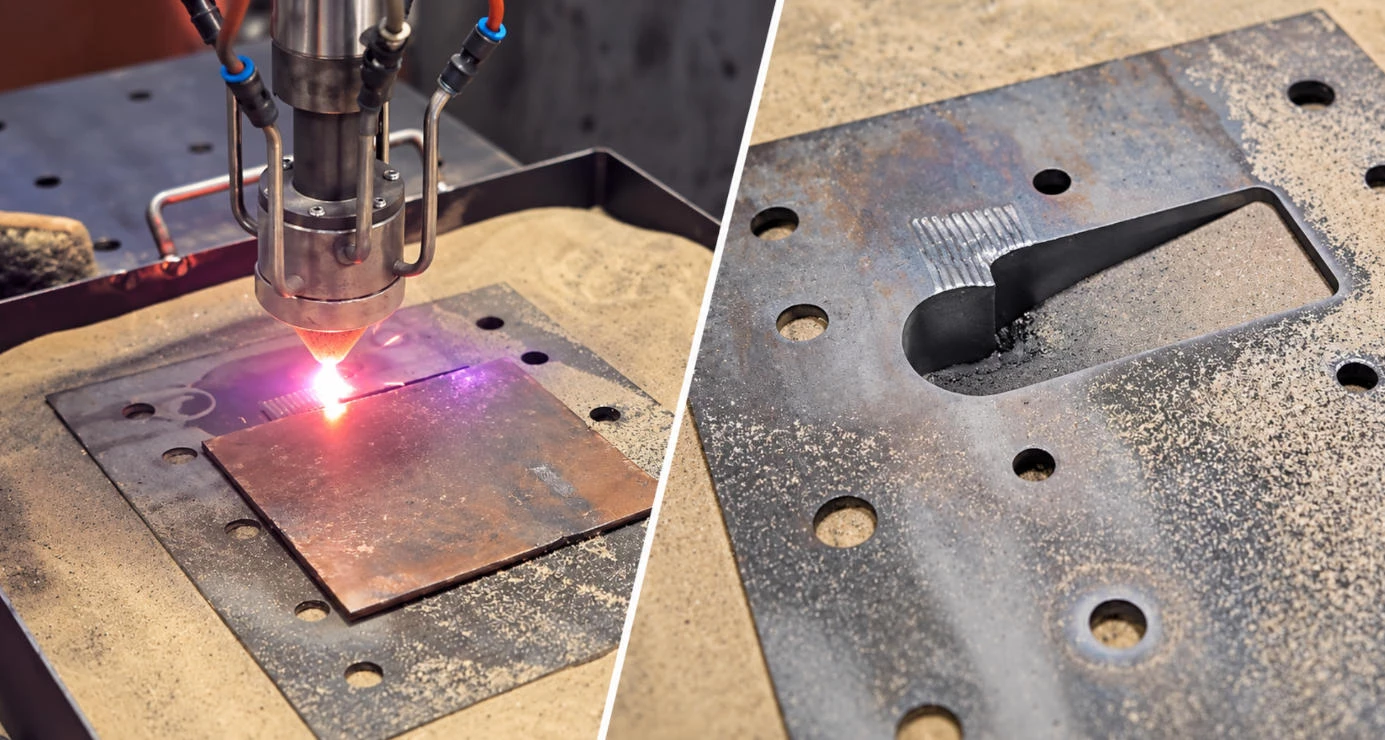
The video shows one of the stages involved in restoring a blanking die whose working area was chipped during operation: https://youtube.com/shorts/_IqCXlPsPmw
Metal is deposited in the damaged area using a laser. The restored section is then machined: the processing allowance is removed, and the required geometry is recreated. After dimensional inspection, the die is ready to return to service.
Why Local Restoration Can Be More Cost-Effective Than Replacement
Manufacturing a new die requires raw material and precision machining. Depending on the application, heat treatment, grinding and subsequent fitting may also be necessary. This involves both financial costs and production time.
When the damage is localised, most of the tool may remain fully serviceable. Complete replacement can therefore be unnecessary. It may be sufficient to rebuild the missing volume of metal and machine the restored area back to its original dimensions.
Laser metal deposition works directly within the defective area. Heat is concentrated in a limited zone, while the amount of deposited metal is controlled during the restoration process. This is particularly important when repairing precision tooling, where the original geometry must be preserved and the amount of subsequent machining kept to a minimum.
Advantages of Restoring Dies with Laser Metal Deposition
The principal advantage of the technology is the ability to retain an expensive tool when the damage is localised. Instead of manufacturing an entirely new component, only the chipped or worn area is restored.
The method can also be used to:
- build up metal directly in the damaged area;
- create a machining allowance for subsequent processing;
- restore a working edge or a specific section of the profile;
- reduce the amount of material that must be removed after deposition;
- reduce the consumption of tool material;
- return a die to service when repair by conventional methods would be difficult.
The economic result depends on the die design and the nature of the damage. However, when dealing with a small localised chip, restoration usually requires considerably fewer resources than remanufacturing the entire tool.
Limitations of the Technology
Laser metal deposition is not suitable for every type of damage. Before work begins, the depth and location of the defect, the condition of the base metal, the presence of cracks or deformation, and the overall wear of the tool must be assessed.
If the damage extends far beyond the visible chip, the reference geometry has been distorted, or the main body of the die has reached the end of its service life, restoration may be technically or economically impractical.
Metal deposition is also only one stage of the repair process. It must be followed by precision machining, restoration of the required profile and dimensional inspection. Without these operations, the correct performance of the die cannot be ensured.
The decision to proceed with a repair is therefore made after examining the individual component. Specialists determine whether the damaged area can be restored and how much subsequent machining will be required.
Die Restoration Services from Bas-Agro LLC
Bas-Agro LLC performs laser metal deposition followed by machining of the restored areas to the specified dimensions. We assess dies with localised chips, worn working surfaces and other types of damage where the missing metal can be rebuilt.
If a small chip appears on an expensive die, there is no need to order a new tool immediately. The possibility of repair should be assessed first. In many cases, the damaged area can be rebuilt, machined to size and returned to the production process.
Learn more about our laser metal deposition services: https://bas.ua/posts/category/news/laser-coating-services
Add a comment
Comments
There are no comments yet. Be the first to comment.
You must be logged in to post a comment
Login