
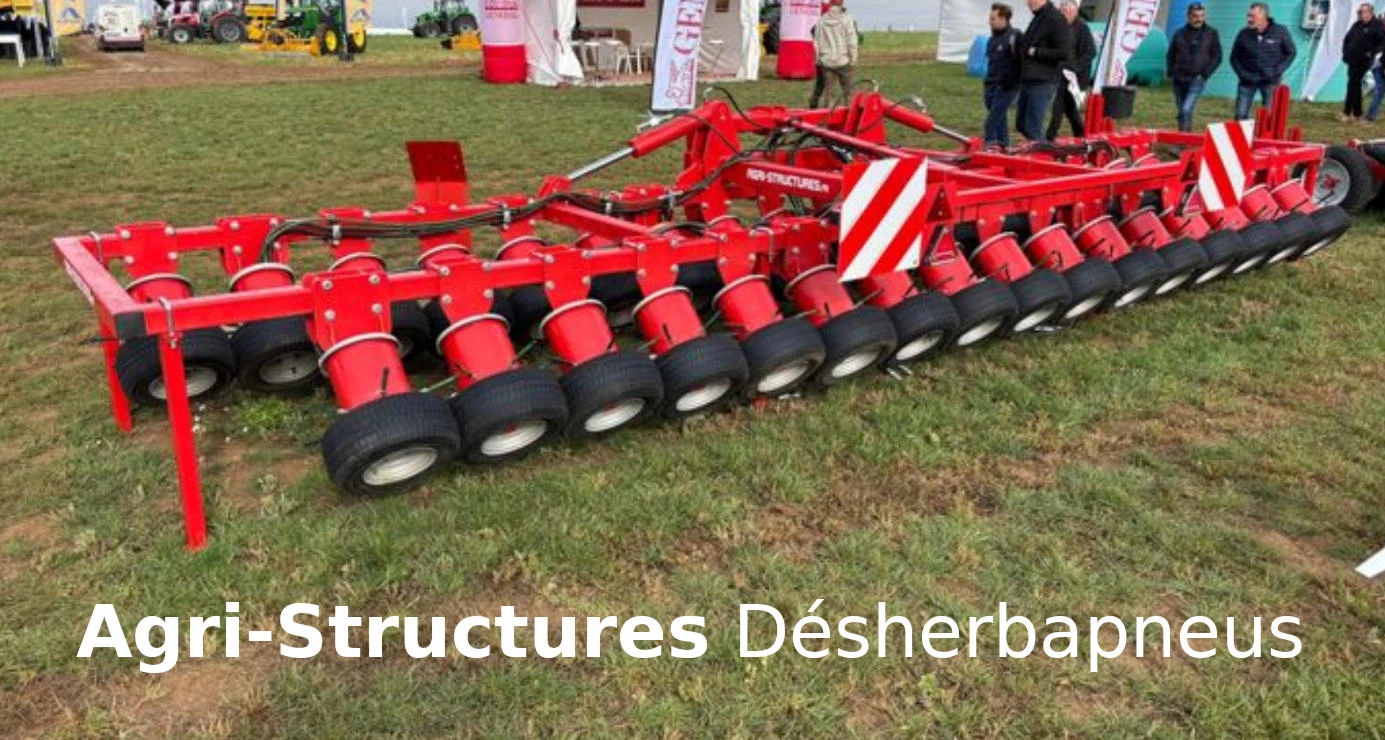
Desherbapneus Weeder by Agri-Structures: Mechanical Weed Pulling Instead of Surface Cutting
French company Agri-Structures has introduced a rather unusual solution for mechanical weed control - the Desherbapneus weeder. It is not a conventional inter-row cultivator unit, not a tine harrow, and not a rotary hoe. The idea behind the machine is closer to manual weed pulling, but transferred to field scale: the working wheels catch the plants, pull them out of the soil, bring the roots to the surface, and leave the weeds to dry.
The manufacturer itself describes Desherbapneus as an “arracheuse d’adventices”, meaning a machine for pulling out weeds. According to Agri-Structures, this is not so much a tool for regular surface cultivation as it is a solution for situations where weed pressure has already become critical, and standard passes with a rotary hoe, inter-row cultivator or tine harrow have not produced sufficient results. On its official page, the company directly explains that the development of the machine was prompted by heavy infestation of lamb’s quarters in organic soybean fields.
Why Tires
The key feature of Desherbapneus is the use of 40 cm “pulling” wheels. They are arranged in two rows, allowing the machine to cover the entire working surface. To improve efficiency, the machine is equipped with guide fingers that help direct weed stems into the gripping zone. According to Agri-Structures, the machine has a hydraulic drive for the working elements, a simple design, and is intended to be easy to maintain.
The agronomic logic behind this approach is clear. If a weed is only cut, some plants may re-root or continue growing under favorable conditions. Desherbapneus works differently: it is designed to pull the plant out together with the root. The root system ends up on the surface, where the weed loses moisture faster and dries out. The manufacturer separately emphasizes that this method reduces the risk of re-rooting.
A Machine for a “Rescue” Pass
Desherbapneus should not be seen as a universal replacement for all other mechanical crop-care tools. Its concept is closer to a rescue tool that can be useful when weeds have already outgrown the early control stages and begun to compete seriously with the crop. The manufacturer itself describes the machine as a tool that can potentially “save” crops already under heavy weed pressure.
The example of lamb’s quarters in soybeans is especially illustrative. For organic farming, this is a very typical problem: chemical herbicide control is limited or impossible, while mechanical passes must be carried out at the right stage of weed development. If the timing is missed, standard implements are not always capable of effectively removing plants that have risen above the crop. In such conditions, a weed-pulling mechanism can make practical sense.
Main Technical Characteristics of Desherbapneus
| Parameter | Value |
|---|---|
| Machine type | weeder / weed-pulling machine |
| Working width | 6.40 or 9.60 m |
| Working elements | 2 rows of “pulling” wheels |
| Wheel diameter | 40 cm |
| Working element drive | hydraulic motors |
| Design | folds in two sections |
| Additional elements | guide fingers for improved weed capture |
| Main purpose | pulling weeds out with the root and bringing them to the surface for drying |
The official Agri-Structures page confirms two available working widths - 6.40 and 9.60 m, two rows of wheels, two-section folding, 40 cm wheel diameter, and the presence of guide fingers.
The specialist publication Farm Connexion additionally notes that the working speed may range approximately from 1 to 5 km/h depending on conditions, and that the machine can fold to a transport width of less than 3 m. These parameters should be treated specifically as data from the publication, since they are not listed separately on the manufacturer’s official page.
Where Desherbapneus Can Be Useful
The most logical field of application for this implement is crops with a sufficiently strong stand and row spacing where weeds rise noticeably above the crop or can be effectively guided into the gripping zone of the working wheels. The French publication mentions soybeans and sugar beets, as well as lamb’s quarters as an example of a weed that can create strong pressure on crops.
For organic farms, this machine is interesting primarily because it expands the set of mechanical weed-control tools. A typical system is often based on a combination of prevention, crop rotation, precision sowing, rotary hoeing, tine harrowing, and inter-row cultivation. Desherbapneus adds another level - a later or corrective pass, when the task is not merely to damage the weed, but to pull it out of the soil as completely as possible.
Practical Limitations
At the same time, Desherbapneus is not a “magic” machine for every situation. The effectiveness of this principle will depend on soil moisture, the stage of weed development, crop height, crop density, wheel rotation speed settings, and the forward speed of the implement. Farm Connexion separately notes that the operator needs to match the hydraulic flow for the motors with the working speed in order to correctly adjust wheel rotation.
This is an important point. If the wheels rotate too slowly, the machine may not capture weeds effectively enough. If they rotate too fast, excessive damage to plant mass or unstable operation in dense stands may occur. In other words, Desherbapneus requires not only a tractor with suitable hydraulics, but also careful field adjustment.
Desherbapneus by Agri-Structures is an example of how mechanical weed control is gradually moving beyond conventional cultivators, harrows, and rotary hoes. The machine offers a different operating principle: not cutting, not combing, and not covering weeds with soil, but pulling them out by the root and leaving them on the surface to dry.
For farms working in organic agriculture or seeking to reduce dependence on herbicides, this concept looks practical and timely. It does not eliminate the need for systematic crop care, but it can become an important “insurance” tool in years with high weed pressure. That is why Desherbapneus should be seen not simply as a new machine, but as another step in the development of more precise, flexible, and agronomically justified mechanical weeding.
Add a comment
Comments
There are no comments yet. Be the first to comment.
You must be logged in to post a comment
Login