
Cyclair Review: Autonomous Mechanical Weeding for Row Crops
The most challenging area for mechanical weeding lies directly within the crop row, between individual plants. Here, the working tool must remove a weed while leaving the neighbouring crop seedling undamaged. French company Cyclair is developing a robotic system that combines machine vision, autonomous movement and interchangeable cultivation tools for work both between and within rows.
Based in Pressac, in France’s Vienne department, the company has been developing autonomous weeding technology since 2020. Its robots have been used in maize, sunflower and oilseed rape. A separate development programme focuses on adapting the equipment to sugar beet, including field trials involving the French Sugar Beet Technical Institute, ITB.
How the Robot Navigates Crops
Cyclair’s control system analyses the actual layout of plants in the field. Cameras and machine vision algorithms recognise crop rows and vegetation, while LiDAR helps determine the spatial structure of surrounding objects. The robot uses these data to plan its route and account for obstacles.
The manufacturer describes the system’s ability to recognise rows during the day and at night, including where plants are missing. This is a significant task for a field machine: uneven emergence and damaged sections of a crop can make automatic guidance more difficult.
Plant recognition also controls the weeding tools. The system identifies the positions of crops and weeds and operates the tools accordingly. The precision of the operation therefore depends on coordination between cameras, recognition algorithms, actuators and mechanical components.
Rover GW Hybrid 2026: A Platform for Large Fields
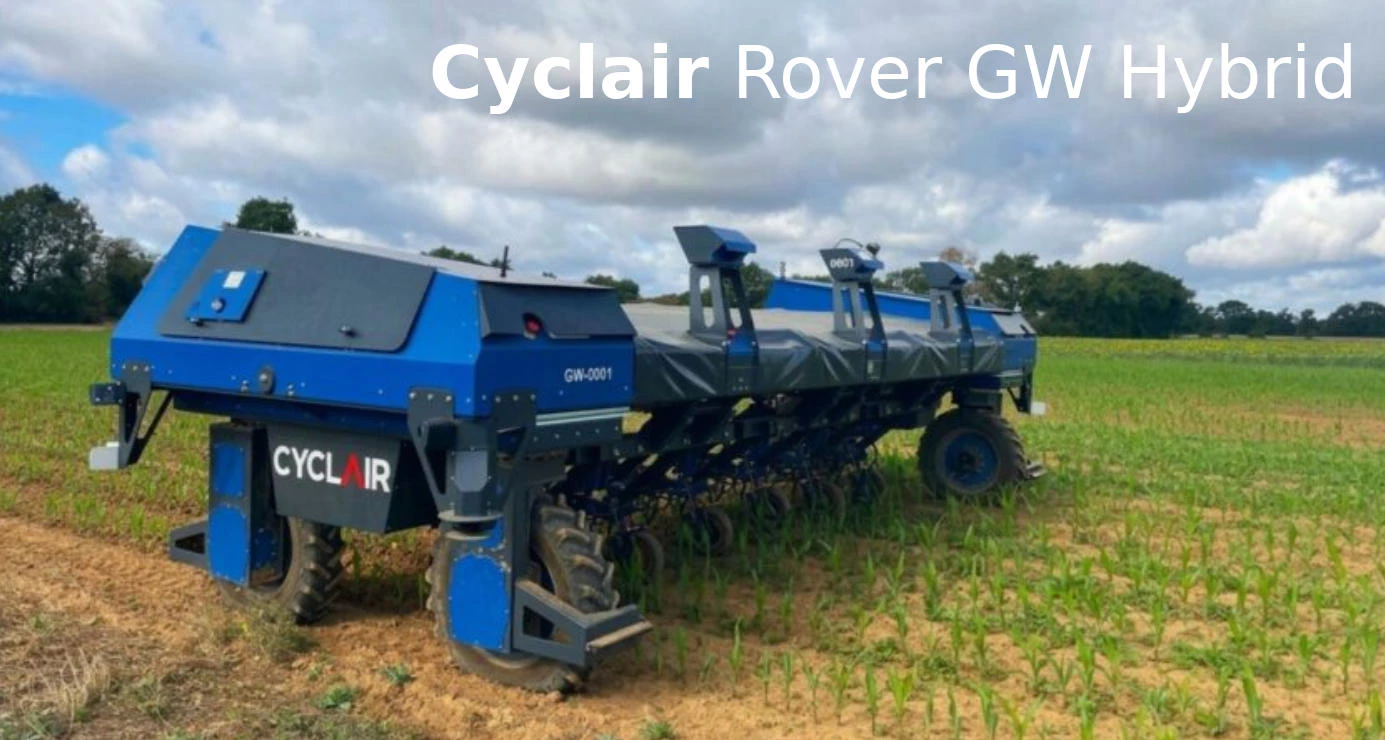
Cyclair’s catalogue presents the Rover GW Hybrid 2026 as an autonomous platform for field crops. The machine has four electrically driven steerable wheels, an adjustable track width and a hybrid energy system. This design combines electric propulsion with fuel use to support extended operation.
The main specifications declared for this particular version are listed below.
| Parameter | Rover GW Hybrid 2026 |
|---|---|
| Working width | 7 m |
| Row spacing | 45–80 cm |
| Operating endurance | 30 hours |
| Work rate | Up to 22 ha per day |
| Mechanical traction power | 18 kW |
| Running gear | Four electrically driven steerable wheels |
The daily work rate in the catalogue represents the machine’s stated capacity. Actual output depends on tool configuration, crop conditions and the duration of stops. Similarly, operating endurance describes the energy system’s capacity, while field operations also require tool inspections and adjustments.
To match the machine to the crop, Cyclair offers platform configuration by crop type, row spacing and the number of rows to be worked. The tool combination is selected for the specific task.
How Cyclair Removes Weeds
Cyclair’s equipment includes powered active tools and passive cultivation tools. They work by undercutting, uprooting and covering weeds with soil. These different mechanisms allow the cultivation method to be adapted to the growth stages of both crops and weeds.
| Tool | Working area and purpose | Manufacturer’s stated parameters |
|---|---|---|
| BAC active tool | In-row weeding close to crop plants | Shallow operation at 2–3 cm; individual adjustment |
| Kress finger weeders | Removal of young weeds directly within the crop row | Working depth of 1–3 cm |
| Flexible and semi-flexible cultivation tools | Inter-row cultivation, uprooting and covering weeds | Range of 1–9 cm; optimum depth of 3–5 cm according to Cyclair |
| Ridging discs | Moving soil towards the crop row and covering weeds | Settings depend on crop development and cultivation conditions |
The active BAC tool is designed to work in the zone that a conventional inter-row cultivator leaves as a protective strip. Its blades are motor-driven, and the control system takes the position of crop plants into account. For this tool, the manufacturer specifies use from BBCH 12–14, depending on crop vigour. This guideline must be applied to the particular crop and its ability to withstand mechanical disturbance.
Kress finger weeders target young weeds within the row. Flexible fingers move the surface soil and loosen weed seedlings. Ridging discs use a different mechanism, burying unwanted vegetation with soil moved from the inter-row area.
For flexible and semi-flexible inter-row tools, Cyclair specifically emphasises treatment of young weeds; for grasses, it specifies stages up to two leaves. Timely intervention therefore remains decisive even with automatic control. Changing the tool set requires human involvement.
What Field Trials Have Shown
Cyclair’s development already includes trials assessing weeding performance. During the 2024 season, chemical, mechanical and combined weed control programmes were compared in maize in the Vienne department. The trial involved the Vienne Chamber of Agriculture, the GIEE Sol et Eau Poitou group and Eaux de Vienne.
The Re-Sources programme report found that the mechanical programme was more effective than the chemical programme under the conditions of this trial. However, the authors noted that the site was dominated by broadleaf weeds that were relatively easy to control. Reported difficulties included high rainfall, the need for repeated passes and the limited endurance of the battery-powered version used at that time. These results cannot be extrapolated to all soils and weed populations.
In 2026, ITB, together with Cyclair and Cérésia, tested the robot in sugar beet at the Terralab site near Reims. Assessments were conducted at the two-leaf, six-to-eight-leaf and twelve-leaf stages. Researchers reported effective weed control between the rows.
Initial weed numbers within the crop row were too low to assess in-row efficacy. ITB therefore did not draw a definitive conclusion about in-row weeding. The institute also reported further development of this tool and plans to continue testing. These findings support treating inter-row cultivation and selective work between individual plants as separate tasks with different levels of evidence for their effectiveness.
Remote Control and Agronomic Data
The Cylink software system provides operation planning, progress monitoring and remote support. Robots transmit information about their condition and work progress to the cloud system. Weed infestation reports can also be generated to help plan subsequent interventions.
For the farm, this changes the structure of staff responsibilities: tasks must be assigned, progress monitored and the machine serviced. Automatic guidance and tool control operate alongside equipment selection and agronomic decisions about cultivation timing.
Why Océalia Is Investing in Cyclair
In June 2026, French cooperative group Océalia announced a minority investment in Cyclair. The partnership aims to scale up robotic weeding and assess its economic viability for farms.
The partners set a target cost per pass comparable to conventional chemical weed control: €35–85/ha, depending on the complexity of the operation. This is an economic objective for the project. Calculating seasonal costs also requires accounting for the number of passes, transport, energy supply and maintenance.
Océalia and Cyclair have also submitted a joint application to the PRAAM programme for large-scale trials and the development of service delivery models. They are separately exploring the use of expertise from Océalia’s Lely Centers to provide local service support.
Spare Parts for Tillage Equipment
Mechanical weeding requires serviceable working tools, secure fasteners and precise depth adjustment. To maintain the machines operating on your farm, Bas-Agro LLC offers spare parts for agricultural tillage equipment. This catalogue section provides parts for repairs and keeping equipment operational. When ordering, check the part number, machine model and component dimensions: matching these parameters determines correct installation and the assembly’s performance under load.
Add a comment
Comments
There are no comments yet. Be the first to comment.
You must be logged in to post a comment
Login