
CyanForce Laser Weeder Enters the European Market
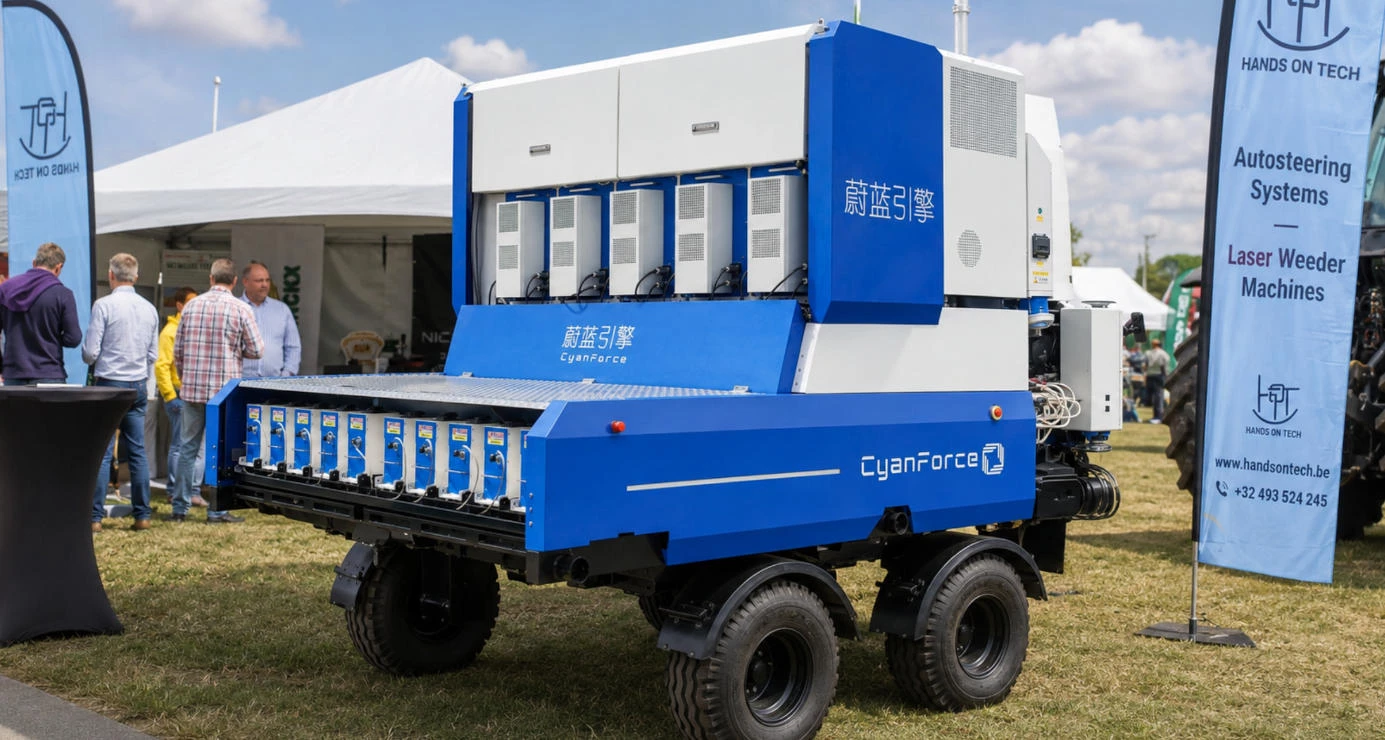
Chinese laser weed-control technology is taking another step from demonstration projects toward practical use in European crop production. Belgian company Hands On Tech has begun promoting CyanForce laser weeders in the Benelux countries. The first 2-metre-wide prototype was presented at the Foire de Libramont agricultural exhibition in Belgium. Before serial deliveries begin, the machine is still undergoing design refinement and certification.
According to Hands On Tech, a series of field demonstrations is planned throughout 2026, while a commercial version for the European market is expected to become available in late 2026 or early 2027. The machines are developed in China, while assembly of versions intended for the Benelux market is planned to take place in Belgium.
CyanForce’s entry into Europe is not simply an isolated dealer initiative. In February 2026, the manufacturer announced that it had signed an agreement with its first European distributor, a Belgian agricultural technology company that would be responsible for sales, demonstrations and after-sales support in Belgium and neighbouring countries. CyanForce also stated that its European partner would participate in prototype testing and adaptation of the machines to local field conditions.
A Laser Instead of a Blade or Herbicide
The operating principle of CyanForce differs significantly from both mechanical inter-row cultivation and spot spraying. Cameras continuously monitor the field surface, while computer-vision algorithms classify plants and determine the locations of weeds. The system then identifies the meristem — the plant tissue where active cell division occurs — and directs a laser beam at this target.
According to CyanForce, laser energy heats the plant tissue, causing the water inside the cells to expand rapidly. This damages the cellular structures and prevents the growing point from developing normally. Therefore, the system is not designed to physically cut off the entire above-ground part of the plant, but rather to thermally damage its critical growth zone with high precision.
The European prototype is specified with 150 W CO₂ lasers. The same output of 150 W per laser module is also confirmed in CyanForce’s current technical documentation for the entire Guangyun trailed series.
This approach has an important agronomic characteristic: weed control is most effective while the plants are still small. Research into laser weed control shows that as plants increase in size, the amount of energy required to damage them reliably rises significantly. For example, trials with ryegrass found that more developed plants required approximately ten times greater energy density than the youngest seedlings.
Artificial Intelligence Must Aim Within a Millimetre
One of the most important parameters of laser weeding is not the absolute power of the emitter, but the system’s ability to identify the correct target.
CyanForce claims a maximum weed-recognition rate of 99%, while laser-positioning accuracy is stated at ±1 mm. The system uses real-time motion compensation because the tractor, machine and plants are constantly moving relative to the cameras during operation.
Hands On Tech also reports accuracy of around 1 mm for the European machine. However, the importer stresses that before operating in a specific crop, the computer-vision system must be trained to distinguish the crop plants from the weed species typically present in that field.
The laser weeder therefore combines three technological operations in one continuous process: high-speed imaging of the field surface, machine-based plant recognition and targeted delivery of thermal energy.
Up to 18,000 Weeds per Minute
Very high theoretical throughput has been announced for the 6-metre machine that Hands On Tech intends to offer in Europe. According to the Belgian company, the T600B version with 20 laser modules can treat up to 12,000 weeds per minute. The Enterprise version equipped with 30 modules can process up to 18,000 plants per minute.
This corresponds to approximately 720,000 and 1.08 million target plants per hour respectively. These figures are consistent with the manufacturer’s current specification for the 30-module, 6-metre Guangyun C1-T600, for which CyanForce lists a maximum capacity of 1,080,000 plants per hour.
However, the number of weeds destroyed per hour should not be confused with field capacity measured in hectares. Actual field performance will depend on travel speed, terrain, row configuration, weed density, headland turns and other operating factors.
Hands On Tech estimates a practical capacity of approximately 1 ha/hour for the 6-metre machine. For comparison, CyanForce gives a figure of 5 mu/hour for its 2-metre-wide model. One Chinese mu is approximately 0.0667 ha, meaning the quoted capacity is around 0.33 ha/hour. Simple scaling to a working width three times greater gives approximately the same order of magnitude — around 1 ha/hour — although the actual performance of the 6-metre version still needs to be confirmed in field trials.
From 1.2 to 12 Metres
Interestingly, the European and current Chinese specifications for CyanForce machines do not yet fully correspond.
Hands On Tech reports that six working-width versions ranging from 1.2 to 6 m are being prepared for the Benelux market. Meanwhile, the official CyanForce website already presents a significantly broader Guangyun range: C1-T120, T160, T200, T300, T400, T600, T800 and T1200, with working widths ranging from 1.2 to 12 m.
The main specifications of the current production range are as follows:
| CyanForce model | Working width | Laser modules | Max. capacity |
|---|---|---|---|
| C1-T120 | 1.2 m | 6 | 216,000 plants/hour |
| C1-T160 | 1.6 m | 8 | 288,000 plants/hour |
| C1-T200 | 2.0 m | 10 | 360,000 plants/hour |
| C1-T300 | 3.0 m | 15 | 540,000 plants/hour |
| C1-T400 | 4.0 m | 20 | 720,000 plants/hour |
| C1-T600 | 6.0 m | 30 | 1,080,000 plants/hour |
| C1-T800 | 8.0 m | 40 | 1,440,000 plants/hour |
| C1-T1200 | 12.0 m | 60 | 2,160,000 plants/hour |
Data: CyanForce. For all listed machines, the manufacturer specifies 150 W laser output, a maximum recognition rate of 99% and positioning accuracy of ±1 mm.
There is another important detail when comparing the available sources. Future Farming describes a 6-metre European T600B configuration with 20 laser modules and a separate Enterprise version with 30 modules. The designation T600B does not appear on the manufacturer’s current website, where the production C1-T600 is equipped with 30 modules. This may indicate different stages in the machine’s development or a dedicated European configuration. For this reason, these specifications should be considered separately rather than combined into a single technical description.
The Six-Metre Machine Weighs 3.5 Tonnes
The laser system is a relatively heavy implement because its structure combines optics, cameras, electronics, computing systems, laser modules, protective housings and power equipment.
The current C1-T600 weighs 3.5 tonnes. Its overall dimensions are approximately 2.5×6.4×2.5 m, while the required tractor linkage lift capacity is stated at 5 tonnes. The equipment requires at least 75 kW of PTO power. The machine’s rated electrical power is 53 kW.
For the European 6-metre configuration, Hands On Tech specifies a weight of 3–3.5 tonnes and a tractor power requirement of around 75 kW, or 102 hp. In the demonstration configuration, the generator is mounted on the tractor’s front linkage.
Two different parameters need to be distinguished here. In CyanForce’s official specification table, 75 kW refers to the minimum required PTO power, whereas in the article describing the European machine, 75 kW is given as the required engine power. In addition, CyanForce’s general description of the Guangyun series recommends pairing the machines with tractors rated above 120 hp. The final tractor requirements for the European C1-T600 should therefore be assessed after certification of the production configuration has been completed.
From Vegetables to Maize and Wheat
The primary market for this type of technology has traditionally been crops where weed control requires significant manual labour or where herbicide use is restricted.
CyanForce positions its trailed machines for organic vegetable production, medicinal plants, flowers and broadacre crops. The manufacturer specifically mentions maize, wheat, peanuts, vegetables and forage crops among the potential applications.
However, using laser weeding over large areas does not mean the technology has already become a direct substitute for herbicides in every field. Scientific reviews identify several major challenges for further development, including reducing the treatment time per plant, improving energy efficiency, enhancing autonomous navigation, lowering machine costs and ensuring compliance with laser safety requirements.
There is also a purely biological factor: the larger the weed, the more difficult it becomes to damage it with a sufficient dose of energy. The most logical operating strategy for such a machine is therefore repeated treatment at the early stages of weed development rather than attempting to destroy already well-developed weeds in a single pass.
Europe Will Be an Important Test for CyanForce
CyanForce is a relatively young company. The manufacturer states that the business was founded in 2022 and that the Guangyun series entered the market in 2025. In October 2025, the company presented the range at the China International Agricultural Machinery Exhibition as its first commercial laser-weeding system.
The technology is now entering a considerably more demanding stage — adaptation to European farms. Laboratory accuracy and maximum treatment rates must translate into stable operation in dusty conditions, across uneven fields, at different crop densities and with diverse weed populations.
This is why the 2026 demonstration season may prove more important for CyanForce than its exhibition debut. If the system can maintain millimetre-level precision and acceptable productivity under real field conditions, laser weed control will gain another serious contender for use not only in high-value vegetable crops but also across a broader segment of field agriculture.
The most important feature of the technology, however, is not the laser itself. Its practical efficiency depends on the entire technological chain — camera → recognition algorithm → growing-point localisation → targeting → correct laser energy dose. An error at any stage can either leave the weed undamaged or create a risk for the crop plant. It is the ability to repeat this cycle thousands of times per minute that makes a modern laser weeder primarily a precision-agriculture system — and only secondarily a laser machine.
Add a comment
Comments
There are no comments yet. Be the first to comment.
You must be logged in to post a comment
Login