
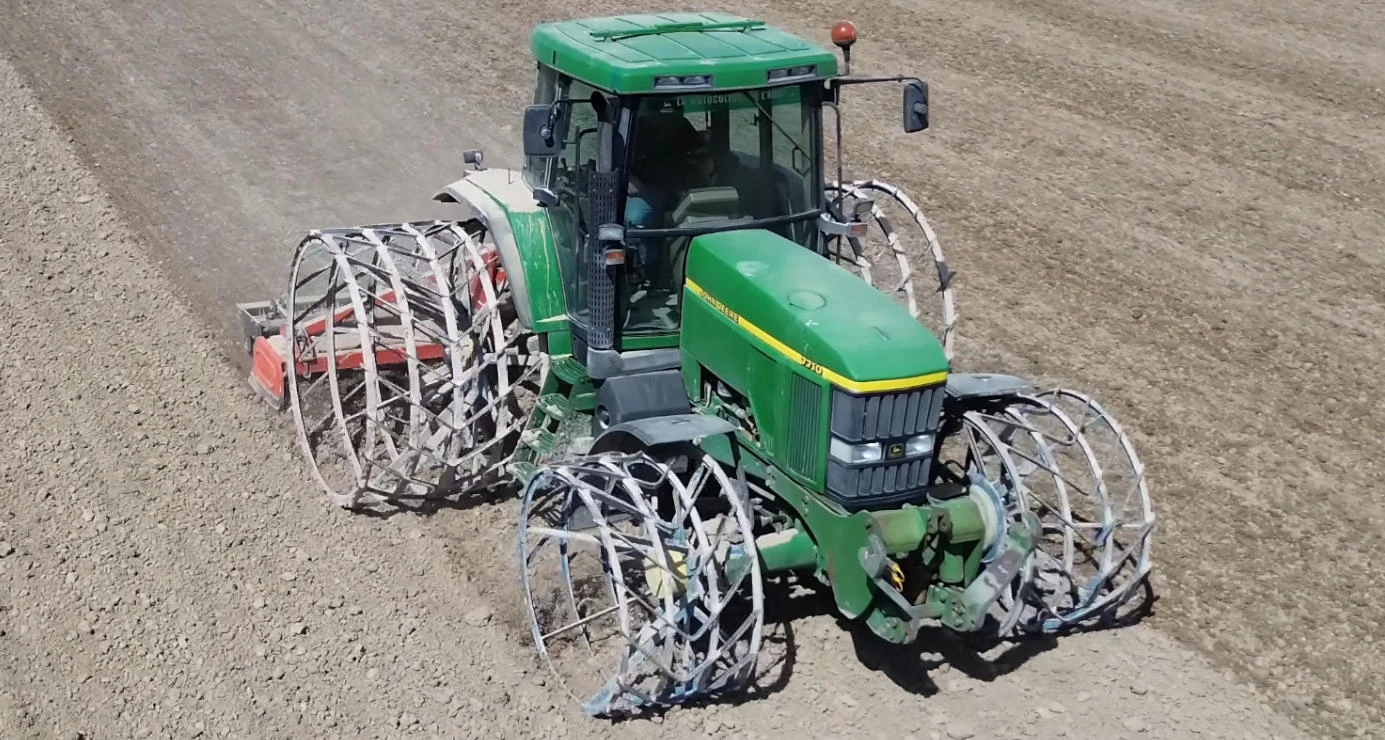
Cage Wheels for Tractors: Why an Old Mechanical Idea Is Becoming Relevant Again
The French company Roues Somac has attracted attention in the agricultural machinery market with specialized cage wheels for tractors designed for conditions where conventional pneumatic tires quickly lose efficiency: flooded rice paddies, waterlogged soils, viscous mud, and fields with a hard surface crust. At first glance, this design may look like a return to the early era of tractor engineering. But from an agronomic point of view, it is not retro technology. It is a practical answer to one of the basic problems of field mechanization: a tractor must not only have power, it must also be able to transfer that power to the soil.
Somac is not a random player in this niche. According to the manufacturer’s official website, the company was founded in 1955 and began by commercializing cage wheels, rice cage wheels, and lugged wheels for work in flooded rice fields. Today, Somac’s product range includes dual wheels, special rims, wheels for difficult conditions, forestry wheels, and hydraulic and mechanical equipment for wheel handling.
What Is a Cage Wheel?
A cage wheel is an open-type metal structure in which a spatial steel frame with working elements replaces the traditional rubber tire and tread. These metal elements penetrate the soil and create traction. In the case of Somac’s rice wheels, the manufacturer directly states that they are intended for preparing rice paddies and incorporating stubble, grass, and other plant residues into submerged soil. Somac also notes an important design detail: the wheels are wide enough so that, on the second pass, they can work the space left between the two cage wheels.
This makes a cage wheel fundamentally different from a conventional tire. A pneumatic tire works through its contact patch, air pressure, casing flexibility, and tread pattern. A cage wheel works more aggressively, but in certain conditions it can be more effective. It does not try to “float” over the surface. Instead, its metal ribs cut into the wet layer, partially mix it, and create mechanical grip where a rubber tread would simply clog with mud.
According to Maquinac, Somac’s solution uses a fully metallic cage-type structure, asymmetric angles of the working elements for better traction in soft soils, and the ability to operate both in flooded rice fields and in dry rice paddies with a hard crust. The publication also notes that the design can be used on stony tracks with limited vibration transfer to the tractor.
Why This Matters Now
Cage wheels are not a mass-market solution for conventional grain farming. They should not be seen as a universal replacement for tractor tires, and Somac itself cautiously notes that rice cage wheels are normally used on submerged soil. Still, interest in such systems points to a broader trend: farmers are increasingly looking not only for more power, but for better mobility, less wheel slip, controlled ground pressure, and the ability to work within narrow weather windows.
On heavy, waterlogged, or low-lying fields, the problem is often not a lack of horsepower. The real problem is that the tire loses grip, clogs with mud, slips, sinks, and begins to damage soil structure. The operator increases engine speed, adds ballast, tries another pass, and often makes the situation worse. A cage wheel approaches the problem differently: it mechanically changes the way the machine contacts the soil.
This solution is especially logical for rice production. In rice paddies, machinery does not simply work on a wet field. It operates in an environment where water, mud, and plant residues form a complex mass with low bearing capacity. In such conditions, a conventional agricultural tire may quickly lose traction, while the open metal structure of a cage wheel cleans itself more effectively and allows the tractor to keep moving through a very difficult soil layer.
Beyond Somac: Other Unusual Solutions That Change Tractor-Soil Contact
Cage wheels are only one direction. Modern agricultural machinery offers a whole spectrum of solutions aimed at reducing slip, compaction, and energy losses.
The first direction is low-pressure IF/VF tires. For example, Michelin describes its Ultraflex technology as allowing operation at lower pressure, with a larger contact patch and better soil protection. According to the manufacturer, a VF tire can carry up to 40% more load at the same pressure compared with a non-VF radial tire, or operate at lower pressure under the same load. For Ukrainian farms, this is often more practical than specialized metal wheels, because such tires can be used across a much wider range of field operations.
The second direction is hybrid designs between tires and tracks. Trelleborg PneuTrac is positioned as a solution that combines the advantages of a radial agricultural tire with the benefits of a track. The manufacturer emphasizes a longer footprint, improved traction, better flotation, and lateral stability, especially for vineyards and orchards. This is a different approach from Somac: not metal “biting” into submerged soil, but increasing the support area without fully switching to tracks.
The third direction is dual wheels and wide tires. This is a well-known method for reducing specific ground pressure and increasing traction. Somac also offers different types of dual-wheel systems, including solutions for narrow tires and for improved load-bearing capacity. The drawback is the increased overall tractor width, which can complicate road transport, movement through villages, and work in fields with narrow tramlines.
The fourth direction is tracked and half-track tractors. In materials discussing the John Deere 8RX, a key argument is that the large contact area of a track system can reduce ground pressure even on a heavy machine. One comparison noted that water infiltrated more than three times faster in the track left by an 8RX than after an 8R with single tires. For large farms, this is an important argument, although tracked machinery is more expensive and is not always justified for a mixed machinery fleet.
Ukrainian Context
For Ukraine, Somac cage wheels are unlikely to become a mass-market product in the near future. Ukrainian crop production is predominantly not rice-based, and the main field crops are grown under different technological conditions. However, the logic behind such wheels may be interesting for certain niches: low-lying waterlogged fields, drained or reclaimed land, organic farms with a careful approach to soil structure, specialized vegetable or forage systems, and situations where machinery must enter the field after heavy rainfall within a very short working window.
The main conclusion is not that every farm needs metal cage wheels. The conclusion is different: a tractor wheel is not a secondary detail, but a key element of the entire technology. It determines whether the tractor can actually use its engine power, whether it will slip, whether it will compact the soil, and whether the operation can be completed on time.
In modern agriculture, the engine, transmission, and electronics are not the only things that matter. The physics of contact with the field is becoming just as important. Somac’s cage wheels are a reminder that the most effective solution does not always have to look high-tech. It can be made of steel, have a simple open structure, and work exactly where a conventional tire loses its meaning.
For farmers, this is a reason to take a broader view of tractor running gear. In dry conditions, a correctly selected tire and correct pressure may be enough. On heavy soils, dual wheels or VF tires may help. In orchards and vineyards, specialized hybrid solutions can be useful. For heavy draft operations, tracked tractors may be the best option. And for flooded or extremely waterlogged fields, the cage wheel remains a narrow but fully rational tool.
BAS-AGRO GROUP LLC manufactures spare parts for agricultural machinery according to a sample or drawing and also sells ready-made spare parts from stock. For farms, this matters not only during scheduled repairs, but also when machinery works in difficult conditions and requires reliable parts for the running gear, transmission, drives, and mounted equipment.
Add a comment
Comments
There are no comments yet. Be the first to comment.
You must be logged in to post a comment
Login