
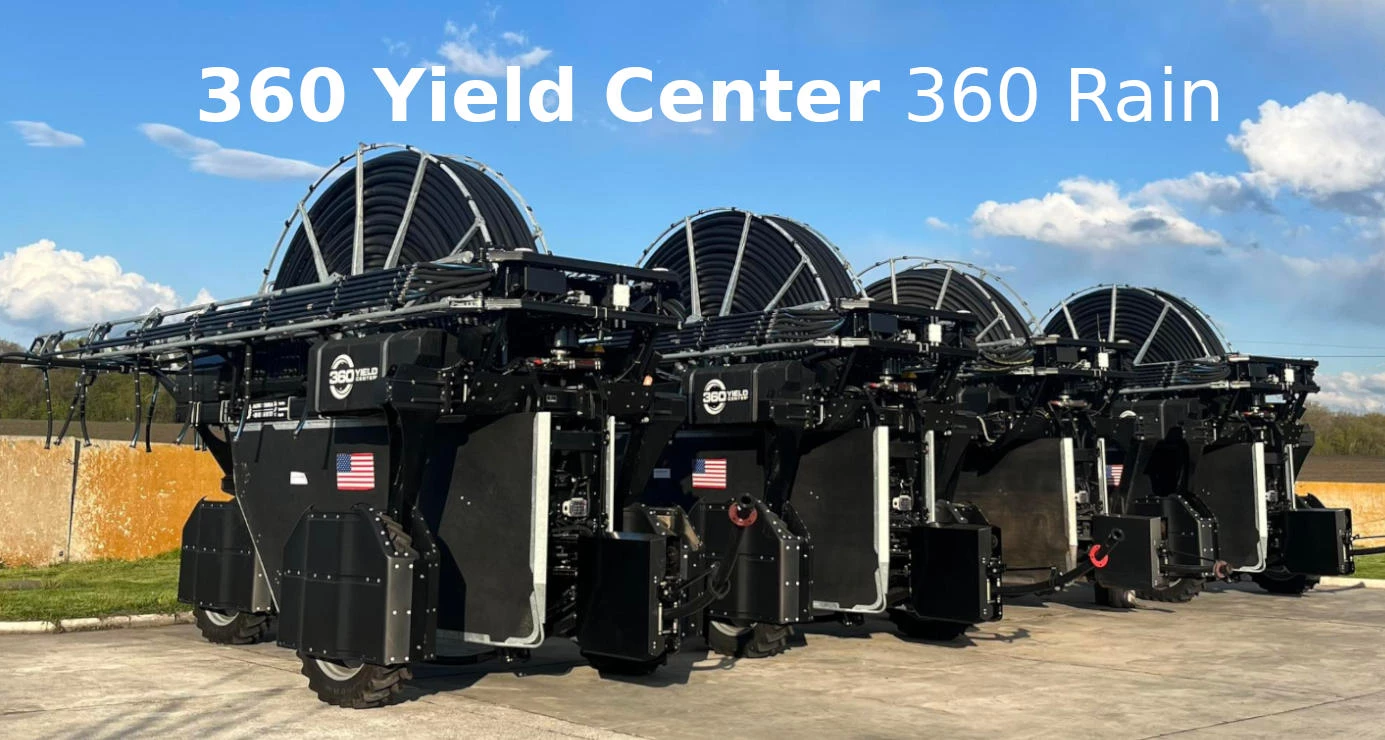
Autonomous 360 RAIN Robots: When Irrigation Becomes Precision Field Robotics
Four autonomous 360 RAIN irrigation robots are preparing to work in the fields of Poltava region. For Ukrainian agriculture, this is not merely the arrival of another interesting machine, but a clear example of how irrigation is gradually moving from a conventional infrastructure-based system toward mobile robotic technology. While irrigation used to be associated mainly with sprinklers, hose reel irrigators, pumping stations and a significant amount of manual control, 360 RAIN offers a different logic: the machine moves independently across the field along a predefined route, delivers water directly to the crop zone and can simultaneously work with nutrient solutions.
According to reports from the Ukrainian market, a batch of four autonomous 360 RAIN robots was shipped to a farm in Poltava region. For agricultural producers, such machines are interesting not only because of automation itself, but also because of their practical agronomic function: maintaining crop moisture during critical growth stages, reducing dependence on uneven rainfall and combining irrigation with liquid fertilization.
It is important to clarify one technical detail. In news materials for the Ukrainian market, there may be references to a working width of 18-36 m depending on the configuration. At the same time, the open official metric specification of 360 RAIN published by the manufacturer lists two basic boom widths: 18 m and 24 m. These are the parameters that should be considered confirmed for the technical description of the system until the manufacturer or an official supplier publishes a separate specification for a wider configuration.
What Is 360 RAIN?
360 RAIN is an autonomous field machine for adaptive irrigation developed by 360 Yield Center. The manufacturer positions it not simply as an irrigation machine, but as a system for applying water, nutrients, organic liquid materials and by-products in different field conditions. In other words, the concept of 360 RAIN is much broader than conventional sprinkling: the machine can operate as a tool for controlled water supply and as a platform for precise liquid nutrition.
The key idea of the system is that water or another liquid is applied not as a wide spray over the field, but through a boom with working drops. For row crops, banded drop options are used, directing liquid into the root zone. For broadcast or solid-seeded crops, solutions with flat fan drops are available. This approach has clear agronomic logic: lower losses from wind drift, reduced evaporation and more accurate placement in the zone where moisture and nutrients are actually needed by the plant.
The machine moves autonomously across the field. Its route is formed based on the planter pass: a special GPS kit for the planter records the route, and then these data are used as working paths for the irrigation machine. This is especially important for irregularly shaped fields, where traditional circular irrigation systems often leave corners or non-standard areas outside effective coverage.
How the Autonomous System Works
360 RAIN connects to a water source or liquid resource through a hose. The official specification states a maximum hose length of 900 m, a main hose diameter of 7.62 cm and HDPE as the material. During operation, the machine unwinds and rewinds the hose using a vertical reel. A sensor system monitors travel speed, reel speed and turning radius so that the hose does not pull the machine or create excessive load.
Power is supplied by a 24 hp diesel engine. The fuel tank has a capacity of 1,140 l, and the approximate fuel consumption, according to the manufacturer, is about 2 l/h. The drive system is electric: separate electric motors are responsible for travel, the reel, the metering unit and the additional manure unit in the corresponding configuration.
The machine’s speed range in the official metric specification is 0.08-0.72 km/h. This is not transport speed in the usual sense, but working speed, which determines the application rate. The slower the machine moves at a given liquid flow rate, the more moisture or solution each unit of area receives.
In terms of productivity, the manufacturer indicates up to 15 ha per day for the version with an 18 m boom and up to 20 ha per day for the version with a 24 m boom. Recommended supply parameters for a 900 m hose are 760 l/min at 9 bar. Approved liquids are water, nutrients and manure, provided that the fraction complies with the outlet limitation of up to 19 mm.
Not a Single Model, but a Configurable System
360 RAIN should more accurately be viewed not as a single “robot in isolation,” but as a platform with different configurations. The open official specification lists two basic working boom widths: 18 m and 24 m. The 18 m version best matches planters with 6, 12 or 24 rows, while the 24 m version is suited to planters with 8 or 16 rows. Different row spacings are supported, including 52.5 cm and 75 cm in the metric part of the documentation.
Different types of working drops are also offered. Banded drop can be used for water, banded drop manure for organic materials and flat fan drop for full-coverage application. This modularity makes the system interesting not only for corn or soybeans, but also for a wider range of crops, including solid-seeded crops and specialized crops.
For applying nutrients and organic liquids, the manufacturer offers the 360 Injection Skid. This is an additional unit with pumping and control equipment that allows the operator to manage the supply of water, fertilizers or manure. The system includes pressure and flow sensors, as well as the ability to control pumps, valves and injection pumps. For a farm, this means that 360 RAIN can be not just an “irrigator,” but part of fertigation technology - the application of nutrients together with water.
Spare Parts for Conventional Sprayers - Available on the BAS Website
Against the background of the development of autonomous systems such as 360 RAIN, it is also important not to forget conventional sprayers, which remain one of the most important crop protection tools on most farms. They are used every day to apply plant protection products, liquid fertilizers, UAN, micronutrients and other working solutions. Therefore, the technical condition of booms, nozzles, filters, pumps, bodies, valves and other components directly affects the quality of field treatment.
For agricultural enterprises operating conventional trailed, mounted or self-propelled sprayers, spare parts can be purchased on the BAS website in a dedicated section: https://bas.ua/shop/spare-parts-for-sprayers-000000033-1.
The catalog includes components for sprayer maintenance and repair. This is a practical solution for farms that need to quickly restore machinery before the season or during intensive field operations. After all, even the most advanced application technology does not cancel the basic rule of agronomy: the working machine must be serviceable, dose the product accurately and distribute the solution evenly across the entire working width.
Why This Matters for Ukraine
For Ukrainian farms, autonomous irrigation is becoming especially important for several reasons. First, climate instability is increasingly reflected not only in a shortage of rainfall, but also in its uneven distribution. Even in regions that were previously not considered critically dependent on irrigation, drought periods may coincide precisely with the phases when the crop is forming yield.
Second, conventional irrigation infrastructure is not always available or economically justified for every field. Center pivots are effective on large fields with regular geometry, but they are less flexible on fields with complex contours, obstacles, shelterbelts, roads or heterogeneous structure. An autonomous machine moving along a recorded route can potentially adapt better to such conditions.
Third, labor shortages are pushing farms to look for solutions that reduce the need for constant manual control. 360 RAIN does not eliminate engineering maintenance, preparation of the water source or control of pumping equipment, but it transfers part of the fieldwork into autonomous mode. The operator can remotely monitor the machine via an application, adjust speed, application rate and operating time, and receive notifications about technical or operational events.
Advantages and Limitations of the Technology
The main advantage of 360 RAIN is the combination of autonomous movement, precise application and flexible work with different liquids. The system delivers water closer to the base of the plant, reducing dependence on wind compared with conventional overhead sprinkling. It can also work on irregularly shaped fields and cover areas that remain problematic for circular irrigation machines.
The second advantage is the ability to combine operations. If irrigation and liquid nutrition are performed in one pass, the farm can potentially save time, fuel and labor resources while reducing the number of technological passes across the field.
However, the technology also has limitations. 360 RAIN requires a prepared water source or liquid resource, the required pressure, pumping infrastructure, power supply for the base station, mobile communication and high-quality route planning. The machine is not a trailed unit for road towing: it must be transported by semi-trailer. The system is also technologically complex, which means it requires trained service support and operators who understand not only mechanics, but also the logic of precision agriculture.
Analogues and Competitors
The autonomous irrigation segment is not yet a mass market, but it is developing rapidly. A close competitor in terms of concept is the French OSCAR robot from Osiris Agriculture, which is also focused on autonomous irrigation, fertigation and vegetable crops. In open materials, OSCAR is described as a machine with GNSS-RTK navigation, an irrigation boom and operation in existing tramlines.
Another direction is rainbutler from rain2soil. This autonomous irrigation robot combines the flexibility of a hose-based system with uniform irrigation and is positioned by the manufacturer as a solution for reducing water, energy and labor costs.
In the broader field of agricultural robotics, FarmDroid FD20 can also be mentioned, although it is not a direct competitor to 360 RAIN in terms of irrigation function. FarmDroid specializes in autonomous seeding and mechanical weeding, but it demonstrates the same general trend: field operations are moving from tractor-based mechanization to robotic platforms with RTK navigation.
Traditional competitors for 360 RAIN remain center pivots, linear irrigation machines, hose reel irrigators and stationary drip irrigation systems. However, this is not really a competition of “machine against machine,” but rather a competition of agronomic scenarios. A pivot is strong on large, regular fields. Drip irrigation is effective for high-value crops and long-term infrastructure. Hose reel systems are simpler and well known to farms. 360 RAIN occupies an intermediate but promising niche: mobile autonomous irrigation with the possibility of precise liquid nutrition.
The appearance of four 360 RAIN robots in Poltava region is not just a local news item about new machinery. It is a signal that Ukrainian farms are beginning to test more complex, flexible and precise water management systems. For a country where yields increasingly depend on weather risks, such solutions may become part of a new agrotechnological strategy.
360 RAIN is interesting because it combines several directions at once: autonomous navigation, precise irrigation, fertigation, work with organic liquid materials and remote control. This is no longer just irrigation mechanization, but an element of digital and robotic farming. Its efficiency in Ukrainian conditions will depend on the quality of water infrastructure, service support, correct crop selection and the economics of a specific farm. But the very fact that such machines are entering the practice of Ukrainian fields shows that the future of irrigation is becoming not only engineering-based, but also robotic.
Add a comment
Comments
There are no comments yet. Be the first to comment.
You must be logged in to post a comment
Login