
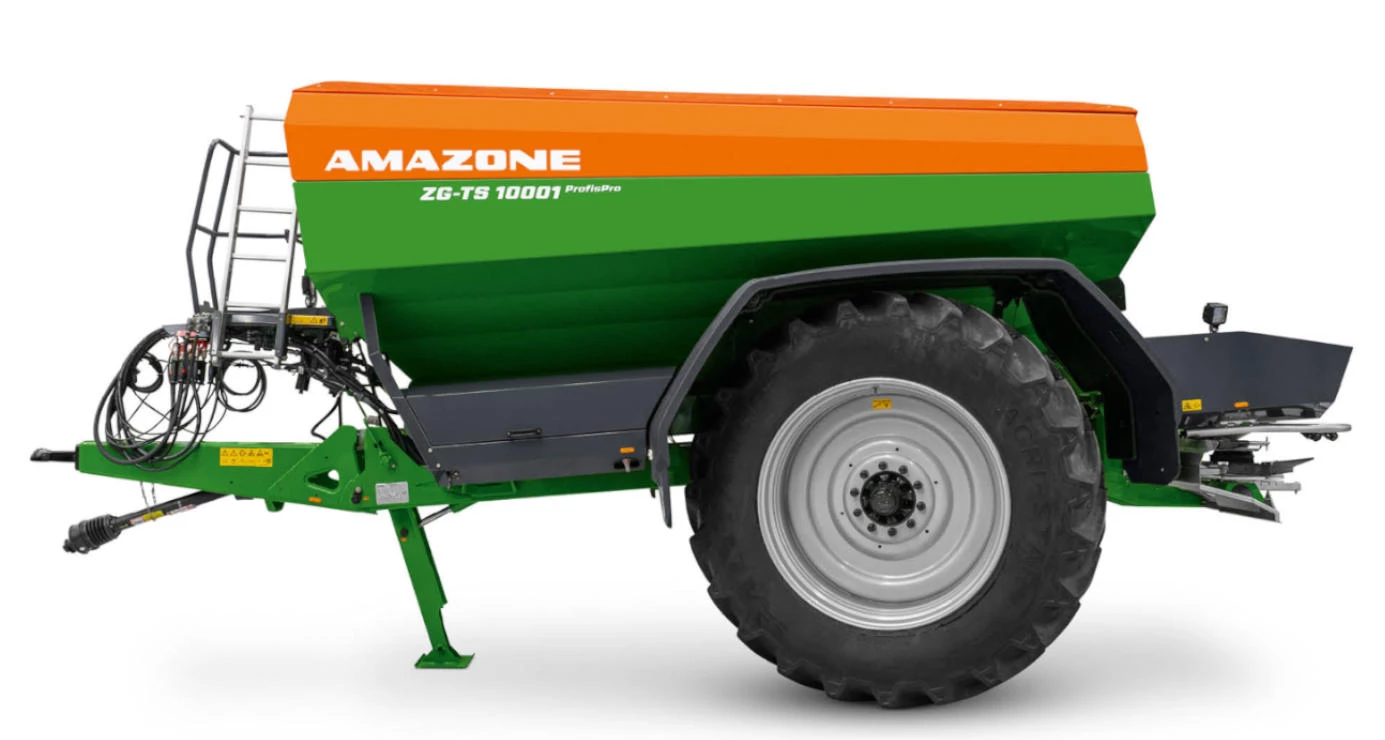
AMAZONE ZG-TS 10001 with Weather Station: How WindControl Adjusts Fertiliser Spreading in Windy Conditions
When mineral fertiliser is applied, crosswinds alter the trajectories of the granules: the throwing distance decreases on one side of the spreader and increases on the other. On the AMAZONE ZG-TS 10001 trailed spreader, the WindControl system helps address this problem. A sensor measures wind speed and direction, while the automatic control system adjusts the spreading disc speeds and the position of the fertiliser delivery system. Settings change during operation.
In farming practice, this equipment is often referred to as a weather station. In AMAZONE’s technical description, WindControl performs a specific task: measuring wind conditions to control granule distribution. The manufacturer associates its operation with the work of Professor Karl Wild at HTW Dresden, the University of Applied Sciences in Dresden.
Which Machine Is the System Designed For?
The AMAZONE ZG-TS 10001 is a twin-disc trailed mineral fertiliser spreader with a 10,000-litre hopper. It belongs to the ZG-TS range, for which the manufacturer specifies working widths from 15 to 54 m. The achievable width depends on the spreading vanes fitted and the characteristics of the fertiliser.
Key specifications of the model and spreading unit:
| Parameter | AMAZONE specification |
|---|---|
| Machine type | Twin-disc trailed spreader |
| ZG-TS 10001 hopper capacity | 10,000 litres |
| Working width of the ZG-TS range | 15–54 m |
| Maximum spreading system throughput | 650 kg/min |
| Interchangeable TS spreading vane sets | TS 10, TS 20, TS 30 |
| WindControl availability | Optional equipment |
The figure of 650 kg/min describes the mass flow of fertiliser through the spreading unit. The application rate in kilograms per hectare depends on the working width and forward speed. WindControl must be checked in the specification of the individual spreader: the ZG-TS 10001 model designation alone does not confirm that the system is fitted.
Why Wind Disrupts Lateral Distribution
A disc spreader produces spread fans that overlap between adjacent passes. Crosswinds change their shape and disrupt the intended overlap. Even if the machine delivers the correct average quantity of fertiliser per hectare, distribution across the working width can become uneven.
AMAZONE distinguishes between the effects of different wind directions. Headwinds and tailwinds stretch or compress the spread pattern along the direction of travel, whereas crosswinds significantly alter lateral distribution. The resulting asymmetry requires separate adjustments to the right and left sides of the machine.
How WindControl Controls the Discs
A sensor with a high measurement frequency sends wind data to the machine’s job computer. The system also takes the forward speed into account when calculating new settings. It adjusts both the disc speeds and the fertiliser delivery system above them.
In a crosswind, the system increases the disc speed on the side spreading fertiliser into the wind and rotates the delivery system outwards. On the opposite side, it reduces the disc speed and rotates the delivery system inwards. This combination counteracts the reduction in throwing distance on one side and the excessive increase on the other.
Adjusting the delivery position has a separate function. In the TS spreading unit, fertiliser reaches the disc through a delivery system that can rotate around the disc’s centre. This changes the direction of the spread fan. Electric actuators make the necessary adjustments during operation, including those commanded by WindControl.
Why the Sensor Rises Above the Tractor
The sensor’s position matters when measuring wind. The tractor cab and the machine itself disturb the airflow, so the measuring element is mounted on an extending mast.
The mast rises automatically when the spreading discs are switched on and retracts into a protected position when they are switched off. The operating manual specifies that automatic movement takes place at forward speeds of 0–3 km/h. In its working position, the sensor must be 500 mm above the highest point of the tractor and spreader, while the overall height must not exceed 4 m.
This arrangement allows wind measurements above the turbulence generated by the tractor. The manufacturer also provides manual mast control.
How WindControl Differs from ArgusTwin
The two systems use different sources of information. WindControl uses wind measurements. ArgusTwin monitors the spread fans using 14 radar sensors and automatically adjusts the delivery system separately on each side when deviations occur. AMAZONE states that this monitoring helps account for changes in fertiliser spreading properties, operation on slopes and external influences.
Early descriptions presented WindControl as an addition to ArgusTwin. AMAZONE subsequently made WindControl available independently of the radar system for both ZA-TS mounted spreaders and ZG-TS trailed spreaders. The equipment and capabilities of an individual machine should therefore be established from its specification and documentation.
When the System Warns the Operator
The working menu displays wind direction, wind speed and information about gustiness. Colour indicators show how far the system can still compensate for the effects of the airflow.
If the wind becomes too strong or gusts change too frequently, WindControl issues a warning that the adjustment limit has been reached. The ability to continue spreading therefore depends on the actual conditions and the available adjustment range. The manufacturer explicitly recognises situations in which automatic compensation is no longer sufficient.
Settings Must Still Match the Fertiliser
WindControl works alongside the spreader’s initial settings. To help select them, AMAZONE offers the mySpreader app, which combines FertiliserService, EasyCheck and EasyMix.
FertiliserService generates recommendations based on the machine model, working width, fertiliser type and application rate. Operators can search for fertiliser by name, chemical composition, granule size or bulk density. These parameters help match the settings to the material actually loaded into the hopper. For blends, EasyMix calculates compromise settings that account for differences between the components.
EasyCheck allows lateral distribution to be checked directly in the field. The kit includes 16 lightweight rubber mats placed at specified distances from the tramline. After the spreading passes, the collected granules are photographed using a smartphone. The app compares the results and recommends adjustments to the machine settings where necessary.
For the ZG-TS 10001, the operating sequence consists of selecting settings for the particular fertiliser, checking distribution in the field and then automatically adjusting for changing wind conditions. WindControl warnings remain an operational signal for the driver: they indicate when the system has reached its adjustment limits.
Vane Wear and Spare Parts for Fertiliser Spreaders
Spreading vanes are among the working components most exposed to wear, as fertiliser granules constantly travel across their surfaces. AMAZONE explicitly identifies the vanes as wearing parts and states that their service life depends on the fertiliser type, operating time and quantity applied. Their condition affects the uniformity of lateral distribution, making vane inspection and timely replacement part of machine maintenance.
Bas-Agro LLC offers spare parts for fertiliser spreaders from various manufacturers. The catalogue includes spreading vanes and vane sets, drive shafts, couplings and other components, including parts for Kuhn, Kverneland, Sola and UNIA equipment. Parts can be selected by machine model and catalogue number; custom manufacturing can be discussed based on a sample or drawing. The required components can be ordered at bas.ua, with delivery throughout Ukraine.
Add a comment
Comments
There are no comments yet. Be the first to comment.
You must be logged in to post a comment
Login