
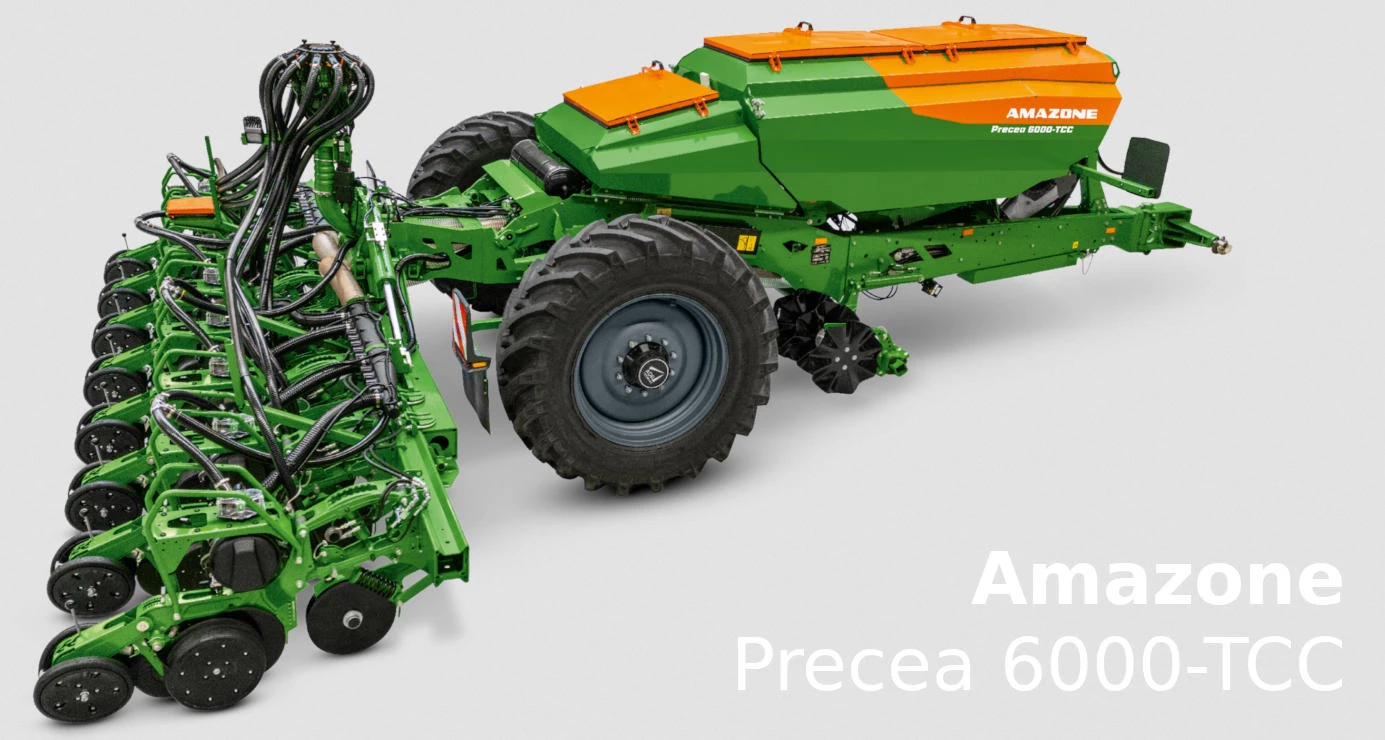
Amazone Precea-TCC: A Review of the Trailed Precision Planter Range and Its Latest Updates
The Amazone Precea-TCC family began with wide working width machines for large farms and contractors. In May 2023, the manufacturer introduced the 9000-TCC and 12000-TCC models with nominal working widths of 9 and 12 m, a central seed hopper and simultaneous fertiliser application. Today, the range also includes the Precea 6000-TCC and 7500-TCC, both available with different seed storage and delivery configurations.
The family shares several features: pneumatic seed singulation using positive air pressure, electrically driven metering units and operating speeds of up to 15 km/h. Configurations differ in working width, row count, hopper capacity and the equipment available for controlling seed and fertiliser application.
Which Models Make Up the Precea-TCC Family?
Amazone’s official website lists four models. One useful distinction is their seed loading arrangement: the smaller machines offer a choice between individual hoppers on the row units and a central seed supply, while the 9000-TCC and 12000-TCC use a central seed hopper.
| Model | Nominal working width | Seed storage |
|---|---|---|
| Precea 6000-TCC | 6 m | Individual 70-litre hoppers or a central hopper with Central Seed Supply |
| Precea 7500-TCC | 7.5 m | Individual 70-litre hoppers or a central hopper with Central Seed Supply |
| Precea 9000-TCC | 9 m | Central hopper with Central Seed Supply |
| Precea 12000-TCC | 12 m | Central hopper with Central Seed Supply |
The model designation does not replace the specifications of a particular row configuration. For example, an eight-row machine with 70 cm row spacing has a working width of 5.6 m. At 75 cm spacing, this becomes 6 m, while 80 cm spacing gives 6.4 m. The family also includes narrow-row configurations with 45 and 50 cm row spacing.
A notable addition was the Precea 7500-TCC, presented among Amazone’s innovations for Agritechnica 2025. The manufacturer shows it, among other configurations, as a ten-row machine with 75 cm row spacing. It has a 3,000-litre fertiliser hopper, and the announcement specifies an 850-litre hopper for the central seed storage version. The original wide working width 9000-TCC and 12000-TCC models have a 2,000-litre seed hopper and a twin-chamber fertiliser hopper with a total capacity of 6,000 litres.
Central Seed Supply and Individual Hoppers Serve Different Needs
The Central Seed Supply system, or CSS, carries seed in an air stream from the main hopper to small receiving units above the individual metering units. As a receiving unit fills, the seed restricts the airflow and delivery stops. When the seed level drops, airflow resumes and transports another batch.
The central hopper therefore provides storage and seed transport, while singulation takes place separately in each row. The self-regulating CSS delivery process does not require electronic fill-level control at every receiving unit.
Individual 70-litre seed hoppers offer another configuration for frequent hybrid changes or work on smaller fields. Amazone provides this option on the Precea 6000-TCC and 7500-TCC. Remaining seed can be emptied from each row unit separately, and the singling discs can be changed without tools. The manufacturer also permits the row units to be folded with the seed hoppers full.
How the Precea Meters Seed
Inside the metering unit, positive air pressure holds seeds against the holes in a rotating disc. They then pass three stripper fingers that remove excess seeds. SmartControl automatically adjusts the stripper fingers using information from the optical seed monitoring system.
Each metering unit has its own ElectricDrive motor. The operator sets the seed rate through the terminal, and disc speed is matched to forward speed. Once a seed leaves the pressure holding zone, it travels through a delivery channel into the furrow.
The PreTeC row unit then controls placement: a catcher roller secures the seed in the furrow, while the following V-shaped press rollers close the furrow and consolidate the soil. Different crops require the appropriate singling discs. Amazone lists maize, sunflower, soya beans, sugar beet, oilseed rape and several other crops among the supported applications.
Placement Depth and Performance Around Curves
Sowing depth and press roller settings are adjusted directly on the row unit, largely without tools. Coulter pressure is adjusted hydraulically through the ISOBUS terminal. The optional SmartForce system automatically adapts downforce as soil conditions change, maintaining the set contact force between the gauge wheels and the soil.
Differences in row unit speed around curves are significant on a wide planter. The outer rows travel farther than the inner rows. CurveControl accounts for this difference and adjusts the speed of individual singling discs to maintain the specified seed spacing across the machine’s working width. This function was already included in the Precea-TCC description when the family launched in 2023.
Fertiliser Application: From a Continuous Band to Individual Portions
The FerTeC twin HD double-disc fertiliser coulter places fertiliser ahead of the sowing unit. Its design allows the relationship between seed and fertiliser placement depths to be set initially. Subsequent changes to sowing depth produce a corresponding adjustment to the fertiliser coulter position.
The optional FertiSpot system converts the continuous flow of granules into individual portions synchronised with seed placement. For maize, a portion can be positioned beneath the future plant. According to Amazone, this approach can reduce fertiliser use by up to 25% compared with band application while maintaining yield. This is a manufacturer-reported result; the actual effect depends on operating conditions. The current equipment page specifies FertiSpot for machines with up to 12 rows.
Application shut-off control has also developed. Alongside individual seed row shut-off, Amazone offers individual fertiliser row shut-off through the distributor head. This allows application to stop on previously covered headland areas and in wedge-shaped sections of a field.
What Has Changed in the Latest Updates?
For Agritechnica 2025, Amazone expanded the equipment available for its trailed Precea machines. The additions included leading star row cleaners with manual or pneumatic adjustment. These clear straw and other organic material ahead of the fertiliser and seed coulters, reducing the likelihood of crop residues being pressed into the furrow.
For narrow-row configurations with 45 and 50 cm spacing, the manufacturer introduced twin wheels. Four 270/95 R44 tyres run between the seed rows, keeping the running gear from compacting the future seed line directly. Amazone announced this equipment for the spring 2025 season.
The next stage concerns coordination between neighbouring row units. In its exhibition materials, Amazone announced the SynCrop software solution for availability from spring 2026. It synchronises seed placement across rows to produce triangular or block patterns. In a triangular arrangement, plants in adjacent rows are offset relative to one another.
In combination with FertiSpot, CurveControl and individual fertiliser row shut-off, the manufacturer claims total fertiliser savings of up to 30%. This figure should be distinguished from the saving of up to 25% stated for FertiSpot alone. Amazone also says that machines manufactured from 2025 onwards are prepared for retrofitting the listed systems; equipment compatibility depends on the specific model and configuration.
What to Consider When Choosing a Machine
Choosing a Precea-TCC starts with the crop, row spacing and required number of rows. The next consideration is loading: central storage suits extended operation with the same seed, while individual hoppers provide more flexibility when seed changes are frequent. The availability of SmartForce, FertiSpot and automatic control functions should be checked against the selected machine’s specification.
The maximum speed of 15 km/h describes the machine’s design capability. The appropriate operating speed depends on actual seed placement quality and field conditions. Amazone’s manual specifically notes that high application rates can prevent the machine from reaching its maximum speed. For the Precea 6000-TCC and 7500-TCC, the manual lists tractor power requirements starting at 180 and 200 hp respectively, although equipment configuration and hydraulic requirements must also be considered when matching the planter to a tractor.
When preparing planting equipment for the season, suitable components can be found in the Seeder Spare Parts section on the Bas-Agro website. Bas-Agro LLC offers original spare parts and alternatives manufactured in-house for various seeders and planters, as well as custom production of required components from a sample or drawing. Compatibility is checked against the machine model and part number. Delivery is available throughout Ukraine.
Add a comment
Comments
There are no comments yet. Be the first to comment.
You must be logged in to post a comment
Login